


The staggered arrival times of Chinese Nationalist Party (KMT) presidential candidate Eric Chu (朱立倫) and Deputy Legislative Speaker Hung Hsiu-chu (洪秀柱) at a campaign event yesterday revived speculation that the two have yet to patch things up after their fight over the KMT’s presidential candidacy last month.
After taking a backseat in the KMT’s campaigning following her presidential candidacy being rescinded by the party last month, Hung yesterday began her efforts to campaign for the pan-blue camp’s legislative candidates.
She attended two separate campaign events for New Party legislative candidate Pan Huai-tsung (潘懷宗) in Taipei’s Shilin District (士林) and KMT legislative candidate Chiang Wan-an (蔣萬安) in Taipei’s Zhongshan District (中山).
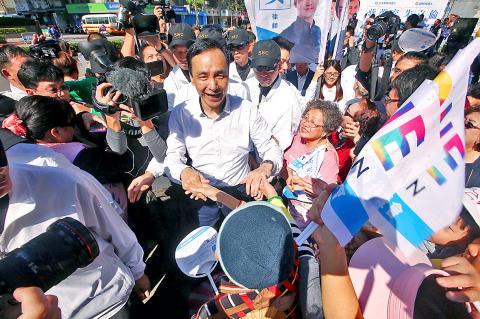
Photo: CNA
Hung was scheduled to arrive at Pan’s event at 10am, 50 minutes before Chu was due to appear. She also arrived at Chiang’s event 40 minutes prior to Chu’s scheduled arrival time of 11:20am.
When asked if she was deliberately trying to avoid Chu, Hung said that whether the two of them simultaneously attended an event was determined by their schedules and the needs of candidates.
“I am not attempting to avoid Chu. It was the candidates’ arrangement, which was designed to maintain the level of excitement at their events,” Hung said.
“What is the point of arriving at events together, chanting some campaign slogans and then leaving together? Appearing one after the other is the right way to boost candidates’ campaign events,” she added.
The relationship between the two KMT heavyweights has reportedly been tense after Chu replaced Hung as the KMT’s presidential candidate on Oct. 17, a move the deputy legislative speaker decried as impinging upon the party’s democratic mechanisms.
Hung is rumored to be interested in running for the legislative seat representing New Taipei City’s Yonghe District (永和), a constituency in which the KMT has already nominated incumbent Legislator Lin Te-fu (林德福) as its candidate.
However, Hung on Friday said that she would not run for a district legislative seat, because she wants to reinvigorate and bring reform to the KMT. She also turned down the New Party’s offer to list her as one of its legislator-at-large nominees.
At a campaign event in New Taipei City yesterday morning, Chu said he would pay Hung a visit in the near future and that he hoped the two of them could cooperate.
“In the meantime, I would really like to see Deputy Speaker Hung spend more time helping our legislative candidates and attending more of their campaign events,” Chu said.
When asked whether Hung would be invited to the opening ceremonies for his campaign headquarters next week, Chu said all of the party’s heavyweights and senior members would be among the guests, including Hung.

The military has spotted two Chinese warships operating in waters near Penghu County in the Taiwan Strait and sent its own naval and air forces to monitor the vessels, the Ministry of National Defense (MND) said. Beijing sends warships and warplanes into the waters and skies around Taiwan on an almost daily basis, drawing condemnation from Taipei. While the ministry offers daily updates on the locations of Chinese military aircraft, it only rarely gives details of where Chinese warships are operating, generally only when it detects aircraft carriers, as happened last week. A Chinese destroyer and a frigate entered waters to the southwest

A magnitude 6.1 earthquake struck off the coast of Yilan County at 8:39pm tonight, the Central Weather Administration (CWA) said, with no immediate reports of damage or injuries. The epicenter was 38.7km east-northeast of Yilan County Hall at a focal depth of 98.3km, the CWA’s Seismological Center said. The quake’s maximum intensity, which gauges the actual physical effect of a seismic event, was a level 4 on Taiwan’s 7-tier intensity scale, the center said. That intensity level was recorded in Yilan County’s Nanao Township (南澳), Hsinchu County’s Guansi Township (關西), Nantou County’s Hehuanshan (合歡山) and Hualien County’s Yanliao (鹽寮). An intensity of 3 was

Japanese Prime Minister Sanae Takaichi’s comment last year on Tokyo’s potential reaction to a Taiwan-China conflict has forced Beijing to rewrite its invasion plans, a retired Japanese general said. Takaichi told the Diet on Nov. 7 last year that a Chinese naval blockade or military attack on Taiwan could constitute a “survival-threatening situation” for Japan, potentially allowing Tokyo to exercise its right to collective self-defense. Former Japan Ground Self-Defense Force general Kiyofumi Ogawa said in a recent speech that the remark has been interpreted as meaning Japan could intervene in the early stages of a Taiwan Strait conflict, undermining China’s previous assumptions

Instead of focusing solely on the threat of a full-scale military invasion, the US and its allies must prepare for a potential Chinese “quarantine” of Taiwan enforced through customs inspections, Stanford University Hoover fellow Eyck Freymann said in a Foreign Affairs article published on Wednesday. China could use various “gray zone” tactics in “reconfiguring the regional and ultimately the global economic order without a war,” said Freymann, who is also a nonresident research fellow at the US Naval War College. China might seize control of Taiwan’s links to the outside world by requiring all flights and ships entering or leaving Taiwan


 RSS
RSS