


The retraction of an article calling for the impeachment of President Ma Ying-jeou (馬英九) on an independent online platform has caused other columnists to withdraw their articles in protest and stirred up debate over media censorship.
Academia Sinica associate researcher Huang Cheng-yi (黃丞儀) published an article in the online CommonWealth Magazine’s Independent Opinion section, calling on the legislature to initiate impeachment proceedings against Ma in the wake of the announcement of a meeting between him and Chinese President Xi Jinping (習近平).
The article was taken offline a few hours after its publication.
According to Huang, who disclosed the incident on Facebook, his editor said that the article “has been taken offline because the bosses are worried that the readers might mistake it for the magazine’s official stance.”
“Is it not clear enough that the Independent Opinion section, since its launch, has clearly indicated that it is a platform contributed to by independent commentators and has a disclaimer at the bottom of each page saying that the opinions expressed are solely those of the authors?” Huang asked.
“If the platform has to be worried about every article published being mistaken for the stance of CommonWealth Magazine, it probably should not have bothered to set up this platform in the first place,” he added.
CommonWealth magazine later issued a statement apologizing for the “displeasure the retraction has caused to the author,” saying that despite the disclaimer, articles “are often interpreted differently.”
“Extra discretion is required for handling the issue of cross-strait relationship, which is key to Taiwan’s fate,” it said. “The Ma-Xi meeting is a major public issue, [the platform] believes the public is entitled to a comprehensive understanding of the matter so we are to invite more articles of different viewpoints to be displayed in juxtaposition with each other.”
The incident has prompted an exodus of a group of intellectuals from the platform in protest, who each publicly announced their disapproval of the retraction, as well as their decision to stop writing on the platform and the request to have their previous articles removed.
The list includes but is not restricted to: Chang Chuan-fen (張娟芬), an advocate of the abolition of the death penalty, Rex How (郝明義), publisher and former national policy adviser, Ku Yu-ling (顧玉玲), former secretary-general of the Taiwan International Workers’ Association, Chiu Hua-mei (邱花妹), assistant professor of sociology at National Sun Yat-sen University, and Academia Sinica Institute of Sociology associate research fellow Wu Jieh-min (吳介民).
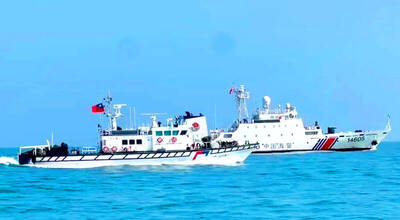
Instead of focusing solely on the threat of a full-scale military invasion, the US and its allies must prepare for a potential Chinese “quarantine” of Taiwan enforced through customs inspections, Stanford University Hoover fellow Eyck Freymann said in a Foreign Affairs article published on Wednesday. China could use various “gray zone” tactics in “reconfiguring the regional and ultimately the global economic order without a war,” said Freymann, who is also a nonresident research fellow at the US Naval War College. China might seize control of Taiwan’s links to the outside world by requiring all flights and ships entering or leaving Taiwan
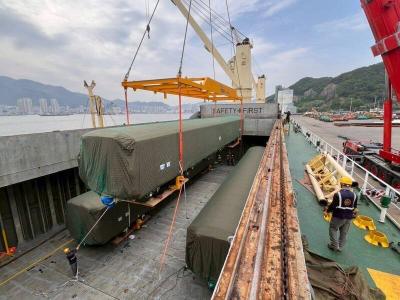
The first of 10 new high-capacity trains purchased from South Korea’s Hyundai Rotem arrived at the Port of Taipei yesterday to meet the demands of an expanding metro network, Taipei Rapid Transit Corp (TRTC) said yesterday. The train completed a three-day, 1,200km voyage from the Port of Masan in South Korea, the company said. Costing NT$590 million (US$18.79 million) each, the new six-carriage trains feature a redesigned interior based on "human-centric" transportation concepts, TRTC said. The design utilizes continuous longitudinal seating to widen the aisles and optimize passenger flow, while also upgrading passenger information displays and driving control systems for a more comfortable
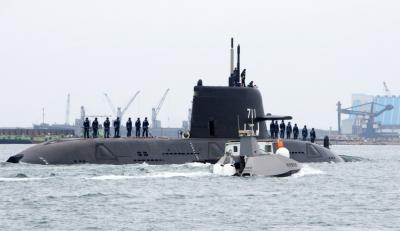
Taiwan's first indigenous defense submarine, the SS-711 Hai Kun (海鯤, or Narwhal), departed for its 13th sea trial at 7am today, marking its seventh submerged test, with delivery to the navy scheduled for July. The outing also marked its first sea deployment since President William Lai (賴清德) boarded the submarine for an inspection on March 19, drawing a crowd of military enthusiasts who gathered to show support. The submarine this morning departed port accompanied by CSBC Corp’s Endeavor Manta (奮進魔鬼魚號) uncrewed surface vessel and a navy M109 assault boat. Amid public interest in key milestones such as torpedo-launching operations and overnight submerged trials,
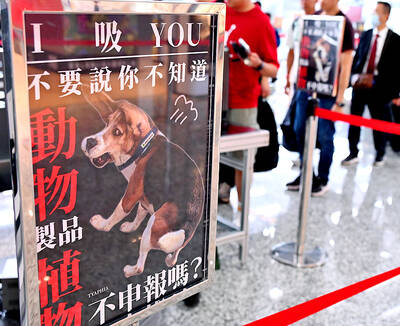
Quarantine awareness posters at Taiwan Taoyuan International Airport have gone viral for their use of wordplay. Issued by the airport branch of the Animal and Plant Health Inspection Agency, the posters feature sniffer dogs making a range of facial expressions, paired with advisory messages built around homophones. “We update the messages for holidays and campaign needs, periodically refreshing materials to attract people’s attention,” quarantine officials said. “The aim is to use the dogs’ appeal to draw focus to quarantine regulations.” A Japanese traveler visiting Taiwan has posted a photo on X of a poster showing a quarantine dog with a


 RSS
RSS