


The Democratic Progressive Party’s (DPP) opposition to tomorrow’s meeting between President Ma Ying-jeou (馬英九) and Chinese President Xi Jinping (習近平) is “inappropriate,” Chinese Nationalist Party (KMT) presidential candidate Eric Chu (朱立倫) said yesterday.
The meeting would be a “significant milestone” in the development of cross-strait peace and stability, he said.
“I would hope that both the ruling and opposition parties could put aside ideology. More importantly, please refrain from interpreting [the meeting] with a political angle or accusing other people of being ‘red,’” he said.
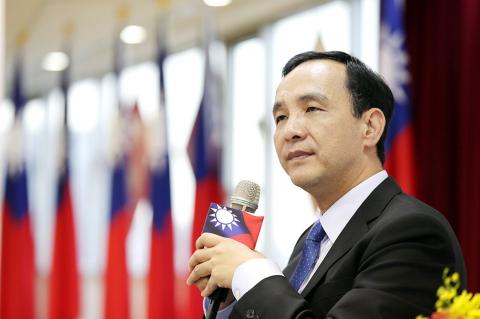
Photo: EPA
“DPP city councilors, for example, yesterday in Tainan called the meeting an act of ‘selling Taiwan,’ which is highly inappropriate,” Chu said. “And DPP Chairperson Tsai Ing-wen (蔡英文) also displayed an attitude that we do not understand.”
“We should harbor a positive mentality to any cross-strait development and exchange,” he added.
When asked whether he considered the meeting a possible boost to the KMT’s election chances, Chu said the meeting should not be viewed in such a way.
“There was already discussion over a possible meeting during the 2013 APEC summit and the plan was also under deliberation last year,” Chu said.
In an afternoon radio interview, Chu said he believes that major issues such as trade, flight routes or Southeast Asia would not be touched upon in the meeting.
“We do not need to have great expectations for this meeting,” he said. “But the meeting itself is a breakthrough and milestone.”
That the leaders of the two sides of the Taiwan Strait are set to meet and make either an announcement or consensus in principle that is advantageous to the cross-strait peace and economic development would be “meaningful enough,” Chu said.
As for the agreement that Ma and Xi would address each other as “mister” instead of using their official titles, Chu said that the KMT and the Chinese Communist Party used to address each other using party position titles during exchanges, but because this time it would be a meeting between the political leaders of the two sides of the Taiwan Strait, it would be “better to address [each other] as mister than as leaders.”

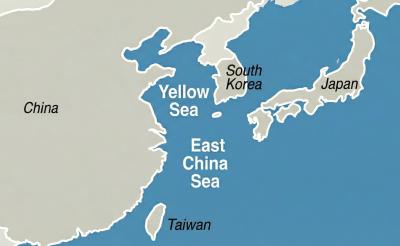
China has reserved offshore airspace in the Yellow Sea and East China Sea from March 27 to May 6, issuing alerts usually used to warn of military exercises, although no such exercises have been announced, the Wall Street Journal (WSJ) reported yesterday. Reserving such a large area for 40 days without explanation is an “unusual step,” as military exercises normally only last a few days, the paper said. These alerts, known as Notice to Air Missions (Notams), “are intended to inform pilots and aviation authorities of temporary airspace hazards or restrictions,” the article said. The airspace reserved in the alert is

South Korea is planning to revise its controversial electronic arrival card, a step Taiwanese officials said prompted them to hold off on planned retaliatory measures, a South Korean media report said yesterday. A Yonhap News Agency report said that the South Korean Ministry of Foreign Affairs is planning to remove the “previous departure place” and “next destination” fields from its e-arrival card system. The plan, reached after interagency consultations, is under review and aims to simplify entry procedures and align the electronic form with the paper version, a South Korean ministry official said. The fields — which appeared only on the electronic form

More than 6,000 Taiwanese students have participated in exchange programs in China over the past two years, despite the Mainland Affairs Council’s (MAC) “orange light” travel advisory, government records showed. The MAC’s publicly available registry showed that Taiwanese college and university students who went on exchange programs across the Strait numbered 3,592 and 2,966 people respectively. The National Immigration Agency data revealed that 2,296 and 2,551 Chinese students visited Taiwan for study in the same two years. A review of the Web sites of publicly-run universities and colleges showed that Taiwanese higher education institutions continued to recruit students for Chinese educational programs without

A bipartisan group of US senators has introduced a bill to enhance cooperation with Taiwan on drone development and to reduce reliance on supply chains linked to China. The proposed Blue Skies for Taiwan Act of 2026 was introduced by Republican US senators Ted Cruz and John Curtis, and Democratic US senators Jeff Merkley and Andy Kim. The legislation seeks to ease constraints on Taiwan-US cooperation in uncrewed aerial systems (UAS), including dependence on China-sourced components, limited access to capital and regulatory barriers under US export controls, a news release issued by Cruz on Wednesday said. The bill would establish a "Blue UAS


 RSS
RSS