


Chinese Nationalist Party (KMT) insiders who yesterday said they were left in the dark over Saturday’s planned meeting between President Ma Ying-jeou (馬英九) and Chinese President Xi Jinping (習近平) in Singapore expressed suspicion of Ma’s motives, which they said could be related to the president’s legal situation.
Since the arrangement of the Ma-Xi meeting was concealed from most of the KMT’s top officials, the news disturbed many of them, sources said.
Sources said that over the past few days, Ma has met with several legal advisers to discuss cases he could face once his presidential term ends in May next year.
One legal adviser said that upon leaving office, Ma would likely face some major lawsuits.
These include litigation related to last year’s conviction of then-prosecutor-general Huang Shih-ming (黃世銘) for illegally leaking confidential information to Ma and then-premier Jiang Yi-huah (江宜樺) during a judicial probe in 2013 on alleged use of improper influence by Legislative Speaker Wang Jin-pyng (王金平).
On Aug. 31, 2013, Huang informed Ma of alleged lobbying involving Wang, then-Democratic Progressive Party caucus whip Ker Chien-ming (柯建銘), former minister of justice Tseng Yung-fu (曾勇夫) and former High Prosecutors’ Office head prosecutor Chen Shou-huang (陳守煌).
The Special Investigation Division (SID) of the Supreme Prosecutors’ Office was investigating Ker on suspicion he had intervened in a bribery indictment against High Court judge Chen Jung-ho (陳榮和).
The SID applied for and received a warrant, issued by the Taipei District Court, to wiretap telephone lines at the legislature from June through September 2013.
During that period, the SID’s wiretapping reportedly overheard conversation between Ker and Wang that dealt with litigation involving Formosa Telecom Investment Co (全民電通), which allegedly included discussions aimed at persuading prosecutors not to appeal a not-guilty decision in the Ker case.
Huang, heading up the SID office at the time, took the wiretap information and reported it in person to Ma.
Huang was convicted of leaking confidential information and given a 14-month jail term by the Taipei District Court.
On Feb. 12, the guilty verdict was upheld by the Taiwan High Court, which found Huang contravened the Communication Security and Surveillance Act (通訊保障及監察法) by disclosing details of the judicial investigation along with wiretap information to Ma and Jiang.
The ruling was final, though it could be commuted to a fine.
In its aftermath, Ma was charged with leaking confidential information and other related offenses, and the criminal prosecution and judicial proceedings against Ma are to take place after his term finishes.

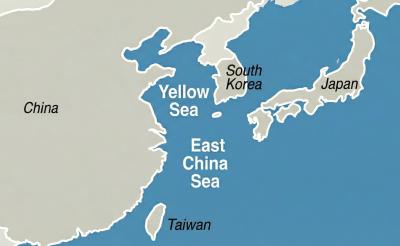
China has reserved offshore airspace in the Yellow Sea and East China Sea from March 27 to May 6, issuing alerts usually used to warn of military exercises, although no such exercises have been announced, the Wall Street Journal (WSJ) reported yesterday. Reserving such a large area for 40 days without explanation is an “unusual step,” as military exercises normally only last a few days, the paper said. These alerts, known as Notice to Air Missions (Notams), “are intended to inform pilots and aviation authorities of temporary airspace hazards or restrictions,” the article said. The airspace reserved in the alert is
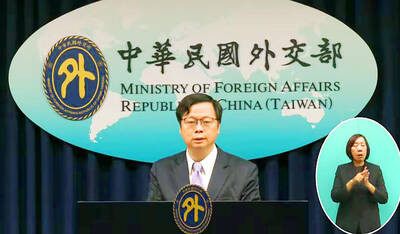
NAMING SPAT: The foreign ministry called on Denmark to propose an acceptable solution to the erroneous nationality used for Taiwanese on residence permits Taiwan has revoked some privileges for Danish diplomatic staff over a Danish permit that lists “Taiwan” as “China,” Eric Huang (黃鈞耀), head of the Ministry of Foreign Affairs’ Department of European Affairs, told a news conference in Taipei yesterday. Reporters asked Huang whether the Danish government had responded to the ministry’s request that it correct the nationality on Danish residence permits of Taiwanese, which has been listed as “China” since 2024. Taiwan’s representative office in Denmark continues to communicate with the Danish government, and the ministry has revoked some privileges previously granted to Danish representatives in Taiwan and would continue to review
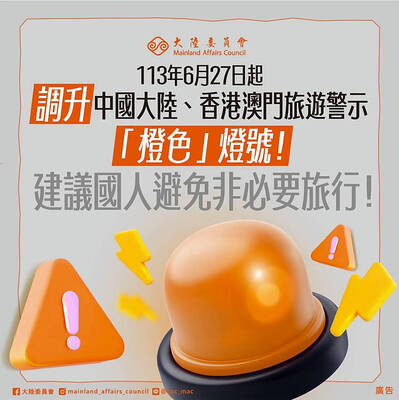
More than 6,000 Taiwanese students have participated in exchange programs in China over the past two years, despite the Mainland Affairs Council’s (MAC) “orange light” travel advisory, government records showed. The MAC’s publicly available registry showed that Taiwanese college and university students who went on exchange programs across the Strait numbered 3,592 and 2,966 people respectively. The National Immigration Agency data revealed that 2,296 and 2,551 Chinese students visited Taiwan for study in the same two years. A review of the Web sites of publicly-run universities and colleges showed that Taiwanese higher education institutions continued to recruit students for Chinese educational programs without
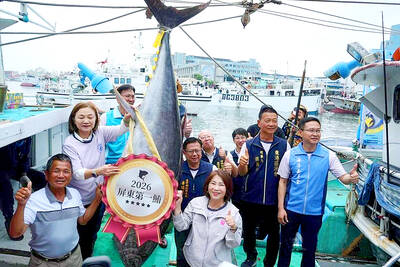
The first bluefin tuna of the season, brought to shore in Pingtung County and weighing 190kg, was yesterday auctioned for NT$10,600 (US$333.5) per kilogram, setting a record high for the local market. The auction was held at the fish market in Donggang Fishing Harbor, where the Siaoliouciou Island-registered fishing vessel Fu Yu Ching No. 2 delivered the “Pingtung First Tuna” it had caught for bidding. Bidding was intense, and the tuna was ultimately jointly purchased by a local restaurant and a local company for NT$10,600 per kilogram — NT$300 ,more than last year — for a total of NT$2.014 million. The 67-year-old skipper


 RSS
RSS