


The Chinese Nationalist Party (KMT) legislative caucus yesterday said it has a positive view of President Ma Ying-jeou’s (馬英九) planned meeting with Chinese President Xi Jinping (習近平), adding that China has made a concession by agreeing to meet Ma in a third country.
KMT caucus whip Lai Shyh-bao (賴士葆) said there is no chance that Taiwan will be belittled at the meeting, as it is to take place in Singapore, rather than in Taiwan or China.
“Former president Lee Teng-hui (李登輝) had hoped to meet with [the Chinese leader] during his term and so did former president Chen Shui-bian (陳水扁). That Ma could now meet with the Chinese president is actually a breakthrough in the cross-strait relationship,” Lai said. “That the meeting is to take place in a third country rules out possible controversies and ensures mutual respect will be upheld.”
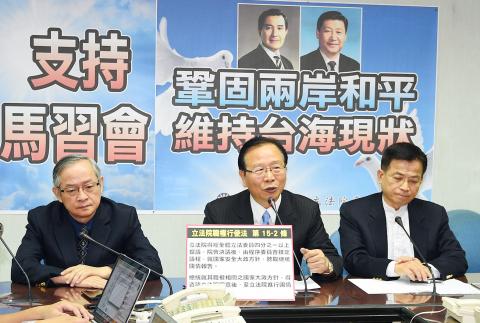
Photo: Lo Pei-der, Taipei Times
“Ma will be setting up a platform, which is similar to the one established by the Koo talks. It could be used by future leaders of the two sides to meet and discuss substantive issues,” he added, referring to the talks between then-Straits Exchange Foundation chairman Koo Chen-fu (辜振甫) and then-Association for Relations Across the Taiwan Straits president Wang Daohan (汪道涵)
In response to questions over the timing of the meeting’s announcement, Lai said: “It is Wednesday today and Ma is visiting Singapore on Saturday, which means that the Executive Yuan reported to Legislative Speaker Wang Jin-pyng (王金平) and the Mainland Affairs Council spoke to the caucuses three days ahead of Ma’s trip.”
“[The reporting process] corresponds to the [basic idea of the] oversight mechanism that has been called for by many,” Lai said.
“Besides pre-meeting reporting, the [KMT] caucus has already signed a motion, proposing to have the president present a ‘state of the nation address’ to parliament after he returns from Singapore,” Lai said.
There are two ways the president could come to the legislature to address to the lawmakers; one is on the president’s own initiative and the other when at least a quarter of the legislators propose it and half of the legislature approves the motion, Lai said. “The motion proposed by us will be put on the next Procedure Committee meeting agenda.”
“[Beijing] has for years precluded the possibility of ‘internationalizing’ the ‘Taiwan problem,’ as it deems the problem an internal one, to the extent of considering internationalizing the problem tantamount to [acknowledging] Taiwanese independence,” KMT Legislator Lin Yu-fang (林郁方) said.
“However, this time the venue of the meeting is Singapore,” Lin said, adding that if it were any Chinese city, the KMT lawmakers would be the first to oppose the meeting.

The Centers for Disease Control (CDC) yesterday reported the first case of a new COVID-19 subvariant — BA.3.2 — in a 10-year-old Singaporean girl who had a fever upon arrival in Taiwan and tested positive for the disease. The girl left Taiwan on March 20 and the case did not have a direct impact on the local community, it said. The WHO added the BA.3.2 strain to its list of Variants Under Monitoring in December last year, but this was the first imported case of the COVID-19 variant in Taiwan, CDC Deputy Director-General Lin Ming-cheng (林明誠) said. The girl arrived in Taiwan on

South Korea is planning to revise its controversial electronic arrival card, a step Taiwanese officials said prompted them to hold off on planned retaliatory measures, a South Korean media report said yesterday. A Yonhap News Agency report said that the South Korean Ministry of Foreign Affairs is planning to remove the “previous departure place” and “next destination” fields from its e-arrival card system. The plan, reached after interagency consultations, is under review and aims to simplify entry procedures and align the electronic form with the paper version, a South Korean ministry official said. The fields — which appeared only on the electronic form

The Ministry of Foreign Affairs (MOFA) is suspending retaliation measures against South Korea that were set to take effect tomorrow, after Seoul said it is updating its e-arrival system, MOFA said today. The measures were to be a new round of retaliation after Taiwan on March 1 changed South Korea's designation on government-issued alien resident certificates held by South Korean nationals to "South Korea” from the "Republic of Korea," the country’s official name. The move came after months of protests to Seoul over its listing of Taiwan as "China (Taiwan)" in dropdown menus on its new online immigration entry system. MOFA last week
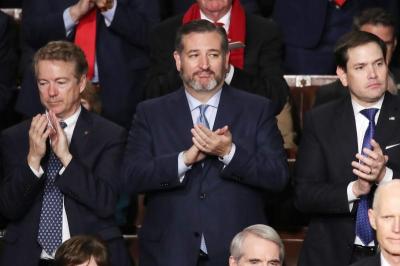
A bipartisan group of US senators has introduced a bill to enhance cooperation with Taiwan on drone development and to reduce reliance on supply chains linked to China. The proposed Blue Skies for Taiwan Act of 2026 was introduced by Republican US senators Ted Cruz and John Curtis, and Democratic US senators Jeff Merkley and Andy Kim. The legislation seeks to ease constraints on Taiwan-US cooperation in uncrewed aerial systems (UAS), including dependence on China-sourced components, limited access to capital and regulatory barriers under US export controls, a news release issued by Cruz on Wednesday said. The bill would establish a "Blue UAS


 RSS
RSS