


National Chengchi University (NCCU) student group the “Wild Fire Alliance” on Friday handed in 1,378 signatures to school authorities, asking the university to abolish its anthem, which they said contained “party-state ideology.”
Pointing to lyrics to the anthem such as “implementing the Three Principles of the People is our party’s mission/building the Republic of China is our party’s responsibility,” student group spokesperson Yang Tsu-hsien (楊子賢) said that the university’s insistence that students sing the anthem in the annual choir competition “makes it difficult for people to tell whether NCCU is a national university or a university established by the Chinese Nationalist Party (KMT).”
Students said that the phrases “the responsibility of our party” echoed party-state ideologies, adding that it sounded more like brainwashing rather than arousing within the students a sense of pride in their school.
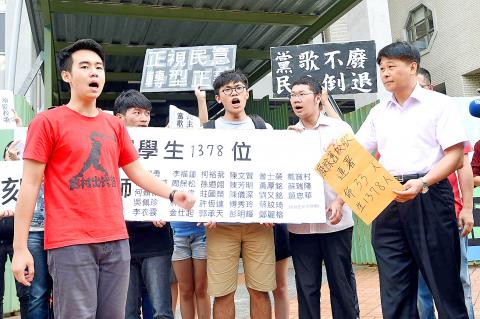
Photo: Fang Pin-chao, Taipei Times
The NCCU was established in 1927 in Nanjing, China, by the KMT as a party university providing training for party members. It was re-established in Taiwan in 1954 under its current name, with Chiang Kai-shek (蔣介石) serving as the university’s president.
Hsu Tsu-wei (徐子為), another student representative, said the university has been sidestepping and boycotting the students’ call through administrative processes, but added that the university should base their considerations on students in the modern age.
“We should be looking to the future, instead of praising the past,” Hsu said, adding that the alliance is not ruling out action both within and outside the school’s administrative system to abolish the anthem.
“We should seek to retain the dynamism of plurality of values and liberties within modern national universities,” Hsu said.
The student’s actions were supported by NCCU professor Chen Fang-ming (陳芳明), who called on the university to address the issue.
“The school anthem is the product of an authoritarian government, and should not exist within a modern and open-minded university,” Chen said.
In response, university authorities said they respected the students’ proposal and would adopt an open-minded attitude toward any issue that is brought to the university’s consideration under the proper channels.
University chief secretary Kou Chien-wen (寇健文) said the university is not affiliated with any political party and its selection of staff is based strictly on capabilities and academic merit.
The anthem has seen decades of years of history and is an important link between alumni and the university, Kou said, but added that the university would be open to suggestions from student groups.
Additional reporting by CNA

The military has spotted two Chinese warships operating in waters near Penghu County in the Taiwan Strait and sent its own naval and air forces to monitor the vessels, the Ministry of National Defense (MND) said. Beijing sends warships and warplanes into the waters and skies around Taiwan on an almost daily basis, drawing condemnation from Taipei. While the ministry offers daily updates on the locations of Chinese military aircraft, it only rarely gives details of where Chinese warships are operating, generally only when it detects aircraft carriers, as happened last week. A Chinese destroyer and a frigate entered waters to the southwest

The eastern extension of the Taipei MRT Red Line could begin operations as early as late June, the Taipei Department of Rapid Transit Systems said yesterday. Taipei Rapid Transit Corp said it is considering offering one month of free rides on the new section to mark its opening. Construction progress on the 1.4km extension, which is to run from the current terminal Xiangshan Station to a new eastern terminal, Guangci/Fengtian Temple Station, was 90.6 percent complete by the end of last month, the department said in a report to the Taipei City Council's Transportation Committee. While construction began in October 2016 with an

NON-RED SUPPLY: Boosting the nation’s drone industry is becoming increasingly urgent as China’s UAV dominance could become an issue in a crisis, an analyst said Taiwan’s drone exports to Europe grew 41.7-fold from 2024 to last year, with demand from Ukraine’s fight against Russian aggression the most likely driver of growth, a study showed. The Institute for Democracy, Society and Emerging Technology (DSET) in a statement on Wednesday said it found that many of Taiwan’s uncrewed aerial vehicle (UAV) sales were from Poland and the Czech Republic. These countries likely transferred the drones to Ukraine to aid it in its fight against the Russian invasion that started in 2022, it said. Despite the gains, Taiwan is not the dominant drone exporter to these markets, ranking second and fourth

Japanese Prime Minister Sanae Takaichi’s comment last year on Tokyo’s potential reaction to a Taiwan-China conflict has forced Beijing to rewrite its invasion plans, a retired Japanese general said. Takaichi told the Diet on Nov. 7 last year that a Chinese naval blockade or military attack on Taiwan could constitute a “survival-threatening situation” for Japan, potentially allowing Tokyo to exercise its right to collective self-defense. Former Japan Ground Self-Defense Force general Kiyofumi Ogawa said in a recent speech that the remark has been interpreted as meaning Japan could intervene in the early stages of a Taiwan Strait conflict, undermining China’s previous assumptions


 RSS
RSS