


Democratic Progressive Party presidential candidate Tsai Ing-wen (蔡英文) yesterday said Taiwan should seek to become an Asia-Pacific center for medical biotechnological research, tapping the nation’s advantages of possessing a genetic database of certain Asian ethnic groups and an understanding their lifestyle habits and environments.
Biotechnology is a fast-moving field and medical biotechnology offers significance prospects for Taiwanese industry, she said.
“We have excellent human resources in clinical medicine and research to study diseases specific to ethnic Chinese, with a renowned international reputation. We also possess a world-class medical system with sufficient medical professionals and facilities that are well-equipped to conduct clinical tests for new medicines and medical devices,” Tsai said.

Photo: CNA
“There are a lot of challenges too, as it is a capital-intensive, skill-intensive and expertise-intensive industry. This is why we should integrate efforts by the government, academic institutes and industries to continue to lay the groundwork by strengthening our human resources, capital, intellectual property and regulations for establishing Taiwan as the research and industrial center of the medical biotechnology of the Asia-Pacific region,” she said.
“Three major connections” are to be made — to future opportunities, to the global market and to local needs,” she said.
Cooperation could be pursued in core areas of medical biotechnology with the developed countries, such as the three medical biotechnology research strongholds in the US — Boston and Irvine and San Diego in California — and European countries such as Switzerland, Belgium, Sweden and the Netherlands, Tsai said, adding that Japan, with whom Taiwan already cooperates in vaccine making, is another possible partner.
“We plan to push for coordination and integration of international regulations and standards, and for the implementation of the Cross-Strait Cooperation Agreement on Medicine and Public Health Affairs,” Tsai said.
Teng Che-ming (鄧哲明), professor emeritus at National Taiwan University’s School of Medicine, said negotiation over the use of Taiwanese medical products in China would be continued.
There is also room for cross-strait cooperation in the development of new medicines for Asian or ethnic Chinese-specific diseases, such as clinical experiments, he said.
“Taiwan’s advantages are that we have a sufficient grasp of certain inherited genes specific to [East Asian people], their lifestyle habits and the geographic environments. So Taiwan could be the experiment base and the early market of the industry, responding to local needs first before making the products available globally,” Tsai said.
Science parks in Taipei; Jhubei (竹北), Hsinchu County; Taichung, Tainan and Kaohsiung would be linked for cross-support and interaction to build Taiwan as a hub for the industry, she said.

LOUD AND PROUD Taiwan might have taken a drubbing against Australia and Japan, but you might not know it from the enthusiasm and numbers of the fans Taiwan might not be expected to win the World Baseball Classic (WBC) but their fans are making their presence felt in Tokyo, with tens of thousands decked out in the team’s blue, blowing horns and singing songs. Taiwanese fans have packed out the Tokyo Dome for all three of their games so far and even threatened to drown out home team supporters when their team played Japan on Friday. They blew trumpets, chanted for their favorite players and had their own cheerleading squad who dance on a stage during the game. The team struggled to match that exuberance on the field, with
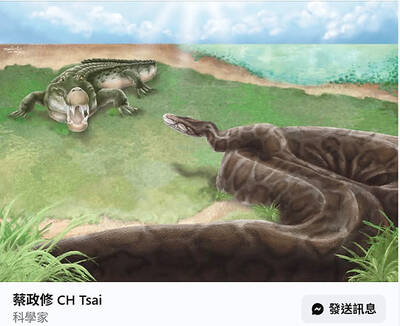
Taiwanese paleontologists have discovered fossil evidence that pythons up to 4m long inhabited Taiwan during the Pleistocene epoch, reporting their findings in the international scientific journal Historical Biology. National Taiwan University (NTU) Institute of Ecology and Evolutionary Biology associate professor Tsai Cheng-hsiu (蔡政修) led the team that discovered the largest snake fossil ever found in Taiwan. The single trunk vertebra was discovered in Tainan at the Chiting Formation, dated to between 400,000 and 800,000 years ago in the Middle Pleistocene, the paper said. The area also produced Taiwan’s first avian fossil, as well as crocodile, mammoth, saber-toothed cat and rhinoceros fossils, it said. Discoveries

Taiwanese paleontologists have discovered fossil evidence that pythons up to 4m long inhabited Taiwan during the Pleistocene epoch, reporting their findings in the international scientific journal Historical Biology. National Taiwan University (NTU) Institute of Ecology and Evolutionary Biology associate professor Tsai Cheng-hsiu (蔡政修) led the team that discovered the largest snake fossil ever found in Taiwan. A single trunk vertebra was discovered in Tainan at the Chiting Formation, dated to between 800,000 to 400,000 years ago in the Middle Pleistocene, the paper said. The area also produced Taiwan’s first avian fossil, as well as crocodile, mammoth, sabre-toothed cat and rhinoceros fossils, it said. Discoveries
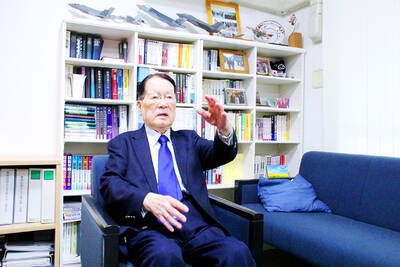
Whether Japan would help defend Taiwan in case of a cross-strait conflict would depend on the US and the extent to which Japan would be allowed to act under the US-Japan Security Treaty, former Japanese minister of defense Satoshi Morimoto said. As China has not given up on the idea of invading Taiwan by force, to what extent Japan could support US military action would hinge on Washington’s intention and its negotiation with Tokyo, Morimoto said in an interview with the Liberty Times (sister paper of the Taipei Times) yesterday. There has to be sufficient mutual recognition of how Japan could provide


 RSS
RSS