


All long-term government contract workers should be made regular employees and compensated for lost seniority, labor rights advocates said yesterday, in a protest outside the Ministry of the Interior.
Rights campaigners wearing white masks blocked off a road outside the ministry and lay on the ground to spell out the Chinese characters for “Give back annual salary” with their bodies, referring to renumeration that comes with seniority.
They said the white masks symbolized the silencing of government contract workers.
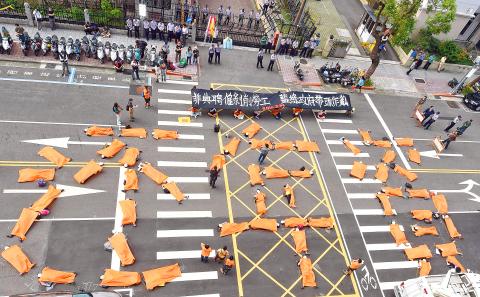
Photo: Liu Hsin-de, Taipei Times
“The government presses on the throats of long-term contract workers and says that if they dare to come forward and fight for their rights, they will not have a job next year,” National Alliance for Workers of Closed Factories member Wu Jing-ru (吳靜如) said, referring to former freeway toll collectors and National Taxation Bureau employees.
Former toll collectors composed the bulk of the protesters, with a number of unions also sending representatives.
Campaigners lying on the roadside covered themselves in orange cloth, the same color as the uniforms of the former toll workers, who were laid off two years ago after a nationwide system of electronic eTag toll collections took effect.
Former Freeway Toll Collectors Self-Help Organization president Sun Hsiu-luan (孫秀鑾) said that because toll workers were employed on annual contracts, they did not accumulate seniority no matter how long they were employed, sharply reducing the value of the severance pay to which they were entitled.
The laid-off workers had been employed for 13-and-a-half years on average, she said.
Taoyuan Confederation of Trade Unions chairman Chuang Fu-kai (莊福凱) questioned the legality of the government’s refusal to allow long-term contract workers to accrue seniority, stating that the Labor Standards Act (勞動基準法) stipulates that workers can be considered “temporary” workers only when they are employed short-term or seasonally.
Anyone employed for more than one year is considered a long-term employee under the act, he said.
Taipei City Confederation of Trade Unions board of supervisors convener Chiang Wan-chin (蔣萬金) said that contract employees are often fired arbitrarily following elections to allow supporters to be awarded positions.
In a later protest outside Democratic Progressive Party (DPP) headquarters, Former Freeway Toll Collectors Self-Help Organization members said the DPP has been unresponsive to their demands, refusing to take a position on reforming the government’s handling of contract hiring and failing to follow up on promises to find jobs for former toll collectors within DPP-controlled governments.
Sun said that although DPP Chairperson Tsai Ing-wen (蔡英文) had promised that positions would be found for the former toll collectors following last year’s elections, only one out of the more than 300 ex-collectors has been given a job.

Considering that most countries issue more than five denominations of banknotes, the central bank has decided to redesign all five denominations, the bank said as it prepares for the first major overhaul of the banknotes in more than 24 years. Central bank Governor Yang Chin-lung (楊金龍) is expected to report to the Legislative Yuan today on the bank’s operations and the redesign’s progress. The bank in a report sent to the legislature ahead of today’s meeting said it had commissioned a survey on the public’s preferences. Survey results showed that NT$100 and NT$1,000 banknotes are the most commonly used, while NT$200 and NT$2,000

The Centers for Disease Control (CDC) yesterday reported the first case of a new COVID-19 subvariant — BA.3.2 — in a 10-year-old Singaporean girl who had a fever upon arrival in Taiwan and tested positive for the disease. The girl left Taiwan on March 20 and the case did not have a direct impact on the local community, it said. The WHO added the BA.3.2 strain to its list of Variants Under Monitoring in December last year, but this was the first imported case of the COVID-19 variant in Taiwan, CDC Deputy Director-General Lin Ming-cheng (林明誠) said. The girl arrived in Taiwan on

South Korea is planning to revise its controversial electronic arrival card, a step Taiwanese officials said prompted them to hold off on planned retaliatory measures, a South Korean media report said yesterday. A Yonhap News Agency report said that the South Korean Ministry of Foreign Affairs is planning to remove the “previous departure place” and “next destination” fields from its e-arrival card system. The plan, reached after interagency consultations, is under review and aims to simplify entry procedures and align the electronic form with the paper version, a South Korean ministry official said. The fields — which appeared only on the electronic form

The Ministry of Foreign Affairs (MOFA) is suspending retaliation measures against South Korea that were set to take effect tomorrow, after Seoul said it is updating its e-arrival system, MOFA said today. The measures were to be a new round of retaliation after Taiwan on March 1 changed South Korea's designation on government-issued alien resident certificates held by South Korean nationals to "South Korea” from the "Republic of Korea," the country’s official name. The move came after months of protests to Seoul over its listing of Taiwan as "China (Taiwan)" in dropdown menus on its new online immigration entry system. MOFA last week


 RSS
RSS