


After changing from betel nuts, 63-year-old farmer Chu Kuo-hsing (朱國興) now grows nationally renowned persimmons, acclaimed for their size and sweetness, at his farm in Taichung’s Heping District (和平).
Chu said he uses low amounts of planticides and fertilizers on his fruit trees, but his persimmons are both sweeter and bigger than the average fruit.
He said his secret is technical assistance from National Chung Hsing University agriculture and natural resources professor Tsay Tsung-tsuan (蔡東纂), who was introduced to Chu by the farmer’s elder brother.
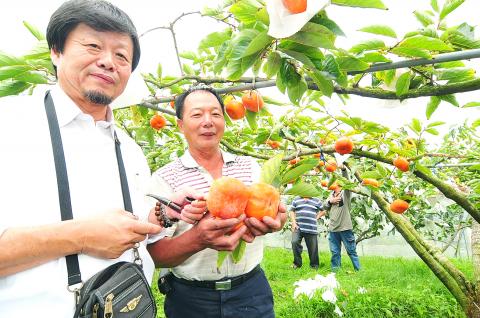
Photo: Lee Chung-hsien, Taipei Times
Prior to becoming a successful persimmon farmer, Chu said he grew bamboo shoots and betel nuts with his parents near Taichung’s Dakeng (大坑) area and that he was a leading betel-nut farmer.
Chu said that a decade ago, he began to sense a contraction in the betel-nut market and decided to transition to persimmon farming.
Chu said he bought three jia (甲) of land (11.77 hectares) and started growing fruit trees right away, but with initially discouraging results.
In spite of spending more than NT$1 million (US$30,714) on fertilizer and weed killer each year, his fruits were “about the size of an egg,” Chu said, adding that his fruit became the butt of jokes in the farmer’s market where his persimmons were derided as “Chu’s little ones.”
Chu said he went to Tsay desperate for help, and the agriculturalist told him that he should drastically reduce his use of chemicals.
Chu reduced his fertilizer use by 90 percent and his persimmons became some of the best on the market, Chu said.
Chu’s persimmons measure 20 on the Brix sweetness scale and weigh between 9 and 15 liang (兩, a traditional unit of weight based on a lump of silver, the equivalent of about 37.5 grams), with the biggest fruits weighing up to 18 liang. The average persimmon on the market weighs between 6 and 9 liang.
Chu said that he sells 60 percent of his produce direct, and does not use retail venues. His fruit has no pesticide or weed killer residue and are sold for between NT$200 and NT$300, Chu said, adding that he is expecting a substantial rise in the market price of persimmons this year.

Considering that most countries issue more than five denominations of banknotes, the central bank has decided to redesign all five denominations, the bank said as it prepares for the first major overhaul of the banknotes in more than 24 years. Central bank Governor Yang Chin-lung (楊金龍) is expected to report to the Legislative Yuan today on the bank’s operations and the redesign’s progress. The bank in a report sent to the legislature ahead of today’s meeting said it had commissioned a survey on the public’s preferences. Survey results showed that NT$100 and NT$1,000 banknotes are the most commonly used, while NT$200 and NT$2,000

The Centers for Disease Control (CDC) yesterday reported the first case of a new COVID-19 subvariant — BA.3.2 — in a 10-year-old Singaporean girl who had a fever upon arrival in Taiwan and tested positive for the disease. The girl left Taiwan on March 20 and the case did not have a direct impact on the local community, it said. The WHO added the BA.3.2 strain to its list of Variants Under Monitoring in December last year, but this was the first imported case of the COVID-19 variant in Taiwan, CDC Deputy Director-General Lin Ming-cheng (林明誠) said. The girl arrived in Taiwan on

South Korea is planning to revise its controversial electronic arrival card, a step Taiwanese officials said prompted them to hold off on planned retaliatory measures, a South Korean media report said yesterday. A Yonhap News Agency report said that the South Korean Ministry of Foreign Affairs is planning to remove the “previous departure place” and “next destination” fields from its e-arrival card system. The plan, reached after interagency consultations, is under review and aims to simplify entry procedures and align the electronic form with the paper version, a South Korean ministry official said. The fields — which appeared only on the electronic form

The Ministry of Foreign Affairs (MOFA) is suspending retaliation measures against South Korea that were set to take effect tomorrow, after Seoul said it is updating its e-arrival system, MOFA said today. The measures were to be a new round of retaliation after Taiwan on March 1 changed South Korea's designation on government-issued alien resident certificates held by South Korean nationals to "South Korea” from the "Republic of Korea," the country’s official name. The move came after months of protests to Seoul over its listing of Taiwan as "China (Taiwan)" in dropdown menus on its new online immigration entry system. MOFA last week


 RSS
RSS