


Several senior Chinese Nationalist Party (KMT) members yesterday threw their support behind KMT Chairman Eric Chu’s (朱立倫) reported plan to enter January’s presidential race.
“The KMT is in chaos... I hope [all party members] can put the fate of their ‘greater self’ above everything else, as any loss or damage sustained by the ‘lesser self’ does not really matter,” former KMT chairman Wu Poh-hsiung (吳伯雄) said during a speech at an event in Taipei yesterday morning.
Wu said he learned the significance of the “greater self” from his decade of experience in the political arena, a comment perceived as urging KMT presidential candidate Hung Hsiu-chu (洪秀柱) — who has faced mounting pressure from her party peers to exit the Jan. 16 race — to prioritize the future of the KMT above that of herself.
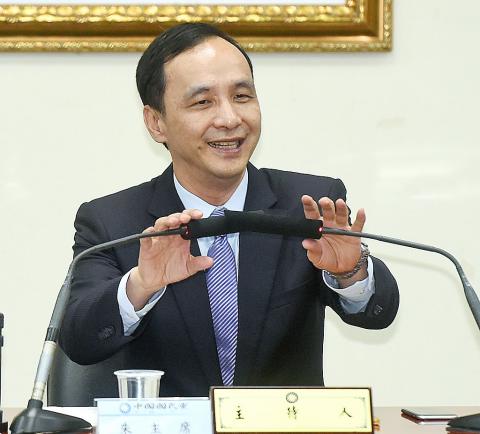
Photo: CNA
On the sidelines of the event, Vice President Wu Den-yih (吳敦義) said Chu had expressed during their recent meetings his concerns and opinions over difficulties faced by the party’s legislative candidates and the anxious voices from within the party regarding the upcoming elections.
“As the head of the party, Chu has a strong sense of mission. I believe any arrangements or decisions he has made were for the sake of party solidarity and the future development of the zhonghua minzu [Chinese ethnic group, 中華民族],” Wu said.
KMT Vice Chairperson Huang Min-hui (黃敏惠) said she hopes her party comrades could unite in their efforts to strive for a better future for the country, the party and the people.
Asked whether Wu’s remarks hinted at his hope for Hung’s withdrawal from the election, Huang said: “It is a shared hope among the majority [of party members.]”
Chu adopted a relatively soft tone on the matter in his address at an afternoon meeting of the KMT’s Central Standing Committee.
“Hung has worked hard to garner public support since her official nomination at the July 19 national party congress. Her arduous efforts must be acknowledged,” Chu said.
It is apparent that members from the KMT headquarters and local levels have given their unreserved support for Hung in the past three months, Chu said, adding that the current situation was the last thing the party wanted to see.
While expressing hope that Hung and the KMT could join hands in addressing the party’s predicament in the approaching elections, Chu urged the deputy legislative speaker to return to the party’s cross-strait stance, which he said is supported by mainstream public opinion.
He also denied allegations that he and KMT Secretary-General Lee Shu-chuan (李四川) had offered Hung any quid-pro-quo deals in exchange for her dropping out of the race.
In an apparent move to dispel rumors that he was interested in running for the top office, Chu said the reasons behind his decision not to register for the KMT’s presidential primary still remained: his promise [to serve out his mayoral term] to the citizens of New Taipei City and his determination to facilitate party unity.
“Hung is an important member of the KMT family. Through rational communication, we can surely work out a solution to jointly overcome our difficulties,” Chu said.
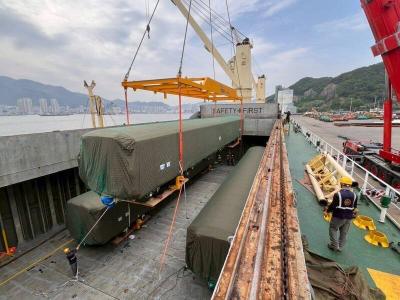
The first of 10 new high-capacity trains purchased from South Korea’s Hyundai Rotem arrived at the Port of Taipei yesterday to meet the demands of an expanding metro network, Taipei Rapid Transit Corp (TRTC) said yesterday. The train completed a three-day, 1,200km voyage from the Port of Masan in South Korea, the company said. Costing NT$590 million (US$18.79 million) each, the new six-carriage trains feature a redesigned interior based on "human-centric" transportation concepts, TRTC said. The design utilizes continuous longitudinal seating to widen the aisles and optimize passenger flow, while also upgrading passenger information displays and driving control systems for a more comfortable
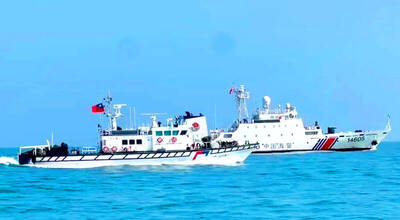
Instead of focusing solely on the threat of a full-scale military invasion, the US and its allies must prepare for a potential Chinese “quarantine” of Taiwan enforced through customs inspections, Stanford University Hoover fellow Eyck Freymann said in a Foreign Affairs article published on Wednesday. China could use various “gray zone” tactics in “reconfiguring the regional and ultimately the global economic order without a war,” said Freymann, who is also a nonresident research fellow at the US Naval War College. China might seize control of Taiwan’s links to the outside world by requiring all flights and ships entering or leaving Taiwan
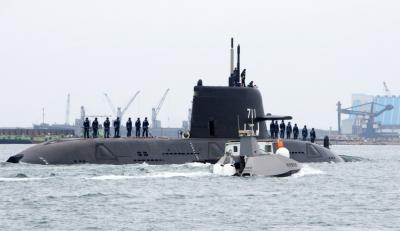
Taiwan's first indigenous defense submarine, the SS-711 Hai Kun (海鯤, or Narwhal), departed for its 13th sea trial at 7am today, marking its seventh submerged test, with delivery to the navy scheduled for July. The outing also marked its first sea deployment since President William Lai (賴清德) boarded the submarine for an inspection on March 19, drawing a crowd of military enthusiasts who gathered to show support. The submarine this morning departed port accompanied by CSBC Corp’s Endeavor Manta (奮進魔鬼魚號) uncrewed surface vessel and a navy M109 assault boat. Amid public interest in key milestones such as torpedo-launching operations and overnight submerged trials,
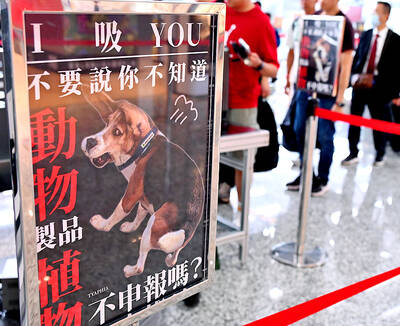
Quarantine awareness posters at Taiwan Taoyuan International Airport have gone viral for their use of wordplay. Issued by the airport branch of the Animal and Plant Health Inspection Agency, the posters feature sniffer dogs making a range of facial expressions, paired with advisory messages built around homophones. “We update the messages for holidays and campaign needs, periodically refreshing materials to attract people’s attention,” quarantine officials said. “The aim is to use the dogs’ appeal to draw focus to quarantine regulations.” A Japanese traveler visiting Taiwan has posted a photo on X of a poster showing a quarantine dog with a


 RSS
RSS