


The Taiwan Health Reform Foundation yesterday said over-the-counter (OTC) drugs should come with instructions that are easy to understand and drug facts should be printed on the package labeling.
Members of the foundation chanted slogans such as: “We want instructions, not textbooks,” and “Show us the warnings, don’t play hide and seek,” as they urged the Food and Drug Administration (FDA) to demand that drug companies improve their OTC drug labeling and instructions.
Foundation chairperson Joanne Liu (劉淑瓊) said the assembly of the first National Conference on Drug Policies in 2008 passed a resolution that said drug package inserts should be written more explicitly and in a way that makes them easier to understand, but six years later many drugs still come with instructions that are too difficult for most people to understand.
The foundation cited a definition written on the information insert of an OTC drug bought in Taiwan: “This product is a specialized and fast-effective histamine antagonist, which can inhibit the secretion of basal gastric acid and stimulated gastric acid. It can reduce secretion, reduce acidity and the amount of pepsin.”
Foundation chief executive officer Amy Wang (王梅影) said the information insert that came with the same drug bought in the US said the drug “reduces the production of stomach acid and is different from antacids, which neutralize the acid already in your stomach,” which is much easier to understand.
Wang said the drug facts printed on the package labeling of US-bought drugs follow a standard format, including the most important “caution” and a drug use consultation hotline, but the drug facts printed on the package labeling of Taiwan-bought drugs are printed on different sides of the box and are unclear.
Wang said the foundation asked two of its members to buy commonly used drugs — ibuprofen (often used as an anti-inflammatory) and diclofenac (often used in pain relief patches) — for their child and pregnant wife respectively.
They found that the drug labeling of one ibuprofen product said “please read the package insert for details” and did not mention that children under the age of 12 should not use the product, but the drug with the same ingredients from another brand had it clearly printed on the package label.
Liu said if the FDA did not revise its standards for reviewing drug product labeling and usage instructions, consumers might face the negative health risks of drug misuse.
The foundation said the FDA should provide a clear standard format of drug facts and package inserts for drug companies to follow.
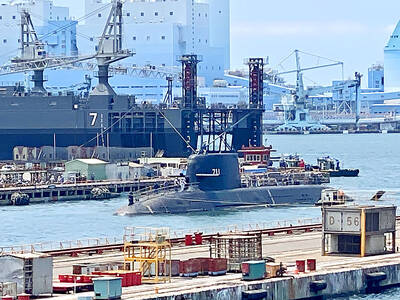
AGING: While Japan has 22 submarines, Taiwan only operates four, two of which were commissioned by the US in 1945 and 1946, and transferred to Taiwan in 1973 Taiwan would need at least 12 submarines to reach modern fleet capabilities, CSBC Corp, Taiwan chairman Chen Cheng-hung (陳政宏) said in an interview broadcast on Friday, citing a US assessment. CSBC is testing the nation’s first indigenous defense submarine, the Hai Kun (海鯤, Narwhal), which is scheduled to be delivered to the navy next month or in July. The Hai Kun has completed torpedo-firing tests and is scheduled to undergo overnight sea trials, Chen said on an SET TV military affairs program. Taiwan would require at least 12 submarines to establish a modern submarine force after assessing the nation’s operational environment and defense
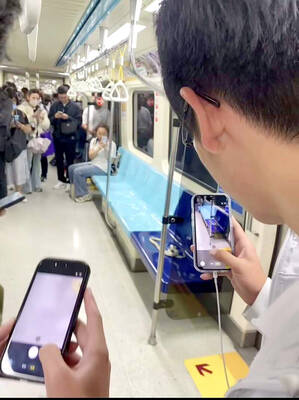
A white king snake that frightened passengers and caused a stir on a Taipei MRT train on Friday evening has been claimed by its owner, who would be fined, Taipei Rapid Transit Corp (TRTC) said yesterday. A person on Threads posted that he thought he was lucky to find an empty row of seats on Friday after boarding a train on the Bannan (Blue) Line, only to spot a white snake with black stripes after sitting down. Startled, he jumped up, he wrote, describing the encounter as “terrifying.” “Taipei’s rat control plan: Release snakes on the metro,” one person wrote in reply, referring
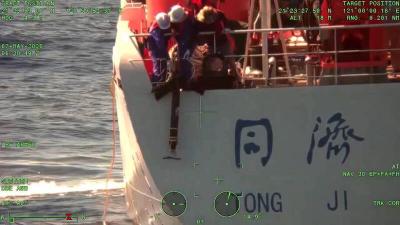
The coast guard today said that it had disrupted "illegal" operations by a Chinese research ship in waters close to the nation and driven it away, part of what Taipei sees a provocative pattern of China's stepped up maritime activities. The coast guard said that it on Thursday last week detected the Chinese ship Tongji (同濟號), which was commissioned only last year, 29 nautical miles (54km) southeast of the southern tip of Taiwan, although just outside restricted waters. The ship was observed lowering ropes into the water, suspected to be the deployment of scientific instruments for "illegal" survey operations, and the coast
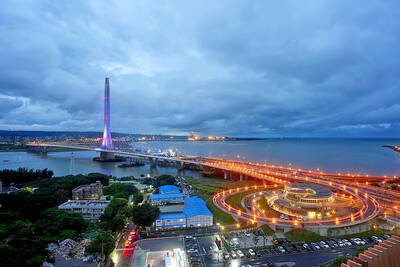
An inauguration ceremony was held yesterday for the Danjiang Bridge, the world’s longest single-mast asymmetric cable-stayed bridge, ahead of its official opening to traffic on Tuesday, marking a major milestone after nearly three decades of planning and construction. At the ceremony in New Taipei City attended by President William Lai (賴清德), Premier Cho Jung-tai (卓榮泰), Minister of Transportation and Communications Chen Shih-kai (陳世凱) and New Taipei City Mayor Hou Yu-ih (侯友宜), the bridge was hailed as both an engineering landmark and a long-awaited regional transport link connecting Tamsui (淡水) and Bali (八里)


 RSS
RSS