


A Chinese Nationalist Party (KMT) lawmaker’s suggestion to call off a top-level cross-strait meeting scheduled for next month to demonstrate Taiwan’s unhappiness with China’s high-handed introduction of a new travel pass for Taiwanese would be considered, Premier Mao Chi-kuo (毛治國) said yesterday, although he stressed that China’s Taiwan Affairs Office (TAO) has responded positively to Taipei’s complaints.
KMT Legislator Lu Hsiu-yen (盧秀燕) said China’s unilateral move to replace its paper “Taiwan compatriot travel document” (台胞證) with a smart-card pass was a slap in the face to President Ma Ying-jeou (馬英九), the premier and Mainland Affairs Council Minister Andrew Hsia (夏立言).
If Taiwan’s government simply delivered an oral protest, it “would be looked down on by both its people and the Chinese government,” Lu said, as she told Cabinet ministers the meeting scheduled for next month between Hsia and TAO Minister Zhang Zhijun (張志軍) should be scrapped.
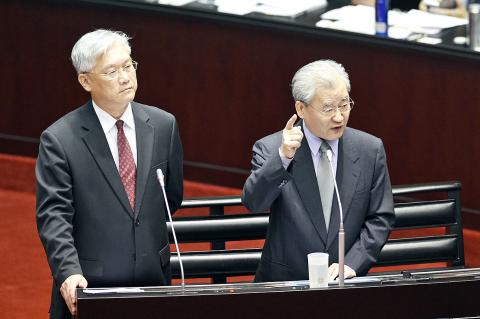
Photo: George Tsorng, Taipei Times
Beijing’s decision to introduce the microchip card without first discussing it with the Mainland Affairs Council dominated the question-and-answer session in the Legislative Yuan for a second day yesterday, with lawmakers across party lines grilling Cabinet members about the new pass.
Mao told Lu that the TAO has made positive responses after the government lodged a complaint, confirming that the card is to be used in the same way as the paper document it replaced.
Hsia told lawmakers concerns that the chip could be used to electronically track Taiwanese or that their personal data could be compromised were misplaced.
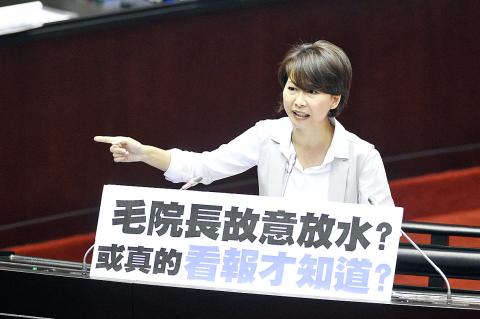
Photo: George Tsorng, Taipei Times
The chip in the card has been studied and found to contain one-time programming, with just 0.1MB capacity.
“It is not designed for tracing or transmitting, nor is it able to carry biological traits,” the minister said.
The premier said the government had made several requests.
“We have requested that if major changes to the existing measures are to be made, they have to be discussed by the two sides via official channels and only put into effect after a consensus has been reached,” Mao said.
Democratic Progressive Party Legislator Chen Ting-fei (陳亭妃) said if the only kind of protest the government offered was words of dissatisfaction, there would be no end to such offenses by the Chinese.
Mao told Chen that the Chinese government should know that “discontent is something that accumulates.”
On Monday in Beijing, TAO spokesman Ma Xiaoguang (馬曉光) said that the card was simply an electronic version of the paper travel document, valid for five years, which would streamline entry and exit processes.
“Since the people on the two sides of the Taiwan Strait are one family, the change is for the convenience and better exchange [of the two peoples] and has received a warm welcome from people of both sides, especially the Taiwanese public,” the spokesperson said.
The Taiwan Solidarity Union on Monday said that the Chinese government has rammed its policy down the throats of the Taiwanese and was trying to “make the Taiwanese part of its domestic business.”
It called on the Ma administration to respond in kind by eliminating the entry document now used by Chinese visitors in favor of visas stamped directly onto their Chinese passports.

Fast food chain McDonald's is to raise prices by up to NT$5 on some products at its restaurants across Taiwan, starting on Wednesday next week, the company announced today. The prices of all extra value meals and sharing boxes are to increase by NT$5, while breakfast combos and creamy corn soup would go up by NT$3, the company said in a statement. The price of the main items of those meals, if ordered individually, would remain the same. Meanwhile, the price of a medium-sized lemon iced tea and hot cappuccino would rise by NT$3, extra dipping sauces for chicken nuggets would go up

Nvidia Corp CEO Jensen Huang (黃仁勳) arrived in Taiwan yesterday ahead of upcoming AI and technology events, saying he plans to meet with clients and Taiwan Semiconductor Manufacturing Co Chairman C.C. Wei (魏哲家) during his visit. After landing at Taipei Songshan Airport, Huang posed for photos with fans and handed out Yakult drinks to reporters and supporters waiting at the scene, saying he has “a lot to do” during the trip. Asked about reports that Nvidia’s planned headquarters site in Taipei’s Beitou Shilin Technology Park could break ground on May 27, Huang said that if the company holds an event, he would

FUKUOKA SITUATION: Japanese media reported that the pathogen is expected to be identified by the summer, while the CDC downplayed the idea that it was hMPV A “mysterious cold-like illness” reported in Japan’s Fukuoka Prefecture does not seem to be a new disease, but Japanese authorities have been asked about the situation, the Centers for Disease Control (CDC) said yesterday. The Fukuoka Prefectural Medical Association on Wednesday told a news conference that a “mystery cold” that has become a hot topic on social media is “highly likely to be caused by some kind of viral infection,” Japan’s KBC News reported. “Many people are experiencing symptoms starting with a sore throat, followed by a runny nose, phlegm and a severe cough,” KBC News reported, citing association officials. Health authorities are

Carrefour Taiwan is to begin using a new name from the start of July, but it cannot divulge the name until then, the chairman of the supermarket chain's parent company said today. President Chain Store Co chairman Lo Chih-hsien (羅智先) was asked by reporters after a shareholders' meeting to confirm whether the company has settled on a new name for the supermarket brand. In March, the government-registered name of two Carrefour Taiwan branches was quietly changed to "Le Chia Kang" (樂家康) in Chinese, raising speculation that has been selected as the name. Lo said that because of local regulations and contractual obligations, the


 RSS
RSS