


Chinese President Xi Jinping (習近平) is likely to make Taiwan a “major issue” during his White House summit with US President Barack Obama this week, former American Institute in Taiwan (AIT) chairman Richard Bush said on Monday.
Obama should urge Xi to be “cautious” and avoid making a “sensitive issue worse” in China’s response to a possible Democratic Progressive Party (DPP) victory in the January elections, said Bush, who is now director for East Asia policy studies at the Brookings Institution in Washington.
There was a “good chance” that the DPP would come back to power, he said in a post on the Brookings Web site titled “The return of the Taiwan issue to US-China relations.”
Xi’s message to Obama was likely to be: “You Americans don’t realize the danger that the DPP and its presidential candidate, Tsai Ing-wen (蔡英文), pose. You need to do your part to contain what will become a bad situation,” Bush wrote.
Beijing probably fears that Tsai would act incrementally and covertly to create an independent Taiwan, “thus foreclosing China’s central goal of future unification,” he said.
“Tsai has made a modest effort to reassure Beijing and Washington about her intentions. She says she wants to preserve the current ‘status quo,’” he said. “But Beijing isn’t buying the vagueness. Xi himself has warned publicly that the cornerstone of cross-strait ties would be shaken if Taiwan does not accept the political foundation of cross-strait relations, particularly the principle of ‘one China.’”
The Chinese Nationalist Party (KMT) is “losing its moxie,” he said.
If Tsai wins the presidency, but does not accommodate Beijing’s demands, Beijing might take steps to restrict governmental and semi-governmental cross-strait interaction and use diplomatic pressure to reduce Taiwan’s international space, he said.
Bush speculated that Tsai could be pressured to respond, resulting in a “downward spiral” and both sides might seek US support.
Bush said Obama should respond to Xi’s warning about Tsai by reminding him that domestic factors are likely to be more important than external ones in deciding Taiwan’s presidential election.
Obama should encourage Xi to give Tsai credit when she does not say things that challenge China’s interests, Bush said, adding that Xi should create more common ground between the two sides, reduce misunderstandings and explore how to manage differences.
“This is best done via private, authoritative discussions,” he wrote.
Xi should focus on what Tsai says — if elected — in her inaugural address and what she does after she becomes president.
“Beijing’s interests are best served not by backing itself into a corner but by keeping options open,” Bush wrote.
However, Walter Lohman, director of the Heritage Foundation’s Asian Studies Center, on Monday told a foundation roundtable meeting about Xi’s visit that it was possible that Taiwan would only be raised in a “pro forma” way.
If Xi does raise Taiwan, “I don’t see that there is very much discussion that is appropriate. There is no real role that the United States does or should play in mediating between Beijing and Taiwan,” Lohman said.
Formosan Association for Public Affairs president Mark Kao (高龍榮) on Monday released a letter he wrote to Obama urging him to “prevail on President Xi to accept Taiwan as a friendly neighbor and move towards normalization of relations.”
He asked Obama to impress upon Xi the need to dismantle the large number of missiles targeted at Taiwan and to renounce the use of force against Taiwan.
“This is the best way to maintain peace and stability in Asia,” Kao said.
Xi arrives in Washington tomorrow and is scheduled to attend a working dinner at the White House. On Friday he will hold a joint news conference with Obama, meet congressional leaders and attend a state dinner.

FUKUOKA SITUATION: Japanese media reported that the pathogen is expected to be identified by the summer, while the CDC downplayed the idea that it was hMPV A “mysterious cold-like illness” reported in Japan’s Fukuoka Prefecture does not seem to be a new disease, but Japanese authorities have been asked about the situation, the Centers for Disease Control (CDC) said yesterday. The Fukuoka Prefectural Medical Association on Wednesday told a news conference that a “mystery cold” that has become a hot topic on social media is “highly likely to be caused by some kind of viral infection,” Japan’s KBC News reported. “Many people are experiencing symptoms starting with a sore throat, followed by a runny nose, phlegm and a severe cough,” KBC News reported, citing association officials. Health authorities are

Nvidia Corp CEO Jensen Huang (黃仁勳) arrived in Taiwan yesterday ahead of upcoming AI and technology events, saying he plans to meet with clients and Taiwan Semiconductor Manufacturing Co Chairman C.C. Wei (魏哲家) during his visit. After landing at Taipei Songshan Airport, Huang posed for photos with fans and handed out Yakult drinks to reporters and supporters waiting at the scene, saying he has “a lot to do” during the trip. Asked about reports that Nvidia’s planned headquarters site in Taipei’s Beitou Shilin Technology Park could break ground on May 27, Huang said that if the company holds an event, he would

Carrefour Taiwan is to begin using a new name from the start of July, but it cannot divulge the name until then, the chairman of the supermarket chain's parent company said today. President Chain Store Co chairman Lo Chih-hsien (羅智先) was asked by reporters after a shareholders' meeting to confirm whether the company has settled on a new name for the supermarket brand. In March, the government-registered name of two Carrefour Taiwan branches was quietly changed to "Le Chia Kang" (樂家康) in Chinese, raising speculation that has been selected as the name. Lo said that because of local regulations and contractual obligations, the
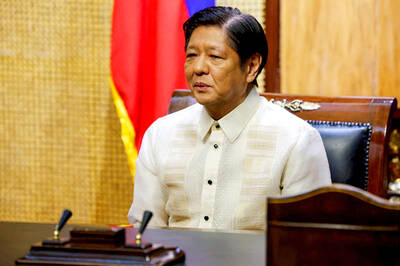
The Philippines would likely be involved in any conflict over Taiwan due to its proximity to the democracy claimed by China, President Ferdinand Marcos Jr said, reiterating a stance that risks angering Beijing. “In the Philippines, we do not have a choice because Taiwan is so close to the Philippines and we have almost 200,000 Filipino nationals living and working in Taiwan,” Marcos said in an interview with Japanese media in Manila on Monday. The Philippine leader’s comments come ahead of a state visit to Japan next week, where he is to meet with Japanese Prime Minister Sanae Takaichi to discuss security


 RSS
RSS