


Civil activists yesterday urged the authorities to conduct a thorough investigation of the five Chinese nationals found on a yacht off Taoyuan County last week to determine whether they were planning to seek asylum in the US, as they claimed, or Chinese spies, coming as they did around the time of the Han Kuang military exercises.
Taiwan Association for China Human Rights chairman Yang Hsien-hung (楊憲宏) told a press conference that whatever the group’s motivations were, they should not be repatriated to China within 15 days of their detention.
The news was first reported by Radio Free Asia (RFA), which on Monday said that the five were found on a yacht on Sunday last week.
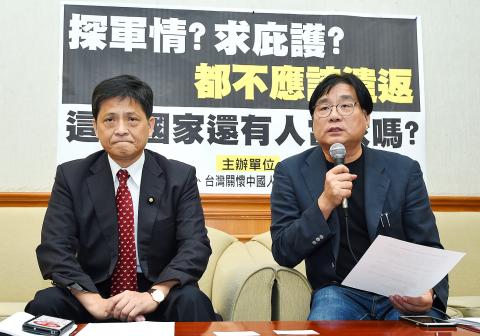
Photo: Liao Chen-huei, Taipei Times
Three of them left China’s Shandong Province on Aug. 6 and almost perished at sea when they encountered a typhoon on Aug. 20, but were rescued by the Japan Coast Guard and sent to China’s Fujian Province, the report said. From there, the trio again set out for Taiwan to pick up two other Chinese citizens who had been staying in Taiwan with expired visas, it said.
The five turned to Taiwanese authorities for help on Saturday last week, when their yacht was stranded, according to the RFA, which quoted Wang Rui (王睿), one of the two who had overstayed in Taiwan, as saying they hoped the Taiwanese government would help them reach Guam and seek asylum there, as they know it is difficult to do so in Taiwan.
The Chinese-language Liberty Times on Wednesday reported that the yacht, which flew the Republic of China flag and had its name painted in traditional Chinese characters, was first found offshore from the Tamsui River (淡水河) estuary on Tuesday last week, the second day of Taiwan’s military exercises, saying they were lost, but then sailed off before reappearing off the Taoyuan coast four days later.
The report said that the National Immigration Agency (NIA) considered the five to have illegally entered and overstayed in Taiwan, and sent them to the Taoyuan District Prosecutors’ Office, which put them in a detention center to be deported to China within 15 days.
Yang said spying on Taiwan’s military and seeking political asylum are “very different things,” but if it is the latter, sending them back to China would put them in great danger and incur grave criticisms from international human rights organizations.
“Even if it is espionage, deporting them is all the more inappropriate, as they would need to go through a proper investigation,” he added. “It is exactly because we still have no set laws for dealing with refugees, despite the fact that President Ma Ying-jeou (馬英九) has ratified the two international human rights conventions as early as in 2009, that we still need a press conference today” to urge authorities not to hurt the rights of potential refugees.”
If the Taiwanese government thinks it lacks the ability to effectively determine the five’s refugee status, “they could be sent to the office of the United Nations High Commissioner for Refugees in a third country — there is one in Bangkok — for the UN to adjudicate,” Yang said.
NIA official Hsu Chun (徐昀) denied that the five would be deported in 15 days as an investigation is under way.
“Only those relatively clear-cut cases, such as overstaying visas, would be subject to it,” Hsu said.
Mainland Affairs Council official Jason Chan (詹文旭) said the 15-day detention limit is actually a new rule, amended in the wake of a constitutional interpretation made by the grand justices, aiming to protect the rights of detainees.
Taiwan Solidarity Union Legislator Lai Chen-chang (賴振昌), saying that while a refugee law, aiming to protect the persecuted, should be pushed, “one targeting the persecutors should likewise be set up.”
“The TSU caucus is planning to propose on Oct. 1 — China’s National Day — a draft bill of Chinese human rights, emulating the US’ North Korean Human Rights Act,” he said.

FUKUOKA SITUATION: Japanese media reported that the pathogen is expected to be identified by the summer, while the CDC downplayed the idea that it was hMPV A “mysterious cold-like illness” reported in Japan’s Fukuoka Prefecture does not seem to be a new disease, but Japanese authorities have been asked about the situation, the Centers for Disease Control (CDC) said yesterday. The Fukuoka Prefectural Medical Association on Wednesday told a news conference that a “mystery cold” that has become a hot topic on social media is “highly likely to be caused by some kind of viral infection,” Japan’s KBC News reported. “Many people are experiencing symptoms starting with a sore throat, followed by a runny nose, phlegm and a severe cough,” KBC News reported, citing association officials. Health authorities are

Nvidia Corp CEO Jensen Huang (黃仁勳) arrived in Taiwan yesterday ahead of upcoming AI and technology events, saying he plans to meet with clients and Taiwan Semiconductor Manufacturing Co Chairman C.C. Wei (魏哲家) during his visit. After landing at Taipei Songshan Airport, Huang posed for photos with fans and handed out Yakult drinks to reporters and supporters waiting at the scene, saying he has “a lot to do” during the trip. Asked about reports that Nvidia’s planned headquarters site in Taipei’s Beitou Shilin Technology Park could break ground on May 27, Huang said that if the company holds an event, he would

Carrefour Taiwan is to begin using a new name from the start of July, but it cannot divulge the name until then, the chairman of the supermarket chain's parent company said today. President Chain Store Co chairman Lo Chih-hsien (羅智先) was asked by reporters after a shareholders' meeting to confirm whether the company has settled on a new name for the supermarket brand. In March, the government-registered name of two Carrefour Taiwan branches was quietly changed to "Le Chia Kang" (樂家康) in Chinese, raising speculation that has been selected as the name. Lo said that because of local regulations and contractual obligations, the

The Philippines would likely be involved in any conflict over Taiwan due to its proximity to the democracy claimed by China, President Ferdinand Marcos Jr said, reiterating a stance that risks angering Beijing. “In the Philippines, we do not have a choice because Taiwan is so close to the Philippines and we have almost 200,000 Filipino nationals living and working in Taiwan,” Marcos said in an interview with Japanese media in Manila on Monday. The Philippine leader’s comments come ahead of a state visit to Japan next week, where he is to meet with Japanese Prime Minister Sanae Takaichi to discuss security


 RSS
RSS