


The reputation of Chiang Kai-shek (蔣中正) is “paradoxically” falling in Taiwan and rising in China, according to a new article in Foreign Policy magazine.
“While Beijing has expressed deeper respect for Chiang, his standing among the Taiwanese has steadily declined,” said the article by Richard Bernstein, a former Asia correspondent for Time and the New York Times.
He said that during World War II it was sometimes hard to know who hated Chiang more — his sworn enemy the Chinese Communist Party and its leader Mao Zedong (毛澤東) — or the US.
“It is a little-known fact that at least twice during the long course of the war, senior US officials considered assassinating Chiang, who was fighting the Japanese on the side of the Americans,” Bernstein said.
He maintained that US Major General Joseph Stilwell plotted to throw Chiang out of a high-flying plane and senior US intelligence officer Carl F. Eifler planned to poison the Chinese nationalist commander with botulinum.
In a May 1944 meeting at his headquarters in Burma, Stilwell told Eifler that he had changed his mind about eliminating Chiang and no action was taken, Bernstein said.
This US “vexation” with Chiang persisted for decades, said the Foreign Policy article, “resulting in a widespread conventional wisdom that he was one of the great incompetents of history.”
However, Bernstein argued that the view on Chiang in the US has softened in recent years.
“There is the realization that getting rid of Chiang would in all likelihood have not produced a happy result,” he said.
Bernstein said that Chiang mounted a brave, veritably suicidal resistance to the initial full-scale Japanese invasion of China in 1937 and his defiance tied down a million Japanese troops who otherwise would have been available to fight US forces.
According to Bernstein, the 70th anniversary of the end of the war in the Pacific finds many in Beijing “seeming to recognize that Chiang was not only a patriot but that he deserved credit for the defeat of Japan.”
He said that Chiang, who ruled Taiwan from 1949 to his death at the age of 87 in 1975, “exercised a regime of terrifying repression.”
Bernstein said that tens of thousands of people, including much of the Taiwanese educated elite, were executed during in the White Terror era that lasted until 1987.
Now, he said, Chiang is “less venerated” than before.
Meanwhile, a more favorable view of Chiang emerging in China “fits China’s current goal, which is to lure Taiwan into such interdependency that a merging of the two societies will take place almost inevitably,” Bernstein wrote.
“China’s recognition of Chiang’s heroic role in the anti-Japanese resistance is useful because anti-Japan enmity itself is a powerful symbol of Chinese unity. Even more useful to Beijing now is Chiang’s determined opposition to any suggestion of Taiwanese independence,” he added.
Bernstein argued that the very reason Chiang’s reputation has declined in Taiwan is the same reason Beijing has refurbished it.
“Despite the tremendous proliferation of contacts and relations between Taiwan and the mainland, Taiwanese are not buying the idea of unification,” Bernstein said.
The “ruse of history” has turned Chiang into an ideological role model for Beijing — an embodiment of the goal of unification — even if the unification Chiang had in mind was not acceptable to Beijing, the article said.
“Chiang’s loss of heroic status is a sign of the island’s drift toward a separate identity from that of the mainland. It will be a difficult one for Beijing to reverse, because it arises from something that China’s leaders do not generally have to take into account — a genuine expression of the popular will.”
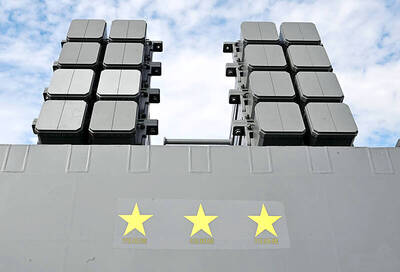
UPGRADE: The Kang Ding-class frigate is replacing its Chaparall missiles with Tien Chien II and Hua Yang VLS, which would provide it with long-range, 360° air defense Taiwan plans to produce 1,200 to 1,376 Hai Chien II missiles (海劍二, Sea Sword II) — also known as TC-2N — to serve as the standard air defense system of the navy’s surface combatant fleet, a source said yesterday. Last week, the Hai Chien II, the naval version of the Tien Kung II missile (天劍二, Sky Sword II), completed a live-fire test in waters off the National Chungshan Institute of Science and Technology’s Jiupeng facility (九鵬) in Pingtung County’s Manjhou Township (滿州). The MIM72 Chaparral and other dated air defense missiles that currently arm Taiwanese ships have inadequate range to combat Chinese

REASONS FOR TRAVEL: An assistant professor said that proposed amendments to penalize drivers if they used drugs overseas would not deter people from traveling People who operate a motor vehicle under the influence of marijuana would have their driver’s license revoked, even if they used the substance while overseas, the Ministry of Transportation and Communications said yesterday, citing proposed amendments to the Road Traffic Management and Penalty Act (道路交通管理處罰條例). The amendments would also authorize the government to revoke the licenses of people determined to have used Category 1 or Category 2 narcotics, even if they were not operating a vehicle while under the influence of drugs, as well as ban them from taking the license test for three years, the ministry said. People aged 18 or

HEAVY WEATHER: Typhoon Jangmi is due to crash straight into the Ryukyus as airlines look to shift flights to larger aircraft or cancel flights to Okinawa entirely Taiwan’s international air carriers announced flight adjustments over the weekend as Typhoon Jangmi is forecast to hit the Ryukyu Islands today and tomorrow. The Central Weather Administration (CWA) upgraded Jangmi from a tropical storm to a typhoon at 8am yesterday, with the eye located 580km south of Naha city. It was moving north at 19kph. Today, China Airlines’ CI-120, CI-121, CI-122 and CI-123 flights between Taoyuan and Naha, Okinawa, have been canceled as well as CI-132 and CI-133 between Kaohsiung and Naha. EVA Air’s BR-112, BR-113, BR-186 and BR-185 flights between Taoyuan and Naha are also canceled. Low-cost carrier Tigerair Taiwan canceled IT-230,
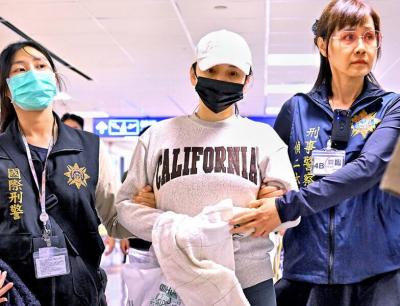
Johanne Liou (劉喬安), a Taiwanese woman who shot to unwanted fame during the Sunflower movement protests in 2014, returned to Taiwan last night after being deported from the US. She is to stand trial in Taiwan for charges involving embezzlement, fraud and drug crimes. The Criminal Investigation Bureau (CIB) said it took her into custody at Taiwan Taoyuan International Airport and would first question her before transferring her to the New Taipei District Prosecutors’ Office. She was arrested upon disembarking a flight from San Francisco that landed shortly before 7pm. Liou absconded to the US in 2019 after jumping bail


 RSS
RSS