


The Democratic Progressive Party (DPP) yesterday criticized the Chinese Nationalist Party (KMT) over the government’s failure to fulfill its promise to end compulsory military service and replace it with an all-volunteer military.
Following an announcement by the Ministry of National Defense that the plan to terminate compulsory military service by the end of next year, and to exempt Taiwanese males born after 1993 from military duty would be postponed due to an insufficient number of recruits, the DPP said the government’s failure was due to its attempt to use the issue to win votes.
“There are pluses and minuses in all recruiting systems, so if the KMT wants an all-volunteer military, it must come up with a solution for the decline in the nation’s birthrate,” DPP spokesperson Cheng Yun-peng (鄭運鵬) said at a press conference after the party’s weekly Central Standing Committee meeting.
“In the past few months, the goverment’s disorganized recruitment efforts have led to an insufficient number of combat soldiers,” he added.
The DPP has reminded the government several times that an all-volunteer military must be put in place only after careful consideration, but the KMT only uses the issue for electioneering and falsely accused the DPP of wanting to keep compulsory military service, Cheng said.
“The whole nation must now pay the price for the government’s immature attitude toward policymaking,” he added.
Reform of the recruiting system has already passed the point of no return, Cheng said, therefore, the DPP believes that a system that combines volunteers and recruits would be optimal.
The system must enable young people to pick up skills that they are able to use after they leave the military, so that young people would be more willing to join the services, Cheng said.
“The government promised to reform the military after some controversial incidents — such as the penalty system that led to the death of the army corporal Hung Chung-chiu (洪仲丘) in 2013, and the unauthorized visit by civilians to an army base housing helicopters — however, all the promises have become bounced checks,” Cheng said.
“This shows that the KMT government is unwilling and unable to deal with problems in the military,” he added.
Cheng said that the DPP has consulted with many military experts and has published blue books on national defense policies, and therefore would be more able to instigate effective reforms in the military.

More than half of the bamboo vipers captured in Tainan in the past few years were found in the city’s Sinhua District (新化), while other districts had smaller catches or none at all. Every year, Tainan captures about 6,000 snakes which have made their way into people’s homes. Of the six major venomous snakes in Taiwan, the cobra, the many-banded krait, the brown-spotted pit viper and the bamboo viper are the most frequently captured. The high concentration of bamboo vipers captured in Sinhua District is puzzling. Tainan Agriculture Bureau Forestry and Nature Conservation Division head Chu Chien-ming (朱健明) earlier this week said that the

NAMING SPAT: The foreign ministry called on Denmark to propose an acceptable solution to the erroneous nationality used for Taiwanese on residence permits Taiwan has revoked some privileges for Danish diplomatic staff over a Danish permit that lists “Taiwan” as “China,” Eric Huang (黃鈞耀), head of the Ministry of Foreign Affairs’ Department of European Affairs, told a news conference in Taipei yesterday. Reporters asked Huang whether the Danish government had responded to the ministry’s request that it correct the nationality on Danish residence permits of Taiwanese, which has been listed as “China” since 2024. Taiwan’s representative office in Denmark continues to communicate with the Danish government, and the ministry has revoked some privileges previously granted to Danish representatives in Taiwan and would continue to review
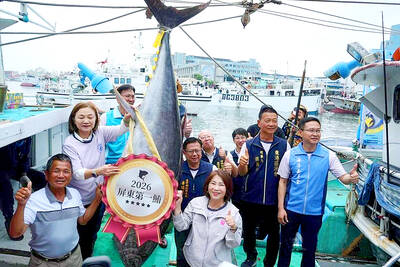
The first bluefin tuna of the season, brought to shore in Pingtung County and weighing 190kg, was yesterday auctioned for NT$10,600 (US$333.5) per kilogram, setting a record high for the local market. The auction was held at the fish market in Donggang Fishing Harbor, where the Siaoliouciou Island-registered fishing vessel Fu Yu Ching No. 2 delivered the “Pingtung First Tuna” it had caught for bidding. Bidding was intense, and the tuna was ultimately jointly purchased by a local restaurant and a local company for NT$10,600 per kilogram — NT$300 ,more than last year — for a total of NT$2.014 million. The 67-year-old skipper

China has reserved offshore airspace over the Yellow Sea and East China Sea from March 27 to May 6, issuing alerts that are usually used to warn of military exercises, although no such exercises have been announced, the Wall Street Journal (WSJ) reported on Sunday. Reserving such a large area for 40 days without explanation is an “unusual step,” as military exercises normally only last a few days, the paper said. The alerts, known as notice to air missions (NOTAMs), “are intended to inform pilots and aviation authorities of temporary airspace hazards or restrictions,” the article said. The airspace reserved in the alert


 RSS
RSS