


Environmental groups and residents of Kaohsiung’s Siaogang District (小港) yesterday rallied in front of Kaohsiung City Hall to protest against the ash they said had blown into their community from a China Steel Corp iron ore storage site.
Dozens of protesters assembled in front of the city hall in the morning, holding placards and covering their hands with ash that they said had blown from the company’s Siaogang District outdoor iron ore storage site into their homes.
The protesters demanded that Kaohsiung Mayor Chen Chu (陳菊) order the company to construct roofed storehouses to curb the ash leaking into the atmosphere, as Taichung Mayor Lin Chia-lung (林佳龍) has done in his city.
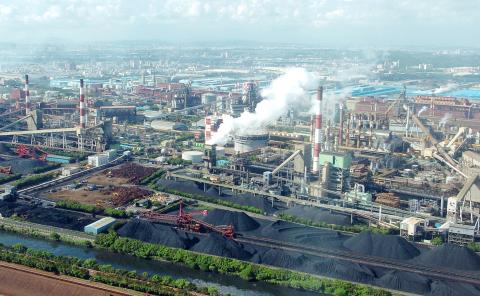
Photo: Chang Chung-yi, Taipei Times
In Taichung, following the passage of a city statute regulating the storage of coal, Taichung-based Dragon Steel Corp — a subsidiary of China Steel — recently announced a NT$9 billion (US$275.5 million) project to construct enclosed depositories to store its bituminous coal.
“Lin Chia-lung did it. Can Chen Chu do it?” Fight for Health Women’s Group Kaohsiung Chapter director Hung Hsiu-chu (洪秀菊) said.
The airborne ash contains carcinogenic PM2.5 dust — airborne articles measuring 2.5 micrometers or less — which is detrimental to the respiratory system, Hung said, demanding that China Steel should be forced to relocate if it does not make the improvements.
Kaohsiung Healthy Air Alliance director Huang Yi-ying (黃義英) said that airborne ash from the China Steel facility has plagued Siaogang residents for a long time, and black, oily, shiny dust can be found in their homes, especially when the northeast monsoon wind is blowing in the winter.
Kaohsiung Environmental Protection Bureau Senior Specialist Yang Hung-wen (楊宏文) said that China Steel would face fines if the ash collected by the residents originated at the company’s storage site, adding that the bureau would test dust samples collected at the site and its environs shortly.
Yang said that China Steel is legally required to control the amount of airborne ash, and if the company’s dust collection system is insufficient to stem the emission of ash, it has to work toward building enclosed storage sites.
However, China Steel said that a test conducted this April that compared the company’s ore ash with the dust collected by residents found that they were different substances.
China Steel said it has established 20m-high dust collecting nets and an automatic sprinkler system at the site, and it has sprayed stabilizers and taken other preventive measures, adding that it has contained 96 percent of airborne ash emissions.
The company said it is working toward constructing roofed depositories in the future, but it could not give a definite timetable given the enormity of the project.
China Steel said it is willing to commission a third party to conduct another test when the northeast monsoon is at its height to test the protesters’ claims.

SECURITY: Starlink owner Elon Musk has taken pro-Beijing positions, and allowing pro-China companies to control Taiwan’s critical infrastructure is risky, a legislator said Starlink was reluctant to offer services in Taiwan because of the nation’s extremely high penetration rates in 4G and 5G services, the Ministry of Digital Affairs said yesterday. The ministry made the comments at a meeting of the legislature’s Transportation Committee, which reviewed amendments to Article 36 of the Telecommunications Management Act (電信管理法). Article 36 bans foreigners from holding more than 49 percent of shares in public telecommunications networks, while shares foreigners directly and indirectly hold are also capped at 60 percent of the total, unless specified otherwise by law. The amendments, sponsored by Chinese Nationalist Party (KMT) Legislator Ko

The eastern extension of the Taipei MRT Red Line could begin operations as early as late June, the Taipei Department of Rapid Transit Systems said yesterday. Taipei Rapid Transit Corp said it is considering offering one month of free rides on the new section to mark its opening. Construction progress on the 1.4km extension, which is to run from the current terminal Xiangshan Station to a new eastern terminal, Guangci/Fengtian Temple Station, was 90.6 percent complete by the end of last month, the department said in a report to the Taipei City Council's Transportation Committee. While construction began in October 2016 with an

NON-RED SUPPLY: Boosting the nation’s drone industry is becoming increasingly urgent as China’s UAV dominance could become an issue in a crisis, an analyst said Taiwan’s drone exports to Europe grew 41.7-fold from 2024 to last year, with demand from Ukraine’s fight against Russian aggression the most likely driver of growth, a study showed. The Institute for Democracy, Society and Emerging Technology (DSET) in a statement on Wednesday said it found that many of Taiwan’s uncrewed aerial vehicle (UAV) sales were from Poland and the Czech Republic. These countries likely transferred the drones to Ukraine to aid it in its fight against the Russian invasion that started in 2022, it said. Despite the gains, Taiwan is not the dominant drone exporter to these markets, ranking second and fourth

Japanese Prime Minister Sanae Takaichi’s comment last year on Tokyo’s potential reaction to a Taiwan-China conflict has forced Beijing to rewrite its invasion plans, a retired Japanese general said. Takaichi told the Diet on Nov. 7 last year that a Chinese naval blockade or military attack on Taiwan could constitute a “survival-threatening situation” for Japan, potentially allowing Tokyo to exercise its right to collective self-defense. Former Japan Ground Self-Defense Force general Kiyofumi Ogawa said in a recent speech that the remark has been interpreted as meaning Japan could intervene in the early stages of a Taiwan Strait conflict, undermining China’s previous assumptions


 RSS
RSS