


Chinese Nationalist Party (KMT) presidential candidate Hung Hsiu-chu’s (洪秀柱) campaign office yesterday announced the organization of a small group of “young” people to defend and promote her campaign pledges on political talk shows.
Voices of young supporters of Hung have long been underestimated on such shows, the office said.
“These young defenders, who were born in the 1970s and the 1980s, aim to shatter the public’s traditional perception of how the KMT runs an election,” Hung campaign office spokesman Lee Chang-chi (李昶志) told a news conference in Taipei.
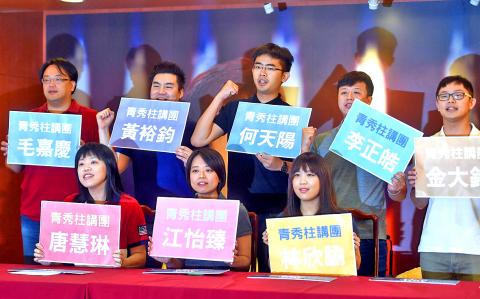
Photo: Fang Pin-chao, Taipei Times
Chanting “Chu [Hung] has young people’s backs and young people have hers,” the eight members of the group, clad in different colored shirts, told the news conference that the various colors signified the diversity of opinions of younger generations.
Hung spokesperson Hsu Chiao-hsin (徐巧芯) said that while the group’s members are young, they have experience in public affairs, are extremely eloquent and possess a unique perspective on current politics.
“They are to appear on political talk shows, preferably those deemed as leaning toward the pan-green camp, to advocate for the main principles of Hung’s campaign and to increase her recognition among voters,” Hsu said.
One of the eight, Mao Chia-ching (毛嘉慶) — who is deputy convener of the campaign office’s propaganda department — has a higher profile than the rest of the group because of his link to the recent “rain boots” scandal.
Political pundit Wang Shih-chi (王時齊) has said that Mao asked her to send a pair of name-brand rain boots to Democratic Progressive Party Chairperson Tsai Ing-wen (蔡英文) and to have Tsai photographed in them, in what Wang said was an apparent attempt to set-up the DPP’s presidential candidate.
“The silence of good people will only lead to the rise of the bad. Our society has been permeated with ill rumors that are spread and fabricated to intensify hatred and social divisions. I will not allow Taiwan to be torn like this,” Mao told yesterday’s news conference.
Another of the eight, Tang Hui-lin (唐慧琳), a research assistant at the KMT’s National Policy Foundation think tank, said the chaos caused by a media environment monopolized by political commentators was the main reason the group was formed.
“These so-called commentators spread worthless information every day to the public that is nothing but outright nonsense. We, the younger generation, can no longer stomach this phenomenon and have decided to step up,” Tang said.

SECURITY: Starlink owner Elon Musk has taken pro-Beijing positions, and allowing pro-China companies to control Taiwan’s critical infrastructure is risky, a legislator said Starlink was reluctant to offer services in Taiwan because of the nation’s extremely high penetration rates in 4G and 5G services, the Ministry of Digital Affairs said yesterday. The ministry made the comments at a meeting of the legislature’s Transportation Committee, which reviewed amendments to Article 36 of the Telecommunications Management Act (電信管理法). Article 36 bans foreigners from holding more than 49 percent of shares in public telecommunications networks, while shares foreigners directly and indirectly hold are also capped at 60 percent of the total, unless specified otherwise by law. The amendments, sponsored by Chinese Nationalist Party (KMT) Legislator Ko
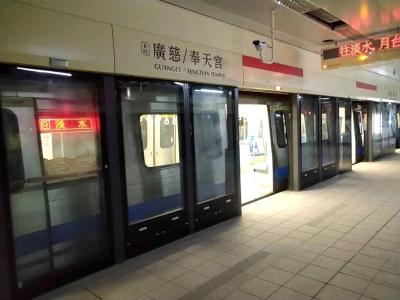
The eastern extension of the Taipei MRT Red Line could begin operations as early as late June, the Taipei Department of Rapid Transit Systems said yesterday. Taipei Rapid Transit Corp said it is considering offering one month of free rides on the new section to mark its opening. Construction progress on the 1.4km extension, which is to run from the current terminal Xiangshan Station to a new eastern terminal, Guangci/Fengtian Temple Station, was 90.6 percent complete by the end of last month, the department said in a report to the Taipei City Council's Transportation Committee. While construction began in October 2016 with an
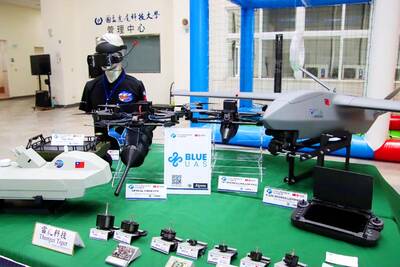
NON-RED SUPPLY: Boosting the nation’s drone industry is becoming increasingly urgent as China’s UAV dominance could become an issue in a crisis, an analyst said Taiwan’s drone exports to Europe grew 41.7-fold from 2024 to last year, with demand from Ukraine’s fight against Russian aggression the most likely driver of growth, a study showed. The Institute for Democracy, Society and Emerging Technology (DSET) in a statement on Wednesday said it found that many of Taiwan’s uncrewed aerial vehicle (UAV) sales were from Poland and the Czech Republic. These countries likely transferred the drones to Ukraine to aid it in its fight against the Russian invasion that started in 2022, it said. Despite the gains, Taiwan is not the dominant drone exporter to these markets, ranking second and fourth
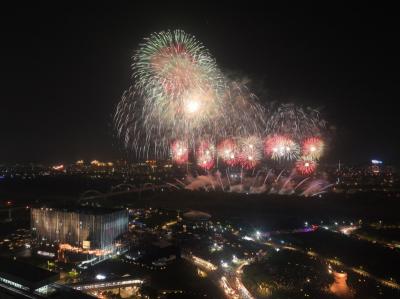
The New Taipei City Art Museum this weekend plans to celebrate its first anniversary with a two-day extravaganza featuring live concerts and a large-scale synchronized fireworks and drone display, the New Taipei City Cultural Affairs Department said. The two-day celebrations are to take place in the museum’s outdoor park, with markets and live performances by singers including Ann Bai (白安), Bii (畢書盡) and the Cosmos People (宇宙人), the department said. The highlight on both evenings would be the "Echoes of Light" show, an aerial spectacle combining fireworks and drone performances designed around the concept of "dual stages in the sky," it


 RSS
RSS