


A greater number of critically endangered Chinese crested terns, previously thought to be extinct, have been spotted in the Matsu archipelago, with their population expected to exceed 100 in the near future.
The Forestry Bureau said 13 adults and four chicks had been observed at tern conservation areas on the islands last month, contributing to a total of 75 adults and 24 chicks spotted this year at the species’ three known breeding sites.
The other two sites are the Jiushan Islands and the Wushishan Islands in China’s Zhejiang Province.
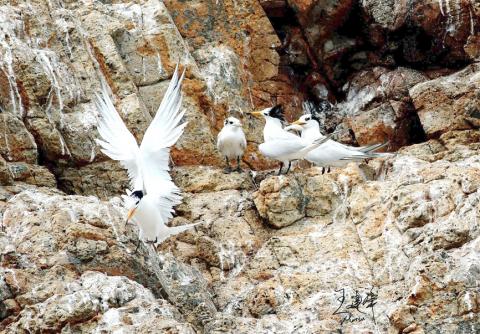
Photo provided by Wang Chien-hua
It was the first time in three years that chicks had been seen in the Matsu islands, the bureau’s conservation official Hsia Jung-sheng (夏榮生) said.
Known for its white rump, pale grey mantle and the black-tipped bill, the species is among the most threatened varieties of seabird worldwide and the birds were assumed to be extinct until they were rediscovered on the Matsu archipelago in 2000, the bureau said.
The seabirds’ global population was estimated to be less than 50 prior to 2000, making the species rarer than the black-faced spoonbills, of which there are an estimated 3,000, the bureau said.
The rediscovery of the birds in 2000 was the first time their breeding activity had been recorded. They were not seen elsewhere until 2004, when they were spotted on the Jiushan Islands, the bureau said.
Academics and birdwatchers regard the species as almost mythological because of their rarity and the difficulty of tracing them, the bureau said.
The Chinese crested tern was designated “critically endangered” on the International Union for Conservation of Nature’s Red List of Threatened Species in 2012 and is classified as an endangered species on Taiwan’s three-category wildlife protection list.
The bureau teamed up with the Lienchiang County Government and National Taiwan University (NTU) in 2010 to conserve and study the birds, the bureau said, adding that a research team led by NTU professor Yuan Hsiao-wei (袁孝維) found that populations at the three breeding sites interact with each other.
To attract terns of different species and boost breeding, the research team and Wild Bird Society of Taipei have positioned models of greater crested terns and decoys on islets around Matsu, which has encouraged favorable breeding conditions since 2011.
The conservation areas were expanded this year, with Tiejian Island (鐵尖島) being the main conservation site with the highest density, which saw nearly 3,000 greater crested terns and 10 Chinese crested terns coming to the area in May, the bureau said.
“A total of 4,000 adults and nearly 1,000 chicks of the greater crested tern and 13 adults and four chicks of the Chinese crested tern have been seen as of last month, which suggests successful conservation efforts,” the bureau said.

The military has spotted two Chinese warships operating in waters near Penghu County in the Taiwan Strait and sent its own naval and air forces to monitor the vessels, the Ministry of National Defense (MND) said. Beijing sends warships and warplanes into the waters and skies around Taiwan on an almost daily basis, drawing condemnation from Taipei. While the ministry offers daily updates on the locations of Chinese military aircraft, it only rarely gives details of where Chinese warships are operating, generally only when it detects aircraft carriers, as happened last week. A Chinese destroyer and a frigate entered waters to the southwest

A magnitude 6.1 earthquake struck off the coast of Yilan County at 8:39pm tonight, the Central Weather Administration (CWA) said, with no immediate reports of damage or injuries. The epicenter was 38.7km east-northeast of Yilan County Hall at a focal depth of 98.3km, the CWA’s Seismological Center said. The quake’s maximum intensity, which gauges the actual physical effect of a seismic event, was a level 4 on Taiwan’s 7-tier intensity scale, the center said. That intensity level was recorded in Yilan County’s Nanao Township (南澳), Hsinchu County’s Guansi Township (關西), Nantou County’s Hehuanshan (合歡山) and Hualien County’s Yanliao (鹽寮). An intensity of 3 was

Japanese Prime Minister Sanae Takaichi’s comment last year on Tokyo’s potential reaction to a Taiwan-China conflict has forced Beijing to rewrite its invasion plans, a retired Japanese general said. Takaichi told the Diet on Nov. 7 last year that a Chinese naval blockade or military attack on Taiwan could constitute a “survival-threatening situation” for Japan, potentially allowing Tokyo to exercise its right to collective self-defense. Former Japan Ground Self-Defense Force general Kiyofumi Ogawa said in a recent speech that the remark has been interpreted as meaning Japan could intervene in the early stages of a Taiwan Strait conflict, undermining China’s previous assumptions

Taiwan Railways Corp (TRC) today announced that Shin Kong Mitsukoshi has been selected as the preferred bidder to operate the Taipei Railway Station shopping mall, replacing the current operator, Breeze Development Co Ltd. Among eight qualified firms that delivered presentations and were evaluated by a review committee, Shin Kong Mitsukoshi was ranked first, while Breeze was named the runner-up, the rail company said in a statement. Contract negotiations are to proceed in accordance with regulations, it said, adding that if negotiations with the top bidder fail, it could invite the second-ranked applicant to enter talks. Breeze in a statement today expressed doubts over


 RSS
RSS