


Chinese dissident Gong Yujian (龔與劍), who supported the Tiananmen democratic movement in 1989 and came to Taiwan with a tour group late last month, is said to have sought political asylum in the nation.
The news was first broadcast by Radio Free Asia on Monday, through which 38-year-old Gong said he has decided to seek political asylum in Taiwan after more than 20 years of harassment and threats from Chinese security agencies.
Taiwan Association for China Human Rights chairman Yang Hsien-hung (楊憲宏), who worked with the Taiwan Association for Human Rights in assisting Gong to stay and seek asylum, told the Taipei Times that Gong has met Wuer Kaixi and Yan Peng (燕鵬), two other exiled Chinese dissidents in the nation, and the two have confirmed Gong’s status as a person subjected to political persecution.
“Gong has brought documents with him, including arrest warrants,” Yang said.
Gong supported the Tiananmen democratic movement as a 12-year-old by helping students hand out the fliers and putting up posters calling for democracy, according to the Radio Free Asia interview. He continued to put up posters demanding justice for the protesting students and revealing the violent oppression of the government against the students after the crackdown, and was arrested in 1994.
Gong was sent to a labor camp for a year and three months on “anti-revolution” charges. He continued to suffer police harassment, intimidation and surveillance afterward, Yang said.
“He told me that he would rather stay in a Taiwanese prison than be frightened in China,” Yang said.
“A refugee law is still needed in Taiwan, and also an amendment to Article 17 of the Act Governing Relations between the People of the Taiwan Area and the Mainland Area (臺灣地區與大陸地區人民關係條例), which is the refugee clause for Chinese [as the ROC does not see them as foreigners],” Yang said. “It is actually demanded by two international human rights conventions, that our government has ratified.”
“We are calling on the government to view Gong as a special case, as it did with the nine Chinese dissidents who were recently granted refugee status, Yang said, adding that the administration of President Ma Ying-jeou (馬英九) should not repatriate Gong.
“Gong has already made statements in the media denouncing the Chinese government, calling it a gang of robbers and scammers. It would be life-threatening if he is sent back to China,” Yang said. “Repatriating Gong would be against human rights conventions and set a bad precedent of caving in to Beijing’s pressure and hurting Taiwan’s dignity as a sovereign nation.”
National Immigration Agency official Hsu Chien-lin (徐健麟) said the agency had not received Gong’s application for asylum as of yesterday, adding that it would have the Mainland Affairs Council deal with the application as a special case.
“An evaluation on whether the case can be identified as one seeking political asylum has to be done,” he said, adding that each case is different when asked whether Gong would be repatriated.
In response to the Taipei Times’ request for comment, the council said last night there is a set mechanism in place for Chinese who seek asylum in Taiwan.
“According to the regulations [governing the long-term residence of Chinese], they can apply for long-term residence on the basis of political consideration, and a review team on the case would be convened by the Ministry of the Interior,” it said, adding that the immigration agency has so far not received the application from the person reported by the media.

LOUD AND PROUD Taiwan might have taken a drubbing against Australia and Japan, but you might not know it from the enthusiasm and numbers of the fans Taiwan might not be expected to win the World Baseball Classic (WBC) but their fans are making their presence felt in Tokyo, with tens of thousands decked out in the team’s blue, blowing horns and singing songs. Taiwanese fans have packed out the Tokyo Dome for all three of their games so far and even threatened to drown out home team supporters when their team played Japan on Friday. They blew trumpets, chanted for their favorite players and had their own cheerleading squad who dance on a stage during the game. The team struggled to match that exuberance on the field, with
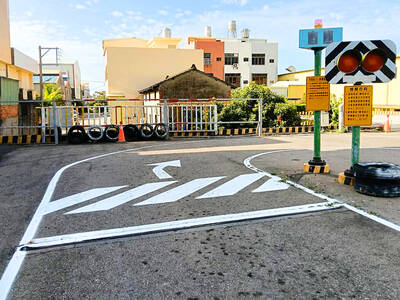
UPDATED TEST: The new rules aim to assess drivers’ awareness of risky behaviors and how they respond under certain circumstances, the Highway Bureau said Driver’s license applicants who fail to yield to pedestrians at intersections or to check blind spots, or omit pointing-and-calling procedures would fail the driving test, the Highway Bureau said yesterday. The change is set to be implemented at the end of the month, and is part of the bureau’s reform of the driving portion of the test, which has been criticized for failing to assess whether drivers can operate vehicles safely. Sedan drivers would be tested regarding yielding to pedestrians and turning their heads to check blind spots, while drivers of large vehicles would be tested on their familiarity with pointing-and-calling

Whether Japan would help defend Taiwan in case of a cross-strait conflict would depend on the US and the extent to which Japan would be allowed to act under the US-Japan Security Treaty, former Japanese minister of defense Satoshi Morimoto said. As China has not given up on the idea of invading Taiwan by force, to what extent Japan could support US military action would hinge on Washington’s intention and its negotiation with Tokyo, Morimoto said in an interview with the Liberty Times (sister paper of the Taipei Times) yesterday. There has to be sufficient mutual recognition of how Japan could provide

A Taiwanese man apologized on Friday after saying in a social media post that he worked with Australia to provide scouting reports on Taiwan’s team, enabling Australia’s victory in this year’s World Baseball Classic (WBC), saying it was a joke and that he did not hold any position with foreign teams or Taiwan’s sports training center. Chen Po-hao (陳柏豪) drew the rage of many Taiwan baseball fans when he posted online on Thursday night, claiming credit for Australia’s 3-0 win over Taiwan in the opening game for Pool C, saying he worked as a physical therapist with the national team and


 RSS
RSS