


From her musical virtuosity and exuberant performance at the star-studded award ceremony of the Special Olympics in Los Angeles on Thursday one might not guess that Taiwanese-American musician Maki Hsieh (謝明錦) was born with a hearing impairment and lives largely in a world of vibration.
Hsieh showcased her diverse artistry as she alternated between playing an orchestral piece with an electric LED violin; singing a gospel rendition of Lean On by Major Lazer; performing a piano piece and soloing an electronic opera song for a choreographed dance troupe and artists who did portraits of her during the performance.
“My shows are not just about me playing music but integrating visual and dance elements to create a unifying synergistic immersible soundscape for the audience,” Hsieh said in an e-mail interview with the Taipei Times.
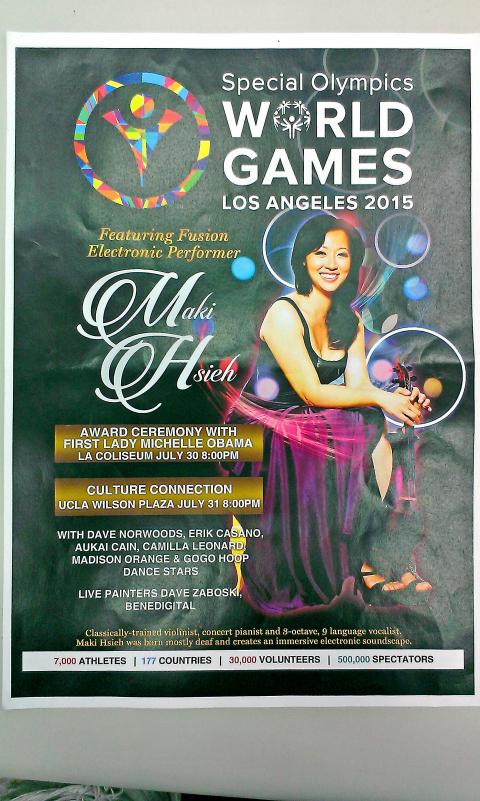
Photo Courtesy of Maki Hsieh
She was one of 30 performers chosen from 17,000 applicants to perform at the ceremony officiated by the US’ first lady, Michelle Obama.
Hsieh’s ambition to unify different art forms is a message about overcoming obstacles and boundaries that resounded through much of the Special Olympics — the world’s largest sports event for athletes with disabilities and an occasion where all athletes come together to work as a team.
In this year’s Games, a total of 52 athletes from Taiwan’s team are to compete in a variety of categories including figure-skating, short-track speed skating, swimming and table tennis.
Hsieh said that part of her genre-defying original electronica can be explained by the way she hears and perceives the world.
The daughter of a Taiwanese father and Japanese-American mother, Hsieh was born deaf in her right ear and partially deaf in her left ear.
She was an irritable and fiery child until she found a way to express herself and communicate by playing piano — the instrument’s vibration became a source of joy for her, she said.
She started classical training when she was four and struggled to associate the sheet music with the piano keys and the sound, but her sensitivity to vibrations and frequency helped her train to become a pianist, violinist and three-octave vocalist.
She later moved from Taiwan to the US and studied pre-med at Johns Hopkins University and trained at Peabody Conservatory with famed violinist Berl Senofsky. She decided against pursuing a music career, as she was discouraged by “the low number of Asians succeeding in mainstream entertainment or even the classical music industry.”
However, after ending her corporate career at Walt Disney, Thomson Reuters and Deutsche Bank, Hsieh re-entered the music scene in 2013 with her debut single Kyoto; a dub-step piece produced by US DJ Skrillex who mixed electric violin and soprano vocals with pulsating beats. The song was number one on the Los Angeles, National and Global ReverbNation charts for five weeks.
Hsieh said her transition from classical music to a fusion artist was because classical music has lost its edge in US mainstream culture because of its perceived lack of creativity and urgency, while “true value is found in intelligent innovation.”
She has Senofsky’s teaching in mind when she shapes her music and performance: “Sensuality is harnessing all of your senses and your job is to evoke sensuality. Each person should feel something or you failed as an artist, as a human being.”
She said that she wants her music to be electric and capable of producing a danceable rhythm and sensual appeal, which accounts for her experimentation with other electronic sub-genres and cooperation with artists from other disciplines.
“Music is emotion in motion and dance is the visual representation of this sonic poetry. What I really love is feeling the beat. It’s not only because of the way I hear and how bass is critical in helping me enjoy music but also because I love seeing people connect within a community in our synergy between dance and music,” she said.
She believed her re-entry to the music scene with fusion electronics is in the right place at the right time — the US audience is tuned into electronic music now more than ever — as shown by the recent success of the Swedish EDM group, Swedish House Mafia and French electronic music duo Daft Punk.
“The advent of iPhone and iPad allows people to access, sample and curate sounds more easily,” she said.
She envisions her future performances will integrate traditional sounds like Taiko drums and Chinese ribbon dancers using fiber-optic light ribbons, so her music can be visual and convey feeling, she said.
Hsieh said her artistic vision of uniting art with technology was ingrained in her family heritage and Taiwanese culture.
Her successful entrepreneur father moved with technology trends when Taiwan was changing from semi-conductors to RAM, she said, adding: “The quest our [Taiwanese] culture has for uncharted territory against all odds is buried in our DNA.”
“Taipei is the city most poised to lead the region and I’m confident that a paradigm in unifying arts and science can create not only great music but also a new Renaissance in Asia. When we each fulfill our purpose as visionary artists and claim our destiny as messengers connecting people with infinite possibilities, walls come down and bridges are built.”

Kenting National Park service technician Yang Jien-fon (楊政峰) won a silver award in World Grand Prix Photography Awards Spring Season for his photograph of two male rat snakes intertwined in combat. Yang’s colleagues at Kenting National Park said he is a master of nature photography who has been held back by his job in civil service. The awards accept entries in all four seasons across six categories: architectural and urban photography, black-and-white and fine art photography, commercial and fashion photography, documentary and people photography, nature and experimental photography, and mobile photography. Awards are ranked according to scores and divided into platinum, gold and

More than half of the bamboo vipers captured in Tainan in the past few years were found in the city’s Sinhua District (新化), while other districts had smaller catches or none at all. Every year, Tainan captures about 6,000 snakes which have made their way into people’s homes. Of the six major venomous snakes in Taiwan, the cobra, the many-banded krait, the brown-spotted pit viper and the bamboo viper are the most frequently captured. The high concentration of bamboo vipers captured in Sinhua District is puzzling. Tainan Agriculture Bureau Forestry and Nature Conservation Division head Chu Chien-ming (朱健明) earlier this week said that the
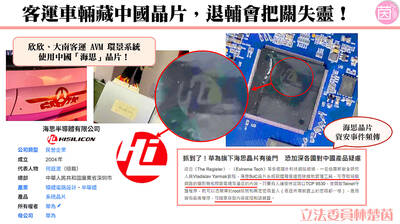
BREACH OF CONTRACT: The bus operators would seek compensation and have demanded that the manufacturer replace the chips with ones that meet regulations Two bus operators found to be using buses with China-made chips are to demand that the original manufacturers replace the systems and provide compensation for breach of contract, the Veterans Affairs Council said yesterday. Democratic Progressive Party Legislator Michelle Lin (林楚茵) yesterday said that Da Nan Bus Co and Shin-Shin Bus Co Ltd have fielded a total of 82 buses that are using Chinese chips. The bus models were made by Tron-E, while the systems provider was CYE Electronics, Lin said. Lin alleged that the buses were using chips manufactured by Huawei subsidiary HiSilicon Co, which presents a national security risk if the

The National Immigration Agency has banned two Chinese from returning to Taiwan, after they published social media content it described as disrespectful to national sovereignty. The agency imposed a two-month ban on a Chinese man surnamed Liang (梁) and a permanent ban on a woman surnamed Yang (楊), an influencer with 23 million followers, in October last year and last week respectively. Minister of the Interior Liu Shyh-fang (劉世芳) yesterday said on the sidelines of a legislative meeting that Chinese visitors to Taiwan are required to comply with the rules and regulations governing their entry permits. The government has handled the ban and


 RSS
RSS