


Both Beijing and President Ma Ying-jeou’s (馬英九) administration have disgraced themselves as their denouncements of former president Lee Teng-hui (李登輝) indicate their “outdated ways of thinking,” former representative to Japan Koh Se-kai (許世楷) said yesterday.
China’s Ministry of Foreign Affairs and Taiwan Affairs Office on Friday made hard-hitting comments about Lee’s visit to Japan, on the heels of Presidential Office spokesperson Charles Chen’s (陳以信) statement earlier that day that Lee had “humiliated” the nation and “forfeited its sovereignty” when he said that the disputed Diaoyutai Islands (釣魚台), known as the Senkakus in Japan, belong solely to Japan. The islands are claimed by Taiwan, China and Japan.
Lee reiterated his position on the issue when answering questions at a meeting at the Foreign Correspondents’ Club of Japan in Tokyo on Thursday.
In a press release, Chinese Ministry of Foreign Affairs spokesman Lu Kang (陸慷) called Lee a “stubborn Taiwan splittist” and condemned Tokyo for assisting his visit and becoming involved in Taiwan separatist activities despite the objections of Beijing.
Saying that the Taiwan issue concerns China’s “core interests,” Lu urged Japan to stick to the “one China” policy and abide by the political principles stated in their bilateral political documents, including the Japan-China Joint Communique of 1972, to “refrain from creating a new political barrier for the two countries.”
Late on Friday night, Taiwan Affairs Office spokesperson Ma Xiaoguang (馬曉光) said China opposes any country providing a political platform for Taiwan separatist activities.
Ma Xiaoguang echoed Chen’s condemnation of Lee over the issue of the Diaoyutai Islands while also joining the Chinese Nationalist Party’s (KMT) presidential candidate Hung Hsiu-chu (洪秀柱) and the party’s spokesperson Lin Yi-hua (林奕華) in castigating Lee for his remarks that “glamorized Japan’s colonial rule in Taiwan.”
Lee’s “despicable” behavior shows that forces advocating Taiwan independence have caused “extreme harm” to peaceful development of cross-strait relations and to the interests of zhonghua minzu (中華民族, people of Chinese ethnicity), which will surely be “spat on by compatriots from both sides,” Ma Xiaoguang said.
Koh, who was the nation’s representative to Japan from 2004 to 2008 under the Democratic Progressive Party administration, yesterday said that Beijing has “overreacted” to Lee’s visit.
“Former president Lee has been out of office for more than 15 years. As an ordinary citizen, he should not be subject to any limits on overseas visits. China is such a big country. How could it be so small-minded?” Koh said.
The way Ma’s administration, the KMT and Beijing reacted to Lee’s visit, during which he advocated the values of democracy, mutual respect and the rule of law, was a manifestation of their lack of understanding of values that have been universally embraced in the modern era, Koh said.
Koh said the development of human rights has long arrived at a point where people have the right to decide their own place in the international order, while the KMT and the Chinese regimes still adhere to a kind of nationalism that dates back to the eighteen century.
“Zhonghua minzu has never existed at all,” Koh said. “It is the right of the people in Taiwan, Xinjiang and Tibet to decide their destinies irrespective of a concept created by China aimed at enforcing its territorial and political borders.”
As the US has actively sought to become a stronger presence in Asia and with its alliance with Japan being the cornerstone of its policy in the region, mainly in response to China’s growing assertiveness, what Lee has proposed in Tokyo would greatly benefit Taiwan, Koh said.
“Taiwan has to ally itself with the US and Japan to reject China’s planned annexation,” he said.
When asked to comment specifically on Beijing’s denouncement of the former president, the Mainland Affairs Council avoided a direct response, saying only that the Republic of China’s (ROC) claim over the Diaoyutai Islands should be respected by all parties so the dignity of the nation can be upheld.
Separately yesterday, KMT Chairman Eric Chu (朱立倫) said he disapproved of the assertion of Lee that the Diaoyutai Islands are rightfully Japan’s.
The Diaoyutais and all the islands in the South China Sea are integral territory of the ROC, Chu said.
“I would never concur with the view that the Diaoyutai Islands and South China Sea islands do not belong to the ROC no matter who is behind the contention,” Chu said.


UPGRADE: The Kang Ding-class frigate is replacing its Chaparall missiles with Tien Chien II and Hua Yang VLS, which would provide it with long-range, 360° air defense Taiwan plans to produce 1,200 to 1,376 Hai Chien II missiles (海劍二, Sea Sword II) — also known as TC-2N — to serve as the standard air defense system of the navy’s surface combatant fleet, a source said yesterday. Last week, the Hai Chien II, the naval version of the Tien Kung II missile (天劍二, Sky Sword II), completed a live-fire test in waters off the National Chungshan Institute of Science and Technology’s Jiupeng facility (九鵬) in Pingtung County’s Manjhou Township (滿州). The MIM72 Chaparral and other dated air defense missiles that currently arm Taiwanese ships have inadequate range to combat Chinese
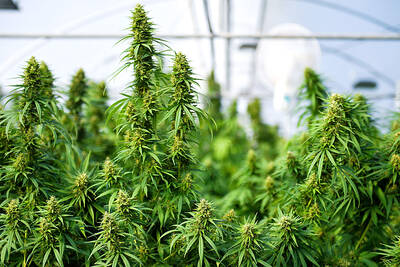
REASONS FOR TRAVEL: An assistant professor said that proposed amendments to penalize drivers if they used drugs overseas would not deter people from traveling People who operate a motor vehicle under the influence of marijuana would have their driver’s license revoked, even if they used the substance while overseas, the Ministry of Transportation and Communications said yesterday, citing proposed amendments to the Road Traffic Management and Penalty Act (道路交通管理處罰條例). The amendments would also authorize the government to revoke the licenses of people determined to have used Category 1 or Category 2 narcotics, even if they were not operating a vehicle while under the influence of drugs, as well as ban them from taking the license test for three years, the ministry said. People aged 18 or
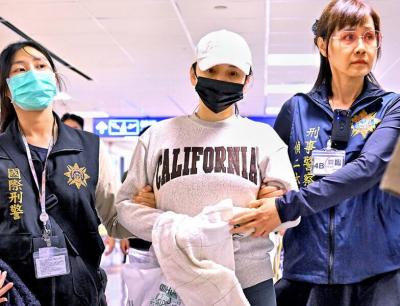
Johanne Liou (劉喬安), a Taiwanese woman who shot to unwanted fame during the Sunflower movement protests in 2014, returned to Taiwan last night after being deported from the US. She is to stand trial in Taiwan for charges involving embezzlement, fraud and drug crimes. The Criminal Investigation Bureau (CIB) said it took her into custody at Taiwan Taoyuan International Airport and would first question her before transferring her to the New Taipei District Prosecutors’ Office. She was arrested upon disembarking a flight from San Francisco that landed shortly before 7pm. Liou absconded to the US in 2019 after jumping bail
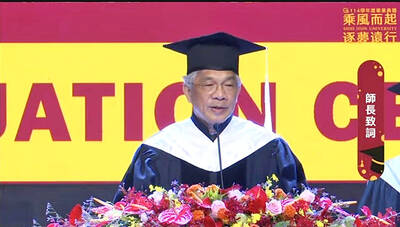
Shih Hsin University President Chen Ching-he (陳清河) yesterday issued a public apology for comments made in his commencement speech last week, stating that he has asked the school to suspend his duties and halt his wages for two months as a show of contrition. At the commencement ceremony on May 30, Chen said, “If you don’t manage your time well, or your own emotions, or your health, then I am telling every one of you — put a quick end to ‘you,’ because the world has no need for ‘you.’” The comments have sparked significant controversy online, and Chen through an open


 RSS
RSS