

The Environmental Protection Administration (EPA) debuted an upgraded version of its environmental survey vehicle and its high-altitude air sampling technology on the outlying islands of Penghu County.
EPA Environmental Analysis Laboratory Acting Director Yen Chun-lan (顏春蘭) said the vehicle, donated by Delta Electronics last year, uses a soft chemical ionization proton transfer reaction time-of-flight spectrometer, which can monitor more than 300 gaseous pollutants that have the ability to bind with oxonium ions using.
The pollutants include volatile organic compounds, inorganic gases and a range of odorous substances, which make up the majority of gaseous pollutants, she said.
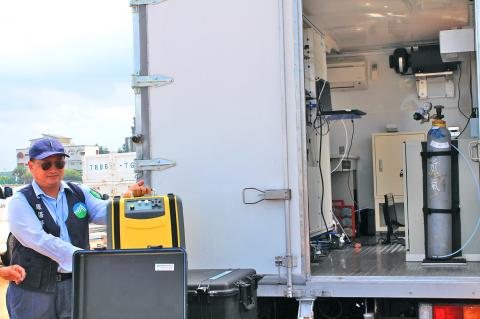
Photo: Sean Lin, Taipei Times Photo: Sean Lin, Taipei Times Sean Lin, Taipei Times
The vehicle also boasts quick sample analysis — capable of yielding results in less than 10 minutes — and can detect pollutants with concentrations as low as 0.01 parts per billion, Yen said.
The technology represents a major improvement on first-generation environmental survey vehicles, which can analyze about 56 pollutants and require up to one hour to produce results, she said.
The faster analysis would also speed up emergency response times to situations such as gas leaks, she said.
Other equipment on the vehicle includes a MS200 portable spectrometer and a Fourier transform infrared spectroscope (FTIR). Although both devices have a lower resolution than the chemical spectrometer, they can operate without an external power supply and can be used to detect escaping gases and pollutants in hard-to-reach areas, she said.
The FTIR uses an infrared spectrometer that shows the intensity of wavelengths projected by leaked gases, thereby identifying them, Yen said.
The equipment cost more than NT$15 million (US$479,202), she added.
The EPA deployed the vehicle close to the site of the recently Penghu Fireworks Festival in Magong City (馬公) to detect any surges in air pollutants caused by fireworks.
The results, produced between April 20 — the start of the festival — and June 15, showed margin increases in particulates under 10 micrometers, particulates under 2.5 micrometers and nitros oxide, which the EPA previously said were associated with fireworks.
The agency said that the phenomenon might be due to the high altitude at which fireworks explode, as environmental survey vehicles are usually monitor air quality near the ground.
The vehicle is to do an environmental surveillance mission at several industrial complexes and science parks, including Formosa Plastics Group’s naphtha cracker in Yunlin County, the Central Taiwan Science Park and Hsinchu Science Park, before being deployed in Kaohsiung, one of the municipalities most affected by air pollution, the EPA said.
Also debuted last month, the EPA’s high-altitude sampling technology, which uses a sampler attached to a balloon that can reach alttitudes of 700m to 1,000m to collect bacteria carried by air streams.
Laboratory researcher Yen Jung-hua (顏榮華) said that with the help of a high-speed motor, bacteria are sucked in by the sampler before falling on a petri dish where they are cultivated.
After bacterial colonies are formed, researchers conduct DNA sequencing to identify them, he said.
Comparing the results obtained in Penghu last month with others produced in New Taipei City’s Wanli District (萬里) between March and April 2013, when northeast monsoons blew across the nation, Yen said that there is no noticeable difference in the types of bacteria identified, and results from both tests showed bacteria commonly found in dirt and deserts.
So far, the laboratory has not detected any health risks associated with these types of bacteria, but would carry out more detailed analysis on days when northeast winds are strong to ascertain whether elevated concentrations of bacteria would affect people’s health, he said.
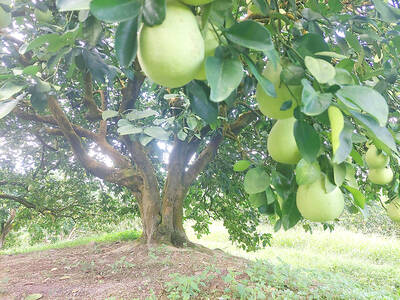
A Hualien pomelo farmer refused to sell to China after the country announced it would permit more Taiwanese pomelo imports, prompting widespread support from Taiwanese consumers, who rallied to buy his fruit. China’s Taiwan Affairs Office last month said that China’s General Administration of Customs registered an additional 79 Taiwanese pomelo orchards and packing facilities in Hualien County, allowing more Taiwanese producers to export pomelos to China. “I am a Hualien fruit farmer and I refuse to sell to China,” Liu Tzu-hao (劉子豪) from Ruisui Township (瑞穗) said in an online post. Liu is a well-known farmer in the community and has served
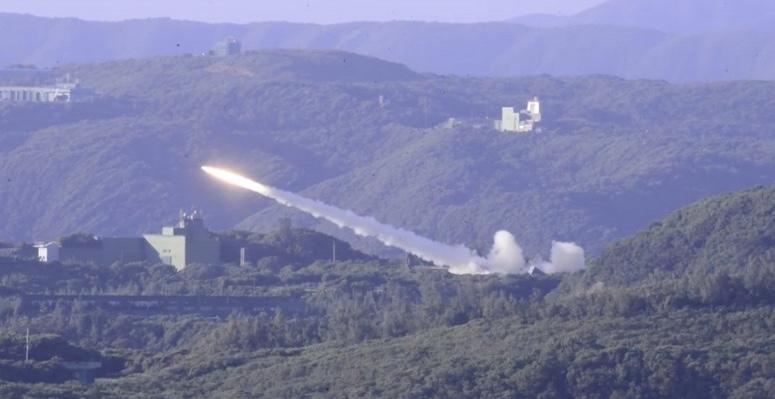
A Chinese military drone was spotted conducting reconnaissance off Taitung County as President William Lai (賴清德) visited Pingtung County this morning to inspect a drill of the armed forces’ precision-strike capabilities, prompting the military to closely monitor its actions. Today was the final day of a three-day military exercise at Jioupeng Base (九鵬基地) to test the joint combat capabilities of the armed forces and coast guard. The exercise began on Wednesday simulating air defense interception and yesterday tested long-range strike capabilities and new air defense weapons. This morning, the military conducted a final exercise involving air defense, anti-ship and drone operations. Military sources said
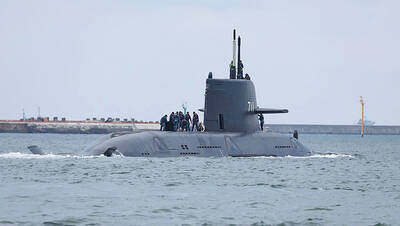
UPDATE: The submarine would need to undergo combined systems testing and crew training for navy personnel before it is ready for mission, an expert said Taiwan’s first domestically built submarine, the Hai Kun (Narwhal, 海鯤), could be delivered to the navy as early as next month, military expert and Taiwan Association for Security and Development chairman Chi Tung-yun (紀東昀) said yesterday. The submarine was yesterday morning observed departing for its 21st sea trial and its 15th submerged test. The vessel missed the initial delivery deadline of November last year due to “testing delays,” its primary contractor, shipbuilder CSBC Corp, Taiwan, said in June. The contractor also cited “political pressure from China” in procuring critical equipment. All testing operations are in the final stages, with the

OCT. 31: The antiviral drugs Tamiflu and Eraflu have been distributed to about 4,000 medical facilities nationwide for people in seven groups who develop flu-like symptoms As the domestic influenza epidemic enters its peak season and continues to escalate, the Centers for Disease Control (CDC) yesterday announced that publicly funded influenza antiviral drugs for seven eligible groups have been extended to Oct. 31, allowing those who develop flu-like symptoms to receive the medication without undergoing a rapid influenza test. The CDC has extended the expanded use of flu antiviral drugs to seven groups: healthcare and influenza-prevention personnel; residents and staff at nursing homes, long-term care facilities and similar institutions; kindergarten and daycare workers and home-based caregivers; students from kindergarten through high school, vocational high school and the


 RSS
RSS