


Young Taiwanese activists have tied themselves up in chains, blocked mountain roads, scaled fences and thrown red paint balloons in a wave of anti-China sentiment likely to turn politics on its head in January’s presidential election.
An energetic and fast-growing youth movement has been united in suspicion of economic and cultural dependence on China.
“When my generation comes of age, Taiwan’s cross-strait attitude is going to be very different,” student movement leader Huang Yen-ju said. “We want China to treat us like a country.”
President Ma Ying-jeou (馬英九) of the Chinese Nationalist Party (KMT) has signed a series of trade and economic pacts with China, though there have been no political talks and suspicions persist on both sides, especially in proudly democratic Taiwan.
Democratic Progressive Party (DPP) presidential candidate Tsai Ing-wen (蔡英文) is running about 10 percentage points ahead in opinion polls, but they can be inaccurate, particularly as her KMT rival has not been officially nominated and the elections are still months away.
Asked about the January election, a spokesman for China’s Taiwan Affairs Office said: “We welcome any Taiwanese party or person, as long as they oppose Taiwan independence.”
The trouble for China is that independence is exactly what Taiwan’s youth movement wants.
Taiwanese activists in their teens and 20s have taken to the streets en masse in recent months, brandishing banners, shouting slogans, scuffling with police and attempting to force their way into government offices.
The scale and duration, while small when compared with the pro-democracy demonstrations in Hong Kong, reflect the same fears about Beijing’s “one country, two systems” formula under which Hong Kong, a former British colony, returned to Chinese rule 18 years ago and which Beijing has suggested as a model for Taiwan.
“Throwing paint is a favorite tactic — it sends a vivid message, but isn’t hurting anyone,” said Chang Chao-lin (張兆林), head of the youth delegation of the Taiwan Solidarity Union (TSU).
Grievances range from the opening of Chinese flight paths over Taiwanese airspace to Taiwan’s application to join the Beijing-backed Asian Infrastructure Investment Bank and to planned changes to the national curriculum guidelines. These include labeling China “the mainland” and relegating significant events in recent Taiwanese history to sideshows, some students say.
In the latest outburst, Yu Teng-jay (游騰傑) threw balloons of red paint against the wall of the Ministry of Education in Taipei last week.
“These curriculum changes are slanted toward a Chinese view of the world,” Yu, 18, said.
Beijing has proclaimed youth outreach a critical plank of it plans for reconciliation, but China’s reputation among young Taiwanese appears to be in inexorable decline.
A main plank of Ma’s administration, a pact which would have opened much of Taiwan’s service sector to Chinese investment, sparked a three-week occupation of the legislative chamber by young activists last year.
The protest, dubbed the Sunflower movement, ignited a wave of demonstrations against the KMT and its amity to China.
Chang said youth was a new focus for the TSU, which uses social media to organize rallies, including one against a visiting Chinese official which led to scuffles and left one man with a dislocated arm.
This upheaval is spilling over into voting behavior, pollsters say.
In local elections last year, support among 20 to 29-year-olds for pro-independence parties saw a 10 percent rise over the previous election cycle, far outstripping a comparable boost among their elders, according to Academia Sinica.
The data also showed the proportion of young people calling themselves “Taiwanese” versus “Chinese” was the highest among all age brackets.
Similarly, in a hypothetical face-off between Tsai and her presumptive opponent, KMT hopeful Hung Hsiu-chu (洪秀柱), in next year’s elections, 20 and 30-somethings supported Tsai by a greater than 20 percent margin, a poll by local broadcaster TVBS showed.
“China clearly wants to take Taiwan, so why should we be more open toward them?” high-school student Fang Xin-jie, 17, asked. “It will only make us more dependent.”

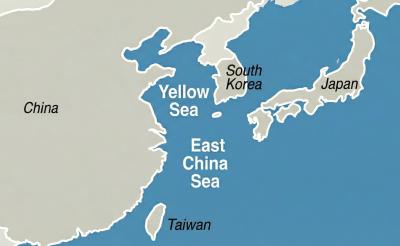
China has reserved offshore airspace in the Yellow Sea and East China Sea from March 27 to May 6, issuing alerts usually used to warn of military exercises, although no such exercises have been announced, the Wall Street Journal (WSJ) reported yesterday. Reserving such a large area for 40 days without explanation is an “unusual step,” as military exercises normally only last a few days, the paper said. These alerts, known as Notice to Air Missions (Notams), “are intended to inform pilots and aviation authorities of temporary airspace hazards or restrictions,” the article said. The airspace reserved in the alert is
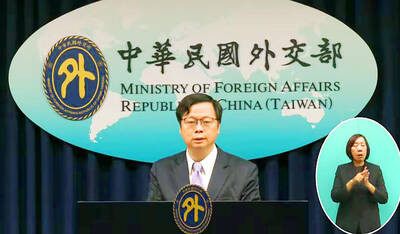
NAMING SPAT: The foreign ministry called on Denmark to propose an acceptable solution to the erroneous nationality used for Taiwanese on residence permits Taiwan has revoked some privileges for Danish diplomatic staff over a Danish permit that lists “Taiwan” as “China,” Eric Huang (黃鈞耀), head of the Ministry of Foreign Affairs’ Department of European Affairs, told a news conference in Taipei yesterday. Reporters asked Huang whether the Danish government had responded to the ministry’s request that it correct the nationality on Danish residence permits of Taiwanese, which has been listed as “China” since 2024. Taiwan’s representative office in Denmark continues to communicate with the Danish government, and the ministry has revoked some privileges previously granted to Danish representatives in Taiwan and would continue to review
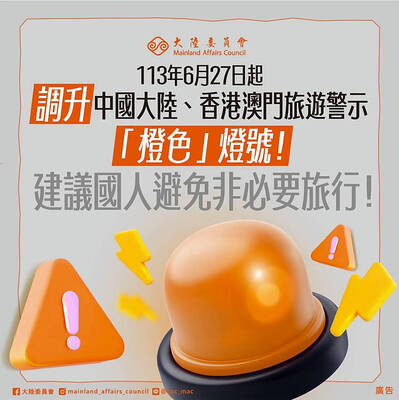
More than 6,000 Taiwanese students have participated in exchange programs in China over the past two years, despite the Mainland Affairs Council’s (MAC) “orange light” travel advisory, government records showed. The MAC’s publicly available registry showed that Taiwanese college and university students who went on exchange programs across the Strait numbered 3,592 and 2,966 people respectively. The National Immigration Agency data revealed that 2,296 and 2,551 Chinese students visited Taiwan for study in the same two years. A review of the Web sites of publicly-run universities and colleges showed that Taiwanese higher education institutions continued to recruit students for Chinese educational programs without

A bipartisan group of US senators has introduced a bill to enhance cooperation with Taiwan on drone development and to reduce reliance on supply chains linked to China. The proposed Blue Skies for Taiwan Act of 2026 was introduced by Republican US senators Ted Cruz and John Curtis, and Democratic US senators Jeff Merkley and Andy Kim. The legislation seeks to ease constraints on Taiwan-US cooperation in uncrewed aerial systems (UAS), including dependence on China-sourced components, limited access to capital and regulatory barriers under US export controls, a news release issued by Cruz on Wednesday said. The bill would establish a "Blue UAS


 RSS
RSS