


A gynecologist yesterday urged women of childbearing age who are hepatitis B carriers to receive regular medical check-ups and drug treatment, if necessary, after a 36-year-old patient nearly passed down the disease to her newborn.
Cheng Ching Hospital’s Reproductive Medicine Center director Hsieh Chang-hsing (謝昌興) said the woman was diagnosed with chronic hepatitis B infection coupled with liver cirrhosis about two years ago after experiencing tarry stool and vomiting blood.
“She was subsequently placed on drugs to control the virus and the medicines helped stabilize her condition,” Hsieh said.
The woman had visited the hospital again a few months ago complaining about serious vomiting, fretting that her liver condition had deteriorated, Hsieh said.
“However, her blood test results showed no signs of aggravation. Instead, an abdominal ultrasound found she was already four months pregnant,” Hsieh said.
In an effort to prevent mother-to-child transmission of the hepatitis B virus (HBV) through an amniocentesis — a medical procedure in which amniotic fluid is removed from the uterus for testing or treatment — Hsieh conducted a non-invasive fetal DNA testing instead, whose results showed that the fetus was uninfected.
The baby girl also tested negative for HBV after birth, Hsieh added.
Hsieh said that infants born to a pregnant woman positive for both hepatitis B surface antigen (HBsAg) and hepatitis B “e” antigen (HBeAg) has an approximately 85 percent chance of acquiring perinatal HBV infection.
The National Health Insurance (NHI) program requires that such newborns be injected with hepatitis B immunoglobulin to avoid a mother-to-child transmission, Hsieh said.
The injections are not covered by the health program if the mother is simply a hepatitis B carrier.
“Expectant women are strongly urged to receive proper medical treatment to control the number of HBV once they are found to be a hepatitis B carrier, in an effort to reduce the risks of them experiencing active hepatitis B infection during pregnancy and spreading the disease to their babies,” Hsieh said.
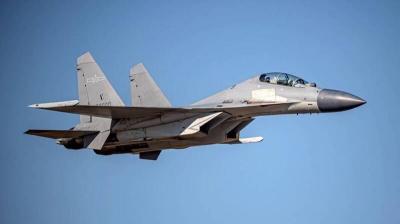
Eight Chinese naval vessels and 24 military aircraft were detected crossing the median line of the Taiwan Strait between 6am yesterday and 6am today, the Ministry of National Defense said this morning. The aircraft entered Taiwan’s northern, central, southwestern and eastern air defense identification zones, the ministry said. The armed forces responded with mission aircraft, naval vessels and shore-based missile systems to closely monitor the situation, it added. Eight naval vessels, one official ship and 36 aircraft sorties were spotted in total, the ministry said.
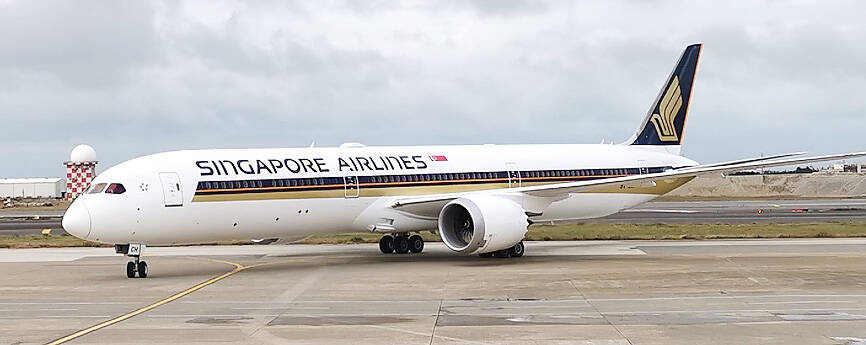
INCREASED CAPACITY: The flights on Mondays, Wednesdays, Fridays and Sundays would leave Singapore in the morning and Taipei in the afternoon Singapore Airlines is adding four supplementary flights to Taipei per week until May to meet increased tourist and business travel demand, the carrier said on Friday. The addition would raise the number of weekly flights it operates to Taipei to 18, Singapore Airlines Taiwan general manager Timothy Ouyang (歐陽漢源) said. The airline has recorded a steady rise in tourist and business travel to and from Taipei, and aims to provide more flexible travel arrangements for passengers, said Ouyang, who assumed the post in July last year. From now until Saturday next week, four additional flights would depart from Singapore on Monday, Wednesday, Friday
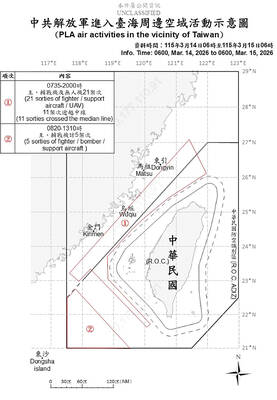
The Ministry of National Defense yesterday reported the return of large-scale Chinese air force activities after their unexplained absence for more than two weeks, which had prompted speculation regarding Beijing’s motives. China usually sends fighter jets, drones and other military aircraft around the nation on a daily basis. Interruptions to such routine are generally caused by bad weather. The Ministry of National Defense said it had detected 26 Chinese military aircraft in the Taiwan Strait over the previous 24 hours. It last reported that many aircraft on Feb. 25, when it spotted 30 aircraft, saying Beijing was carrying out another “joint combat

Taiwan successfully defended its women’s 540 kilogram title and won its first-ever men’s 640 kg title at the 2026 World Indoor Tug of War Championships in Taipei yesterday. In the women’s event, Taiwan’s eight-person squad reached the final following a round-robin preliminary round and semifinals featuring teams from Ukraine, Japan, Thailand, Vietnam, the Basque Country and South Korea. In the finals, they swept the Basque team 2-0, giving the team composed mainly of National Taiwan Normal University students and graduates its second championship in a row, and its fourth in five years. Team captain


 RSS
RSS