


Independent Taipei Mayor Ko Wen-je’s (柯文哲) proposal to establish a Taipei-owned public housing corporation remains stalled, with the Taipei City Council’s first regular session scheduled to end today, but action yet to be taken on four other high-priority acts.
The proposal has been viewed as a touchstone for evaluating the relationship between the council and City Hall, due to the importance of the project to Ko, who promised to implement large-scale construction of new public housing during his first term.
Following the city government’s request to add two special sessions to allow more time for the passage of proposed legislation, the council has agreed to one special session, moving its recess date to July 1.
Because of the impact of recent food safety scandals, the draft act on the Taipei City food safety autonomous regulations (台北市食品安全自治條例) is viewed as likely to be pushed through during the special session.
Taipei Deputy Mayor Teng Chia-chi (鄧家基) — who is Ko’s point man for handling city council relations — said that the city government would work to improve communication with the council, adding that there was an opportunity for the law to be passed and take effect next month.
Other priority acts sent to the city council this session included an act on the usage of funds within the city’s new “volume bank,” an act on construction safety labor regulations and amendments to the city’s zoning regulations.
However, so far none of the acts has passed the council’s Legislation Committee.
Taipei City Council Democratic Progressive Party (DPP) caucus whip Rosalia Wu (吳思瑤) said the stalling of the public housing corporation act within Taipei’s Legislation Committee represented the failure of Ko’s administration to break up the city council’s pan-blue majority.
People First Party (PFP) Councilor Vivian Huang (黃珊珊) — of the pan-blue camp — holds the tie-breaking vote on the committee, which is otherwise split evenly between DPP and Chinese Nationalist Party (KMT) councilors.
The committee’s composition mirrors that of the council itself, as the KMT lacks an absolute majority, but was able to secure the speakership with the support of small-party and independent councilors from the pan-blue camp.
Wu said that although the DPP is allied with the Ko administration, it lacks the necessary votes to push through legislation on its own, meaning that Ko must draw in PFP and independent councilors to create a governing majority.
PFP Councilor Lin Kuo-cheng (林國成) said Ko’s administration had failed to conduct thorough talks “in good faith” with councilors from all parties on its proposed legislation.
In response, Teng said that city commissioners had presented a report on the public housing corporation act and food safety act to the KMT caucus last week, following earlier reports to DPP caucus members.
He added that the food safety act had already passed out of the legislation committee and that the city government would have to communicate with councilors on the public housing corporation act, providing additional explanations after reviewing councilor concerns.
Additional reporting by Abraham Gerber


China has reserved offshore airspace in the Yellow Sea and East China Sea from March 27 to May 6, issuing alerts usually used to warn of military exercises, although no such exercises have been announced, the Wall Street Journal (WSJ) reported yesterday. Reserving such a large area for 40 days without explanation is an “unusual step,” as military exercises normally only last a few days, the paper said. These alerts, known as Notice to Air Missions (Notams), “are intended to inform pilots and aviation authorities of temporary airspace hazards or restrictions,” the article said. The airspace reserved in the alert is
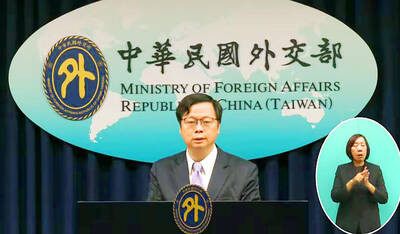
NAMING SPAT: The foreign ministry called on Denmark to propose an acceptable solution to the erroneous nationality used for Taiwanese on residence permits Taiwan has revoked some privileges for Danish diplomatic staff over a Danish permit that lists “Taiwan” as “China,” Eric Huang (黃鈞耀), head of the Ministry of Foreign Affairs’ Department of European Affairs, told a news conference in Taipei yesterday. Reporters asked Huang whether the Danish government had responded to the ministry’s request that it correct the nationality on Danish residence permits of Taiwanese, which has been listed as “China” since 2024. Taiwan’s representative office in Denmark continues to communicate with the Danish government, and the ministry has revoked some privileges previously granted to Danish representatives in Taiwan and would continue to review

More than 6,000 Taiwanese students have participated in exchange programs in China over the past two years, despite the Mainland Affairs Council’s (MAC) “orange light” travel advisory, government records showed. The MAC’s publicly available registry showed that Taiwanese college and university students who went on exchange programs across the Strait numbered 3,592 and 2,966 people respectively. The National Immigration Agency data revealed that 2,296 and 2,551 Chinese students visited Taiwan for study in the same two years. A review of the Web sites of publicly-run universities and colleges showed that Taiwanese higher education institutions continued to recruit students for Chinese educational programs without

A bipartisan group of US senators has introduced a bill to enhance cooperation with Taiwan on drone development and to reduce reliance on supply chains linked to China. The proposed Blue Skies for Taiwan Act of 2026 was introduced by Republican US senators Ted Cruz and John Curtis, and Democratic US senators Jeff Merkley and Andy Kim. The legislation seeks to ease constraints on Taiwan-US cooperation in uncrewed aerial systems (UAS), including dependence on China-sourced components, limited access to capital and regulatory barriers under US export controls, a news release issued by Cruz on Wednesday said. The bill would establish a "Blue UAS


 RSS
RSS