


The nation’s first crowd-funded rocket launch is scheduled to occur in October and provide valuable data to the Advanced Rocket Research Center (ARRC), which hopes to launch vehicles carrying miniaturized satellites within five to 10 years.
The center collaborated with the Backer Founder crowd-funding platform and raised NT$16 million (US$515,099). It plans to launch a two-segment large hybrid rocket to an altitude of more than 100km.
A hybrid rocket is one where two propellants — one solid and one liquid — are used.
Chen Yen-sheng (陳彥升), head of the National Space Organization’s rocket project, said the hybrid rocket is powered by a solid-state hydrocarbon and liquid oxygen, which offers an inflight thrust adjustment capability.
The fuel burn is between 250 and 290 seconds per kilogram, currently ranked No. 1 in fuel burn efficiency worldwide, Chen said.
It is also the fuel of choice for space tours due to its relative safety, Chen said, adding that a company in Silicon Valley has approached the organization with plans to create an emergency braking system using the rocket’s technology.
Former ARRC director-general Wu Tsung-hsin (吳宗信) said there had been nearly 1,000 satellites launched by 2012 and it is a trend to focus on satellites weighing less than 50kg.
Wu said that the peer-reviewed journal Science last year listed the CubeSat miniature satellite as one of its 10 greatest inventions of the year.
The CubeSat does not yet have commercial or private launch options and it needs to be launched with other payloads, Wu said.
He said that the time to launch takes about 18 months with the trajectory of launch depending on the primary payload.
Wu said manufacturing small rockets capable of launching miniature satellites to low Earth orbit — an altitude of between 160km and 2,000km — would be the nation’s way into the global rocket market.
The space tourism market is estimated at between US$4 billion and US$5 billion, of which fuel costs comprises US$1 billion to US$2 billion of expenditure, Wu said, adding that Taiwan’s rockets and fuel could take a share of that market.
Chen said he has always dreamed that one day Taiwan would be able to launch its own satellites, adding that the hybrid rocket brings that dream a little closer.
While the Chungshan Institute of Science and Technology has launched solid-fuel rockets converted from missiles, the nation’s satellites have been launched by foreign rockets.
Chen said the dream of the nation launching its own satellites made him choose to work at the National Space Organization rather than picking up the NT$12 million annual wage he was being paid by NASA.
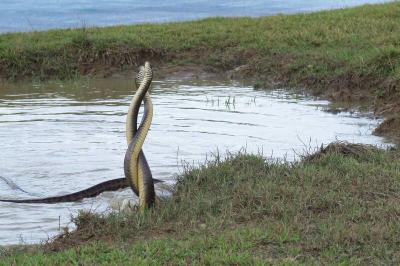
Kenting National Park service technician Yang Jien-fon (楊政峰) won a silver award in World Grand Prix Photography Awards Spring Season for his photograph of two male rat snakes intertwined in combat. Yang’s colleagues at Kenting National Park said he is a master of nature photography who has been held back by his job in civil service. The awards accept entries in all four seasons across six categories: architectural and urban photography, black-and-white and fine art photography, commercial and fashion photography, documentary and people photography, nature and experimental photography, and mobile photography. Awards are ranked according to scores and divided into platinum, gold and

The Chinese Nationalist Party (KMT) caucus yesterday said it opposes the introduction of migrant workers from India until a mechanism is in place to prevent workers from absconding. Minister of Labor Hung Sun-han (洪申翰) on Thursday told the Legislative Yuan that the first group of migrant workers from India could be introduced as early as this year, as part of a government program. The caucus’ opposition to the policy is based on the assessment that “the risk is too high,” KMT caucus secretary-general Lin Pei-hsiang (林沛祥) said. Taiwan has a serious and long-standing problem of migrant workers absconding from their contracts, indicating that
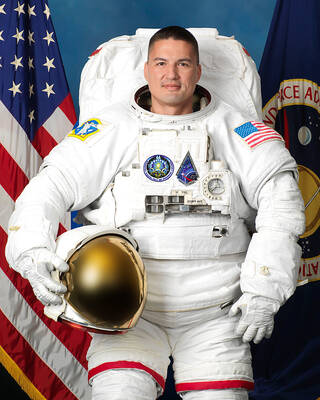
SPACE VETERAN: Kjell N. Lindgren, who helps lead NASA’s human spaceflight missions, has been on two expeditions on the ISS and has spent 311 days in space Taiwan-born US astronaut Kjell N. Lindgren is to visit Taiwan to promote technological partnerships through one of the programs organized by the US for its 250th national anniversary. Lindgren would be in Taiwan from Tuesday to Saturday next week as part of the US Bureau of Educational and Cultural Affairs’ US Speaker Program, organized to celebrate the 250th anniversary of the signing of the Declaration of Independence, the American Institute in Taiwan (AIT) said in a statement yesterday. Lindgren plans to engage with key leaders across the nation “to advance cutting-edge technological partnerships and inspire the next generation of scientists and engineers,”

TRADE-OFF: Beijing seeks to trade a bowl of tempura for a Chinese delicacy, an official said, while another said its promises were attempts to interfere in the polls The government must carefully consider the national security implications of building a bridge connecting Kinmen County and Xiamen, China, the Public Construction Commission (PCC) said yesterday. PCC Commissioner Derek Chen (陳金德), who is also a minister without portfolio, made the remarks in a meeting of the legislature’s Transportation Committee, after Democratic Progressive Party Legislator Hsu Fu-kuei (徐富癸) asked about China’s proposal of new infrastructure projects to further connect Kinmen and Lienchiang (Matsu) counties with Xiamen. China unveiled the bridge plan, along with nine other policies for Taiwan, on Sunday, the last day of Chinese Nationalist Party (KMT) Chairwoman Cheng Li-wun’s (鄭麗文) visit


 RSS
RSS