

Decisions that the US Congress and the White House make on US Navy spending could affect the likelihood and outcome of a US-China military conflict over Taiwan, a congressional report said.
“Some observers consider such a conflict to be very unlikely, in part because of significant US-Chinese economic linkages and the tremendous damage that such a conflict could cause on both sides,” the report said.
Nevertheless, the report said the question of how the US should respond to China’s military modernization effort is a “key issue” in US defense planning.
The US Congressional Research Service report — China Naval Modernization: Implications for US Navy Capabilities — was written by Ronald O’Rourke, a specialist in naval affairs.
It said China’s naval modernization is oriented toward addressing the situation with Taiwan, “militarily if need be.”
“China wants its military to be capable of acting as an anti-access/area-denial force — a force that can deter US intervention in a conflict in China’s near-seas region over Taiwan or failing that delay the arrival or reduce the effectiveness of intervening US forces,” O’Rourke said in the report.
O’Rourke quoted US military reports as saying China is developing remote-controlled underwater vehicles, and torpedo and mine systems capable of area denial “in a Taiwan scenario.”
Estimates put China’s inventory of mines in excess of 50,000.
Although aircraft carriers might have some value for China in a Taiwan-related conflict, they are not considered critical because Taiwan is within range of land-based Chinese aircraft, the report said.
While China might be building large amphibious ships to defend territorial claims in the East and South China seas, the vessels would “be of value for conducting amphibious landings in Taiwan,” it said.
The report also quotes a US intelligence document as saying that China’s military is developing electromagnetic pulse weapons that Beijing plans to use against US aircraft carriers in a potential conflict over Taiwan.
Given the pace of Chinese naval modernization, the report said that the gap in military capability between Taiwan and China would continue to widen in Beijing’s favor over the coming years.
“The People’s Republic of China views reunification with Taiwan as an immutable, long-term goal and hopes to prevent any other actor from intervening in a Taiwan scenario,” the report said.
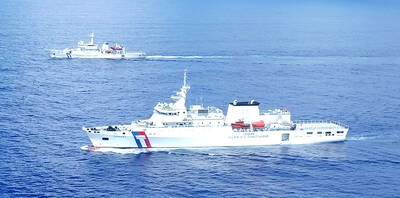
‘FRIENDSHIP FLEET’: A CGA official is scheduled to meet with the president of the Pacific nation, while one of the ships is to host a banquet and National Day event Two Coast Guard Administration (CGA) patrol vessels have docked at Malakal Harbor in Palau as part of an expedition exercise and diplomatic visit, during which a senior official is expected to meet with Palauan President Surangel Whipps Jr, the agency said yesterday. The two vessels, the 4,000-tonne-class Chiayi and the 1,000-tonne-class Penghu, set sail for Palau from Taiwan last week and arrived on Tuesday at Malakal Harbor, the CGA’s Fleet Branch said in a statement. The journey marks the second time the CGA has dispatched a “friendship fleet” to another country, after it sent its first-ever goodwill fleet, comprising the Hualien and
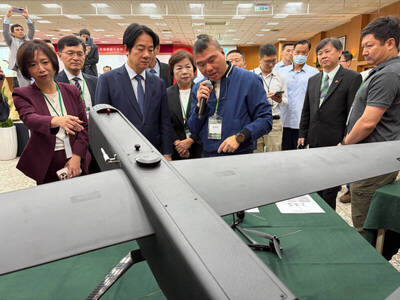
Two executives of drone supplier Jiin Ming Industry Co (錦明實業) have been detained and held incommunicado over the company's alleged use of prohibited China-made chips and camera lenses in drones supplied under recent military contracts, the Taoyuan District Prosecutors' Office said today. In a statement, prosecutors said they raided the offices of Jiin Ming — headquartered in Taoyuan — as well as those of its subsidiaries and its suppliers on Thursday last week. The raids followed a report that the company had breached its procurement contracts by putting the prohibited components into drones delivered to the military. During the raids, prosecutors summoned
The Coast Guard Administration (CGA) today said that two of its patrol vessels have docked at Palau's Malakal Harbor as part of an expedition exercise and diplomatic visit, during which a senior official is expected to meet with the Palauan president. The two vessels, the 4,000-tonne-class Chiayi (嘉義) and the 1,000-tonne-class Penghu (澎湖), set sail for Palau from Taiwan last week and arrived at Malakal Harbor yesterday, the CGA's Fleet Branch said in a statement. The journey marked the second time the CGA has dispatched a "Friendship Fleet" to another country, after it sent its first-ever goodwill fleet, comprising the Hualien (花蓮)
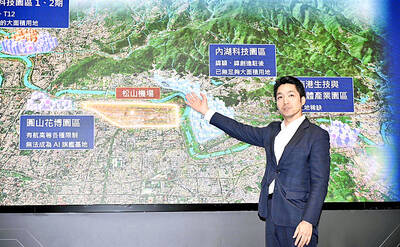
DETAILED PLAN NEEDED: Relocating the airport would affect not just travelers, but also undermine national defense and emergency medical services, a legislator said Taipei Mayor Chiang Wan-an (蔣萬安) yesterday proposed relocating Taipei International Airport (Songshan airport) and turning the site into an artificial intelligence (AI) park, drawing opposition from politicians across party lines. Chiang’s plan would turn the 300 hectares into an AI park featuring tech clusters, residential communities and green space. The industrial cluster would host 200 domestic enterprises, generate NT$12 trillion (US$376.47 billion) in output, and accommodate 65,000 jobs and 35,000 residents, he said. Cabinet spokeswoman Michelle Lee (李慧芝) said the Executive Yuan was surprised by the announcement, as the Taipei City Government did not discuss the proposal with the central government before making


 RSS
RSS