


The Ministry of Justice’s executions of six death row inmates yesterday drew fire from both advocates and opponents of the death penalty.
“I support the death penalty, but I cannot accept that this is the government’s response to our call for better protection for children,” said Wang Wei-chun (王薇君), chairwoman of the Association for Promotion of Children’s Rights and the aunt of a two-year-old child who died after being abused. “The government is not shouldering the responsibility that it should; it is trying to cheat.”
“So what happnes after the executions? Six more next year, or more executions when the next serious crime occurs? What is the government doing [about crime prevention]?” Wang asked.
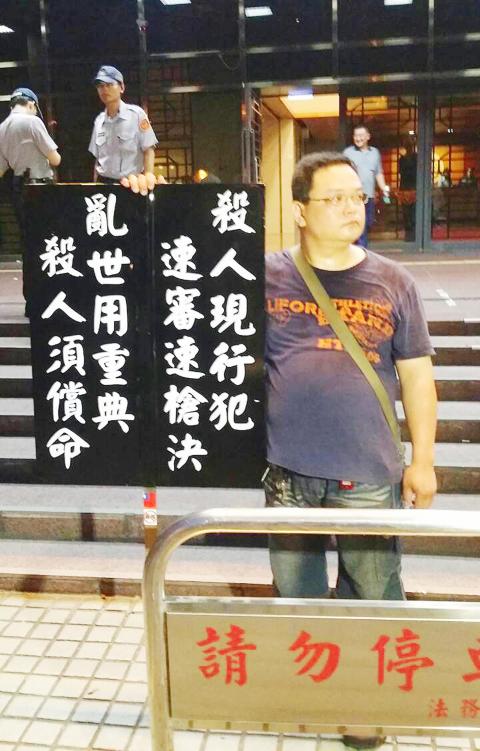
Photo: CNA
Taiwan Alliance to End the Death Penalty executive director Lin Hsin-yi (林欣怡) echoed Wang’s views, although they hold different opinions on whether capital punishment should continue.
“It looks like, rather than coming up with policy actions to prevent such crimes, the government is more interested in trying to shut the public up by executing people. It has certainly let the public down, as the public expects more from the government,” Lin said.
She said that whether one supports or opposes the death penalty, people from both groups share one thing in common: They both want to live in a safe and crime-free society.
The government should do more research into random killings — a relatively new type of crime in Taiwan — to see how it can effectively prevent them, she said.
Social Democratic Party legislative candidate Miao Po-ya (苗博雅), a long-time activist against the death penalty, accused the government of using capital punishment as a political tool.
“The first executions since President Ma Ying-jeou (馬英九) assumed office took place in April 2010 amid debates over the cross-strait Economic Cooperation Framework Agreement; then in March 2011, when it was discovered that a former airman, Chiang Kuo-ching (江國慶), was wrongfully executed in 1996; and then there were more executions following the Sunflower movement and the heated protests against nuclear power,” Miao said.
“Ma should not use the death penalty as a way to save his declining support rate. If we must keep the death penalty, we should have a better system that can prevent it from becoming a tool for political manipulation,” Miao said.
Democratic Progressive Party spokesperson Wang Min-sheng (王閔生) also called on the government to work on crime prevention instead of executing inmates.
When asked if the party would support abolishing the death penalty or working toward this objective once in power, Wang said that there should be measures in place to replace the death penalty and social consensus before it can be abolished.

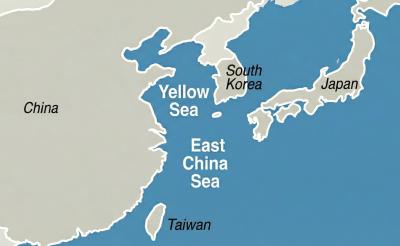
China has reserved offshore airspace in the Yellow Sea and East China Sea from March 27 to May 6, issuing alerts usually used to warn of military exercises, although no such exercises have been announced, the Wall Street Journal (WSJ) reported yesterday. Reserving such a large area for 40 days without explanation is an “unusual step,” as military exercises normally only last a few days, the paper said. These alerts, known as Notice to Air Missions (Notams), “are intended to inform pilots and aviation authorities of temporary airspace hazards or restrictions,” the article said. The airspace reserved in the alert is

NAMING SPAT: The foreign ministry called on Denmark to propose an acceptable solution to the erroneous nationality used for Taiwanese on residence permits Taiwan has revoked some privileges for Danish diplomatic staff over a Danish permit that lists “Taiwan” as “China,” Eric Huang (黃鈞耀), head of the Ministry of Foreign Affairs’ Department of European Affairs, told a news conference in Taipei yesterday. Reporters asked Huang whether the Danish government had responded to the ministry’s request that it correct the nationality on Danish residence permits of Taiwanese, which has been listed as “China” since 2024. Taiwan’s representative office in Denmark continues to communicate with the Danish government, and the ministry has revoked some privileges previously granted to Danish representatives in Taiwan and would continue to review

More than 6,000 Taiwanese students have participated in exchange programs in China over the past two years, despite the Mainland Affairs Council’s (MAC) “orange light” travel advisory, government records showed. The MAC’s publicly available registry showed that Taiwanese college and university students who went on exchange programs across the Strait numbered 3,592 and 2,966 people respectively. The National Immigration Agency data revealed that 2,296 and 2,551 Chinese students visited Taiwan for study in the same two years. A review of the Web sites of publicly-run universities and colleges showed that Taiwanese higher education institutions continued to recruit students for Chinese educational programs without

A bipartisan group of US senators has introduced a bill to enhance cooperation with Taiwan on drone development and to reduce reliance on supply chains linked to China. The proposed Blue Skies for Taiwan Act of 2026 was introduced by Republican US senators Ted Cruz and John Curtis, and Democratic US senators Jeff Merkley and Andy Kim. The legislation seeks to ease constraints on Taiwan-US cooperation in uncrewed aerial systems (UAS), including dependence on China-sourced components, limited access to capital and regulatory barriers under US export controls, a news release issued by Cruz on Wednesday said. The bill would establish a "Blue UAS


 RSS
RSS