


A child protection plan revived by the Taipei City Government last week differs from a plan the city canceled in March, Taipei Mayor Ko Wen-je (柯文哲) said yesterday.
He said that the city government’s announcement of the plan’s cancelation in March had been “imprecise,” failing to specify what was in the plan.
A fatal attack on an elementary student in a school restroom on Friday last week has drawn attention to Taipei’s cancelation of the child protection plan as part of a reduction of “superfluous” duties for police officers.
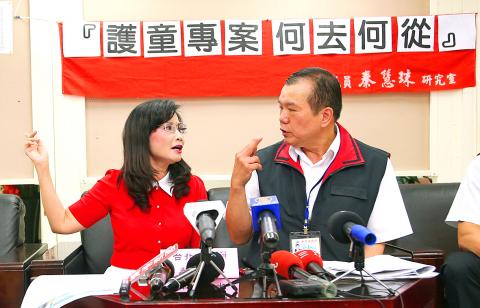
Photo: CNA
The Taipei Police Department yesterday said that the plan canceled in March referred to traffic direction at elementary-school entrances.
Mandatory execution of such directions was canceled by the National Police Administration in 2012, with Taipei “canceling only the name” as part of a March reorganization of police duties, the police department added.
Patrols around campuses had not been affected, it said.
Ko added that semantics should not detract from efforts to improve school safety.
“Do not get caught up in explaining words; what is important is school safety and how to make students and parents feel safe,” Ko said.
He brushed off questions over the accuracy of previous conflicting statements on the “revival” of the plan, saying it was not reasonable to expect the mayor to know every policy detail, while reiterating that the city would review new safety measures after a month.
Ko’s remarks came as Taipei City Councilor Chin Huei-chu (秦慧珠) of the Chinese Nationalist Party (KMT) accused the Taipei Police Department of making misleading statements about the cancelation of the child protection plan in March.
While Taipei Police Department Commissioner Chiu Feng-kuang (邱豐光) said a child protection plan had not been canceled amid efforts to reduce unnecessary police duties, city government meeting records and the police department’s press releases showed that a child protection plan was canceled, she said.
She accused Chiu of “speaking nonsense,” while demanding that the plan be immediately reinstated in full, rather than on a temporary basis as Ko said.
Separately, Minister of the Interior Chen Wei-zen (陳威仁) dismissed Chin’s claims about the child protection plan being canceled by the central government.
He said that there have been two policies that reporters dubbed a “child protection plan,” which might have resulted in confusion.
The first policy was a joint effort between his ministry and the Ministry of Education called “Caring Corridors Service Stations,” which aimed to increase traffic safety for children traveling to school. The plan was implemented in 2008, but terminated in 2012, Chen said.
However, a second policy, the “Police Agencies Execution Plan to Safeguard Campus Security,” has been in place since its launch in 2007. Under the plan, police patrols near schools have been increased, while communication channels have also been established between schools and local police authorities, Chen said.

The Centers for Disease Control (CDC) yesterday reported the first case of a new COVID-19 subvariant — BA.3.2 — in a 10-year-old Singaporean girl who had a fever upon arrival in Taiwan and tested positive for the disease. The girl left Taiwan on March 20 and the case did not have a direct impact on the local community, it said. The WHO added the BA.3.2 strain to its list of Variants Under Monitoring in December last year, but this was the first imported case of the COVID-19 variant in Taiwan, CDC Deputy Director-General Lin Ming-cheng (林明誠) said. The girl arrived in Taiwan on

South Korea is planning to revise its controversial electronic arrival card, a step Taiwanese officials said prompted them to hold off on planned retaliatory measures, a South Korean media report said yesterday. A Yonhap News Agency report said that the South Korean Ministry of Foreign Affairs is planning to remove the “previous departure place” and “next destination” fields from its e-arrival card system. The plan, reached after interagency consultations, is under review and aims to simplify entry procedures and align the electronic form with the paper version, a South Korean ministry official said. The fields — which appeared only on the electronic form

The Ministry of Foreign Affairs (MOFA) is suspending retaliation measures against South Korea that were set to take effect tomorrow, after Seoul said it is updating its e-arrival system, MOFA said today. The measures were to be a new round of retaliation after Taiwan on March 1 changed South Korea's designation on government-issued alien resident certificates held by South Korean nationals to "South Korea” from the "Republic of Korea," the country’s official name. The move came after months of protests to Seoul over its listing of Taiwan as "China (Taiwan)" in dropdown menus on its new online immigration entry system. MOFA last week

A bipartisan group of US senators has introduced a bill to enhance cooperation with Taiwan on drone development and to reduce reliance on supply chains linked to China. The proposed Blue Skies for Taiwan Act of 2026 was introduced by Republican US senators Ted Cruz and John Curtis, and Democratic US senators Jeff Merkley and Andy Kim. The legislation seeks to ease constraints on Taiwan-US cooperation in uncrewed aerial systems (UAS), including dependence on China-sourced components, limited access to capital and regulatory barriers under US export controls, a news release issued by Cruz on Wednesday said. The bill would establish a "Blue UAS


 RSS
RSS