


The bombing of Taipei in the run-up to and during World War II led to dramatic changes in Taipei’s development, but the Chinese Nationalist Party’s (KMT) post-war propaganda has meant that few people know about the historic changes, a National Taiwan Normal University geography professor said yesterday.
In an article on his blog, Hung Chih-wen (洪致文) said that the May 31, 1945, Allied bombing raid had greatly changed Taipei’s urban geography, but those changes have never been mentioned in textbooks constrained by the KMT’s “greater China-centric” view.
The wounds inflicted on Taiwan have never completely healed, Hung wrote.
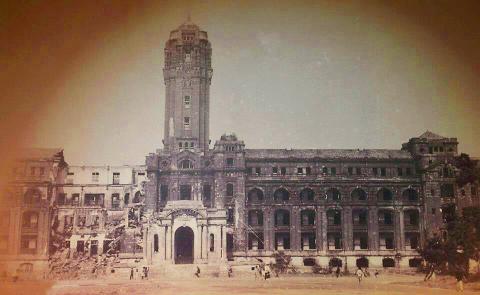
Photo: Screen grab from Professional Technology Temple
However, that bombing raid was not the first time that Taipei had been bombed, he wrote.
The Soviet Union and the Republic of China (ROC) entered into an agreement in 1937 under which the Soviet Union sent “volunteer” pilots and warplanes to aid the ROC in its fight with imperial Japan — a deal that was terminated in 1941 when the Soviet Union signed a non-aggression pact with Japan.
The Soviet Volunteer Group bombed Taiwan on Feb. 23, 1938, although the attack was limited to the Taipei airfield, Hung wrote.
However, the Japanese governor’s office used the attack in its propaganda material, as the flights had originated from an ROC-ruled area of China.
The US’ aerial attacks on Taiwan began with the Nov. 25, 1943 bombardment of a flight strip in Hsinchu, which was largely a test of anti-air capabilities on Taiwan, Hung wrote, adding that the US also bombed Kaohsiung in January 1944.
The US’ bombing runs ramped up in late 1944 during the Formosa Air Battle and contributed to Taiwanese memories of spending time in bomb shelters, Hung wrote, adding that was the first time World War II had touched Taiwan.
The bombing runs led to the establishment of anti-air zones starting in November 1944, which called for the removal of more than 39,285m2 of buildings in Taipei, with a subsequent 669,008m2 removed in April 1945, Hung wrote.
More than 46.3 percent of buildings that were removed were the property of the Japanese imperial government and 40.2 percent were private property, with the remainder belonging to the local government, Hung wrote.
Jinshan S Road and Shida Road, as well as Shida Park, are all remnants of anti-air or evacuation zones, Hung wrote, adding that the roads were not listed in Japan’s expansion plans in 1932 or in the ROC plans in 1950.
Memories of World War II and its effect on Taiwan should be preserved to remind Taiwanese of the horrors of war and the efforts spent in the pursuit of peace, he wrote.

Considering that most countries issue more than five denominations of banknotes, the central bank has decided to redesign all five denominations, the bank said as it prepares for the first major overhaul of the banknotes in more than 24 years. Central bank Governor Yang Chin-lung (楊金龍) is expected to report to the Legislative Yuan today on the bank’s operations and the redesign’s progress. The bank in a report sent to the legislature ahead of today’s meeting said it had commissioned a survey on the public’s preferences. Survey results showed that NT$100 and NT$1,000 banknotes are the most commonly used, while NT$200 and NT$2,000

The Centers for Disease Control (CDC) yesterday reported the first case of a new COVID-19 subvariant — BA.3.2 — in a 10-year-old Singaporean girl who had a fever upon arrival in Taiwan and tested positive for the disease. The girl left Taiwan on March 20 and the case did not have a direct impact on the local community, it said. The WHO added the BA.3.2 strain to its list of Variants Under Monitoring in December last year, but this was the first imported case of the COVID-19 variant in Taiwan, CDC Deputy Director-General Lin Ming-cheng (林明誠) said. The girl arrived in Taiwan on

South Korea is planning to revise its controversial electronic arrival card, a step Taiwanese officials said prompted them to hold off on planned retaliatory measures, a South Korean media report said yesterday. A Yonhap News Agency report said that the South Korean Ministry of Foreign Affairs is planning to remove the “previous departure place” and “next destination” fields from its e-arrival card system. The plan, reached after interagency consultations, is under review and aims to simplify entry procedures and align the electronic form with the paper version, a South Korean ministry official said. The fields — which appeared only on the electronic form

The Ministry of Foreign Affairs (MOFA) is suspending retaliation measures against South Korea that were set to take effect tomorrow, after Seoul said it is updating its e-arrival system, MOFA said today. The measures were to be a new round of retaliation after Taiwan on March 1 changed South Korea's designation on government-issued alien resident certificates held by South Korean nationals to "South Korea” from the "Republic of Korea," the country’s official name. The move came after months of protests to Seoul over its listing of Taiwan as "China (Taiwan)" in dropdown menus on its new online immigration entry system. MOFA last week


 RSS
RSS