


Students from Taipei’s Shih Hsin University over the past week have staged a series of protests over expensive dorm prices for exchange students from China.
Led by the Shih Hsin University Student Labor Rights Action Group, the students accused the university of unfairly charging Chinese students higher prices, adding that Chinese students were being treated like “human ATMs.”
At NT$40,000 per semester over a period of five months, dorm rooms at the university for Chinese students cost significantly more than those for local students, who pay NT$12,000 or NT$24,000 per semester.
Students from the university, including many Chinese, rallied in front of the school’s administrative building on Thursday, demanding comprehensive reforms to dormitory policies.
They said that the university should refrain from treating international students differently from Taiwanese, adding that the number of dormitories should be increased to ensure students would not have to search for private housing options.
Among Taiwanese students at the university, just 6.6 percent live in dormitories, placing a serious burden on students amid sky-high accommodation prices in Taipei, the group said.
During a speech in the Department of Journalism, Shih Hsin president Wu Yung-chien (吳永乾) denied accusations that the university was “exploiting” Chinese students, adding that journalists should refrain from “distorting the truth.”
He said journalists should use reliable sources and ignore remarks made by “a minority of people who hold fixed views and ... cause mischief all day long.”
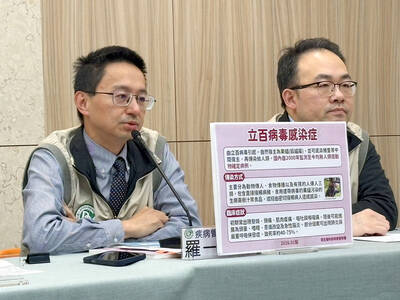
Nipah virus infection is to be officially listed as a category 5 notifiable infectious disease in Taiwan in March, while clinical treatment guidelines are being formulated, the Centers for Disease Control (CDC) said yesterday. With Nipah infections being reported in other countries and considering its relatively high fatality rate, the centers on Jan. 16 announced that it would be listed as a notifiable infectious disease to bolster the nation’s systematic early warning system and increase public awareness, the CDC said. Bangladesh reported four fatal cases last year in separate districts, with three linked to raw date palm sap consumption, CDC Epidemic Intelligence

The manufacture of the remaining 28 M1A2T Abrams tanks Taiwan purchased from the US has recently been completed, and they are expected to be delivered within the next one to two months, a source said yesterday. The Ministry of National Defense is arranging cargo ships to transport the tanks to Taiwan as soon as possible, said the source, who is familiar with the matter. The estimated arrival time ranges from late this month to early next month, the source said. The 28 Abrams tanks make up the third and final batch of a total of 108 tanks, valued at about NT$40.5 billion

Two Taiwanese prosecutors were questioned by Chinese security personnel at their hotel during a trip to China’s Henan Province this month, the Mainland Affairs Council (MAC) said yesterday. The officers had personal information on the prosecutors, including “when they were assigned to their posts, their work locations and job titles,” MAC Deputy Minister and spokesman Liang Wen-chieh (梁文傑) said. On top of asking about their agencies and positions, the officers also questioned the prosecutors about the Cross-Strait Joint Crime-Fighting and Judicial Mutual Assistance Agreement, a pact that serves as the framework for Taiwan-China cooperation on combating crime and providing judicial assistance, Liang
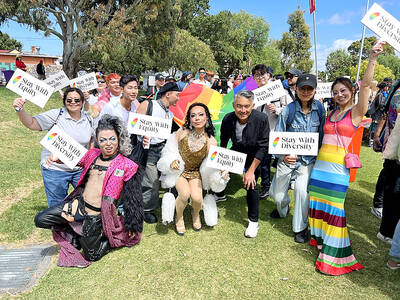
A group from the Taiwanese Designers in Australia association yesterday represented Taiwan at the Midsumma Pride March in Melbourne. The march, held in the St. Kilda suburb, is the city’s largest LGBTQIA+ parade and the flagship event of the annual Midsumma Festival. It attracted more than 45,000 spectators who supported the 400 groups and 10,000 marchers that participated this year, the association said. Taiwanese Designers said they organized a team to march for Taiwan this year, joining politicians, government agencies, professionals and community organizations in showing support for LGBTQIA+ people and diverse communities. As the first country in Asia to legalize same-sex


 RSS
RSS