


In a setback to Hualien County’s much touted effort to refocus its tourist industry toward the international market, pictures of comical and confusing attempts to render signs from Chinese into English have gone viral on the Internet.
A Facebook user posted images of three road signs for Dasyue Road (大學路) within 5km of each other in Hualien County’s Shoufong Township (壽豐). The English romanization of the Chinese characters on the three signs do not match: They read “Daxue,” “Dah Shyue” and in an experimental attempt at partial translation “Big Xue,” none of which employ Tongyong Pinyin or Hanyu Pinyin, which are normally used on signs in Taiwan.
Not only would road users be confused by the multiple renditions, it seems to imply that the signs refer to three different roads, the poster wrote.
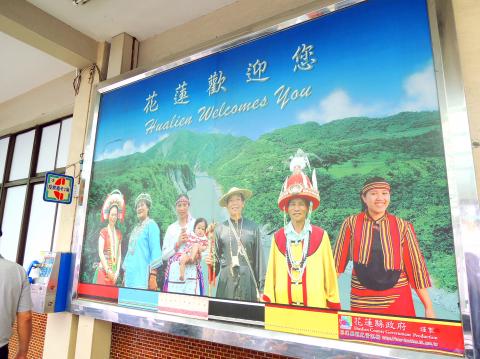
Photo: Wang Chin-yi, Taipei Times
Shoufong Township Office construction division head Huang Wen-tsung (黃文宗) said Hanyu Pinyin should be used on road signs, adding that the use of “Big Xue” was preposterous, especially as the road sign is quite new.
“We have looked into the matter and found that there were three different crews involved in the road’s maintenance,” Huang said, adding that the division would immediately set about rectifying the situation.
“We should be finished within the month,” Huang said.
Screen grab from Facebook
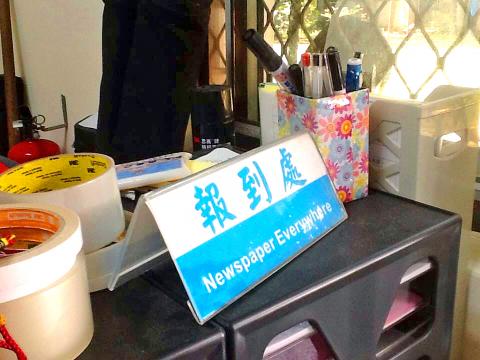
Other examples on Facebook of unusual English translations in the county include a hotel reception desk that informs non-Chinese speakers that there is “Newspaper Everywhere.”
The Facebook user suggested that software translated the Chinese characters, bao dao chu (報到處) (reception desk), into their literal English equivalent. Bao (報), is short for newspaper and dao chu (到處) means everywhere.
As for the billboard outside of the Hualien Train Station which read, “Hualien Welcomes You,” a teacher at National Hualien Senior Girl’s High School named Wang Ya-ling (王雅玲) said she would not expect one of her students to use the term in an English composition.
“Welcome to Hualien,” would be more appropriate, Wang said, adding that it could not be said the billboard is “incorrect,” as English speakers understand the message conveyed.
The county government’s tourism department said that the billboard had been in place for more than six years and that similar phrasing was often used by other cities around the world. However, that the county government would consider covering up the English language part of the billboard if the public find the phrasing inappropriate.

Considering that most countries issue more than five denominations of banknotes, the central bank has decided to redesign all five denominations, the bank said as it prepares for the first major overhaul of the banknotes in more than 24 years. Central bank Governor Yang Chin-lung (楊金龍) is expected to report to the Legislative Yuan today on the bank’s operations and the redesign’s progress. The bank in a report sent to the legislature ahead of today’s meeting said it had commissioned a survey on the public’s preferences. Survey results showed that NT$100 and NT$1,000 banknotes are the most commonly used, while NT$200 and NT$2,000

The Centers for Disease Control (CDC) yesterday reported the first case of a new COVID-19 subvariant — BA.3.2 — in a 10-year-old Singaporean girl who had a fever upon arrival in Taiwan and tested positive for the disease. The girl left Taiwan on March 20 and the case did not have a direct impact on the local community, it said. The WHO added the BA.3.2 strain to its list of Variants Under Monitoring in December last year, but this was the first imported case of the COVID-19 variant in Taiwan, CDC Deputy Director-General Lin Ming-cheng (林明誠) said. The girl arrived in Taiwan on

South Korea is planning to revise its controversial electronic arrival card, a step Taiwanese officials said prompted them to hold off on planned retaliatory measures, a South Korean media report said yesterday. A Yonhap News Agency report said that the South Korean Ministry of Foreign Affairs is planning to remove the “previous departure place” and “next destination” fields from its e-arrival card system. The plan, reached after interagency consultations, is under review and aims to simplify entry procedures and align the electronic form with the paper version, a South Korean ministry official said. The fields — which appeared only on the electronic form

The Ministry of Foreign Affairs (MOFA) is suspending retaliation measures against South Korea that were set to take effect tomorrow, after Seoul said it is updating its e-arrival system, MOFA said today. The measures were to be a new round of retaliation after Taiwan on March 1 changed South Korea's designation on government-issued alien resident certificates held by South Korean nationals to "South Korea” from the "Republic of Korea," the country’s official name. The move came after months of protests to Seoul over its listing of Taiwan as "China (Taiwan)" in dropdown menus on its new online immigration entry system. MOFA last week


 RSS
RSS