


The National Communications Commission (NCC) yesterday urged the Legislative Yuan to quickly pass amendments to three broadcasting acts it sees as the solution to all problems related to must-carry channels.
“Current must-carry channel regulations are to soon generate much controversy. The amendments to the three broadcasting acts are necessary due to changes in communications technology, as well as the market,” the commission said in a statement.
The broadcasting acts are the Radio and Television Act (廣播電視法), the Cable Television Act (有線電視法) and the Satellite Broadcasting Act (衛星廣播電視法).
The NCC statement came in response to criticism from the Taiwan Digital Convergence Development Association, which accused the commission of forcing cable operators to carry all terrestrial TV channels through a new interpretation of Article 37 of the Cable Television Act.
Article 37 states that a cable system operator must concurrently retransmit programs and advertisements of legally established over-the-air TV stations, adding that it must not alter the form, content or channel of these programs and advertisements, and must include these channels in its basic offerings.
“The commission’s rationale is that cable operators should carry more terrestrial TV channels because of increased capacity after the digitalization of their services, so more people can watch terrestrial TV channels free of charge,” the association said.
“However, the only party that is to benefit from such an interpretation would be terrestrial TV channels, which do not have to pay anything to be included in a cable channel lineup. With the exception of the government-funded Taiwan Broadcasting System’s channels, Taiwan Television, China Television and Formosa TV are commercial TV stations. These networks need to pay cable operators if they want people to watch them on cable, and they should not force the commission to amend regulations in their favor,” the association added.
However, the NCC said that Article 37 does not specify the number of channels that a cable TV system has to carry. It also said that terrestrial TV networks discontinued use of analog signals in 2012, which enabled them to develop one main channel and several sub-channels.
Due to the fact that less than 15 percent of cable services employed digital signals at that time, the commission allowed cable operators to carry only terrestrial TV’s main channels.
“However, many cable operators have switched to digital offerings as well, which increases their capacity for channels. The legal basis of Article 37 is now being challenged,” the commission said, adding that more legal issues generated by Article 37 would emerge if the amendments to the broadcasting acts failed to secure legislative approval.
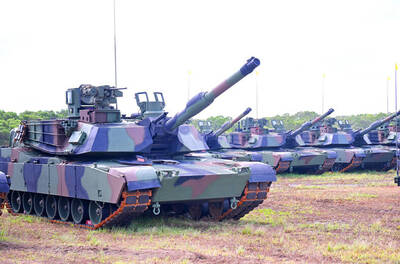
The manufacture of the remaining 28 M1A2T Abrams tanks Taiwan purchased from the US has recently been completed, and they are expected to be delivered within the next one to two months, a source said yesterday. The Ministry of National Defense is arranging cargo ships to transport the tanks to Taiwan as soon as possible, said the source, who is familiar with the matter. The estimated arrival time ranges from late this month to early next month, the source said. The 28 Abrams tanks make up the third and final batch of a total of 108 tanks, valued at about NT$40.5 billion

A group from the Taiwanese Designers in Australia association yesterday represented Taiwan at the Midsumma Pride March in Melbourne. The march, held in the St. Kilda suburb, is the city’s largest LGBTQIA+ parade and the flagship event of the annual Midsumma Festival. It attracted more than 45,000 spectators who supported the 400 groups and 10,000 marchers that participated this year, the association said. Taiwanese Designers said they organized a team to march for Taiwan this year, joining politicians, government agencies, professionals and community organizations in showing support for LGBTQIA+ people and diverse communities. As the first country in Asia to legalize same-sex
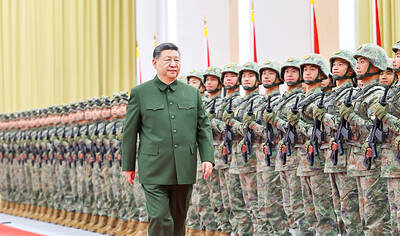
MOTIVES QUESTIONED The PLA considers Xi’s policies toward Taiwan to be driven by personal considerations rather than military assessment, the Epoch Times reports Chinese President Xi Jinping’s (習近平) latest purge of the Chinese People’s Liberation Army (PLA) leadership might have been prompted by the military’s opposition to plans of invading Taiwan, the Epoch Times said. The Chinese military opposes waging war against Taiwan by a large consensus, putting it at odds with Xi’s vision, the Falun Gong-affiliated daily said in a report on Thursday, citing anonymous sources with insight into the PLA’s inner workings. The opposition is not the opinion of a few generals, but a widely shared view among the PLA cadre, the Epoch Times cited them as saying. “Chinese forces know full well that
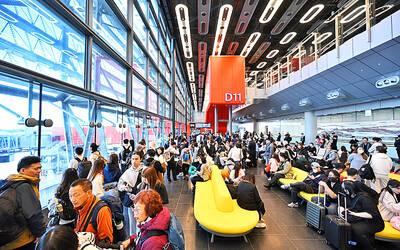
Travel agencies in Taiwan are working to secure alternative flights for travelers bound for New Zealand for the Lunar New Year holiday, as Air New Zealand workers are set to strike next week. The airline said that it has confirmed that the planned industrial action by its international wide-body cabin crew would go ahead on Thursday and Friday next week. While the Auckland-based carrier pledged to take reasonable measures to mitigate the impact of the workers’ strike, an Air New Zealand flight arriving at Taipei from Auckland on Thursday and another flight departing from Taipei for Auckland on Saturday would have to


 RSS
RSS