


The Chinese Nationalist Party (KMT) caucus yesterday called on the Democratic Progressive Party (DPP) to “recognize” KMT Chairman Eric Chu’s (朱立倫) mention of the Republic of China (ROC) during his meeting with Chinese President Xi Jinping (習近平) on Monday.
While the KMT sees the party’s interactions with the Chinese Communist Party (CCP), of which Xi is general secretary, and the Chu-Xi meeting as a “success,” the DPP has been lashing out at the KMT, accusing it of overreaching its authority in cross-strait relations, which should be government-to-government.
The KMT caucus asked the DPP to stop villifying and “coloring the KMT red.”
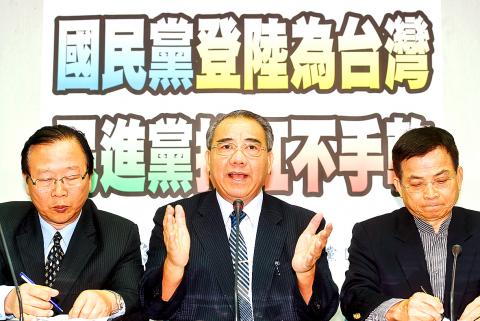
Photo: Fang Pin-chao, Taipei Times
“In the beginning, we considered holding the [KMT-CCP] forum in Taiwan, but [then-president] Chen Shui-bian (陳水扁) said ‘no.’ The DPP then banned its members from participating in the event, and has since made no contribution to the improvement of the cross-strait relationship. So now whenever they see progress achieved by the KMT, they do nothing but villify us,” deputy KMT caucus whip Liao Kuo-tung (廖國棟) said.
The KMT and CCP held their 10th Cross-Strait Economic, Trade and Culture Forum in Shanghai at the weekend.
KMT caucus whip Lai Shyh-bao (賴士葆) said the KMT went to China “for the sake of Taiwan.”
“Chu pointed out that as the two sides [of the Taiwan Strait] have been separated for decades, different ways of thinking are inevitable. He also underlined the importance of Taiwan’s international participation in Beijing,” Lai said.
“Xi said [at the meeting with Chu] that he holds a ‘positive and optimistic view’ toward Taiwan’s bid to join the Asian Infrastructure Investment Bank,” Lai said.
Calling the DPP’s cross-strait policy “empty,” KMT Legislator Wu Yu-sheng (吳育昇) asked which “status quo” it is that DPP Chairperson Tsai Ing-wen (蔡英文) has vowed to maintain.
“Is it the ‘status quo’ achieved on the basis of 1992 consensus by President Ma Ying-jeou (馬英九) over the past seven years or the one during Chen Shui-bian’s presidency? If it is the one we have now, then what is wrong with the consensus?” Wu said.
The so-called “1992 consensus” refers to a tacit understanding between the KMT and the Chinese government that both sides acknowledge that there is “one China,” with both sides having their own interpretation of what “China” means. Former KMT lawmaker Su Chi (蘇起) said in 2006 that he made up the term in 2000, when he was head of the Mainland Affairs Council.
Wu then called on the DPP — who dared Chu to mention the ROC in China — to recognize that Chu brought up the nation’s name in front of Xi when describing the ROC “as established by [ROC founding father] Sun Yat-sen (孫逸仙) after he overthrew the Qing Dynasty.”
“He [Chu] said it courageously in a harmonious, polite and non-abrupt way,” Wu said.
Later yesterday, former national policy adviser Rex How (郝明義) said Wu’s touting of Chu’s mention of the ROC’s name and Chu’s describing how Sun established the ROC was like “a schoolchild who came home bragging that he had recited a part of history before someone.”
“[China] has never disavowed the once existence of the Republic of China. What they are denying is its existence after 1949,” How said. “It is his own business for being childish, but the media should not dance along and grant him a pass to his next childish move.”
Meanwhile, Economic Democracy Union convener Lai Chung-chiang (賴中強) criticized Chu for “only daring to use the ROC’s name in the past tense” in front of Xi.
Lai said that from Xi’s perspective, before 1949, the “one China” was the ROC, under whose banner the CCP fought against the Japanese Imperial Army; after 1949, the “one China” was the People’s Republic of China.
Additional reporting by Wang Wen-hsuan
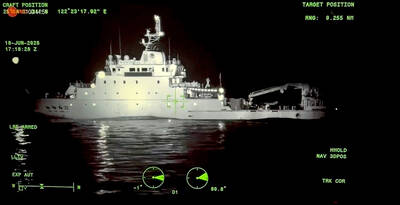
EXCUSES: Beijing is using government and research vessels as a pretext to harass the nation and enter its EEZ, and engage in ‘hegemonic expansion,’ the coast guard said The Coast Guard Administration yesterday said it drove away Chinese oceanographic research vessel Xiang Yang Hong 22 (向陽紅33) from restricted waters after warning it that it was in Taiwan’s exclusive economic zone (EEZ). The Chinese vessel entered restricted waters off the coast of Yilan County’s Suao (蘇澳) at 11:35pm on Thursday, the coast guard said, adding that it dispatched the Lanyu patrol vessel and the boat PP-10077 to shadow the Chinese ship and issue radio warnings ordering it to leave. China has no sovereignty over waters off Taiwan’s east coast, Lanyu’s crew told Xiang Yang Hong 22 over the radio, and demanded
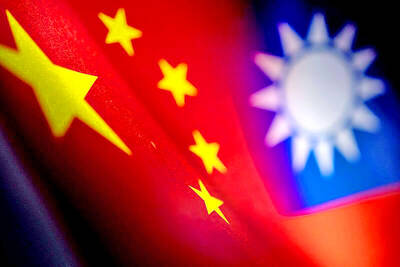
BAIT AND SWITCH: Allowing KMT-run counties to sell to China while the threat of abrupt cancelations hangs overhead is another form of coercion, officials said Beijing is using agricultural purchase offers announced during the Straits Forum to deepen Taiwan’s dependence on the Chinese market, a Taiwanese official said yesterday as they criticized the Taitung County commissioner’s participation in the initiative. During the Straits Forum held in Xiamen on Saturday, Chinese officials announced a sales and purchase agreement for agricultural products from some counties led by the Chinese Nationalist Party (KMT). Taitung County Commissioner Yao Ching-ling (饒慶鈴), who was barred from attending the event in person by the Mainland Affairs Council, participated via video. Under the agreement, China would purchase atemoyas, pomeloes, tea and grouper harvested in Taitung,

SHIFTING FIRE: While the tempo of purely military exercises around Taiwan has gone down somewhat, Beijing is working to isolate Lai diplomatically from support abroad Chinese President Xi Jinping (習近平) is shifting tactics in his campaign to pressure Taiwan, ramping up diplomatic isolation of the nation while dialing down provocative displays of military aggression. Taiwan recorded a daily average of five Chinese military aircraft crossing the Taiwan Strait’s buffer line with China through May this year — half the number logged in the same period last year. In March, Beijing did not send a single fighter jet near Taiwan for seven days, the longest absence on record outside of typhoon season. In comparison, China sent 153 planes near Taiwan during one day at its peak in
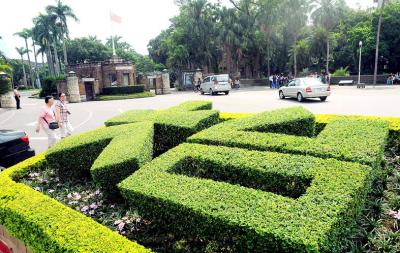
Four Taiwanese universities have been ranked among the world's top 200 institutions in the Quacquarelli Symonds (QS) World University Rankings for next year, the highest Taiwan has ever placed in the category, with National Taiwan University (NTU) achieving its best performance at 54th globally and 17th in Asia. The four Taiwanese institutions in the global top 200 are NTU (54th), National Tsing Hua University (142nd), National Yang Ming Chiao Tung University (177th) and National Cheng Kung University (191st), the rankings showed. All four universities achieved their highest-ever global rankings this year, QS data showed. National Cheng Kung University entered the top 200 for


 RSS
RSS