


A number of political parties and civic groups have reached agreement on a two-stage constitutional reform process that aims to defer the most controversial issues until a second round.
Representatives of more than a dozen groups and political parties yesterday attended the Convention on the Action Plan for Constitutional Reform at the Legislative Yuan in Taipei, which began with speeches by former president Lee Teng-hui (李登輝), the honorary convention convener, and Legislative Speaker Wang Jin-pyng (王金平).
Lee called for constitutional amendments to be processed in two stages, making changes that people have agreed upon first, because “the seventh constitutional amendment in 2005 set the threshold for amending the Constitution too high, and this is what needs to be overcome.”
“With the threshold as it is, the amendment process could easily be stalled by a small minority who have views opposing the calls for change,” Lee said, calling upon Wang and lawmakers at the meeting to “put aside particular interests and help the nation undergo its second democratic reform.”
Regarding the government system, “some call for a parliamentary system, some for a quasi-presidential system, or presidential system. Rewriting the Constitution is also an option for some,” Lee said. “However, what has to be recognized is that each nation’s political development is different, from which different constitutional cultures and political systems are formed.”
“The most vital aspect is the separation of powers, which have to be commensurate with responsibility, and there has to be a mechanism for resolving confrontations between the government and the people,” Lee said.
The legislature would have a bill outlining changes to the procedure for amending the Constitution ready before the end of this plenary session, in time for a June 17 deadline, Wang said, adding that a planned referendum to be held alongside next year’s presidential and legislative elections would be executed.
“The passage of the bill depends on good communication between the ruling and opposition parties, and a consensus achieved with popular support,” Wang said.
The Chinese Nationalist Party (KMT) and the Democratic Progressive Party (DPP) agreed on a two-stage amendment process, with both saying that at the first stage, two changes could be made: lowering the voting age to 18 — with the DPP calling for the lowering of the minimum age for candidacy from 23 to 20 — and decreasing to 3 percent the votes parties are required to win for them to name legislators-at-large.
However, the two major parties do not see eye-to-eye on some issues for the first stage of the procedure. The KMT is calling for absentee voting and the legislature’s right to approve the premiership, while the DPP backs the abolition of the Control Yuan and the Examination Yuan, lowering the threshold for amending the Constitution and complementary revisions to guarantee basic human rights.
The civic groups and smaller political parties’ views aligned more with the DPP’s position.
The Civil Alliance to Promote Constitutional Reform (CAPCR) and the Green Party said they wanted a “bottom-up” process for the procedure to amend the Constitution, with civic deliberation a necessary step.
The Social Democratic Party urged the two main parties to promise that second-stage constitutional amendment talks would take place after next year’s elections.
Almost all of the smaller groups said the Constitution’s human rights clauses needed revamping.
They said it was important to introduce a human rights charter to ensure basic human rights as defined by international conventions and past interpretations of the Council of Grand Justices.
The Taiwan First Nations Party, the nation’s first political party dedicated to the rights of indigenous people, called for a special chapter on repositioning Taiwan as a multicultural and multi-ethnic country.
Yesterday’s conference was organized by the CAPCR, the Civil Constitutional Convention, the Lee Teng-hui Foundation, the Taiwan Association of University Professors and the Economic Democracy Union.

FUKUOKA SITUATION: Japanese media reported that the pathogen is expected to be identified by the summer, while the CDC downplayed the idea that it was hMPV A “mysterious cold-like illness” reported in Japan’s Fukuoka Prefecture does not seem to be a new disease, but Japanese authorities have been asked about the situation, the Centers for Disease Control (CDC) said yesterday. The Fukuoka Prefectural Medical Association on Wednesday told a news conference that a “mystery cold” that has become a hot topic on social media is “highly likely to be caused by some kind of viral infection,” Japan’s KBC News reported. “Many people are experiencing symptoms starting with a sore throat, followed by a runny nose, phlegm and a severe cough,” KBC News reported, citing association officials. Health authorities are

Nvidia Corp CEO Jensen Huang (黃仁勳) arrived in Taiwan yesterday ahead of upcoming AI and technology events, saying he plans to meet with clients and Taiwan Semiconductor Manufacturing Co Chairman C.C. Wei (魏哲家) during his visit. After landing at Taipei Songshan Airport, Huang posed for photos with fans and handed out Yakult drinks to reporters and supporters waiting at the scene, saying he has “a lot to do” during the trip. Asked about reports that Nvidia’s planned headquarters site in Taipei’s Beitou Shilin Technology Park could break ground on May 27, Huang said that if the company holds an event, he would

Carrefour Taiwan is to begin using a new name from the start of July, but it cannot divulge the name until then, the chairman of the supermarket chain's parent company said today. President Chain Store Co chairman Lo Chih-hsien (羅智先) was asked by reporters after a shareholders' meeting to confirm whether the company has settled on a new name for the supermarket brand. In March, the government-registered name of two Carrefour Taiwan branches was quietly changed to "Le Chia Kang" (樂家康) in Chinese, raising speculation that has been selected as the name. Lo said that because of local regulations and contractual obligations, the
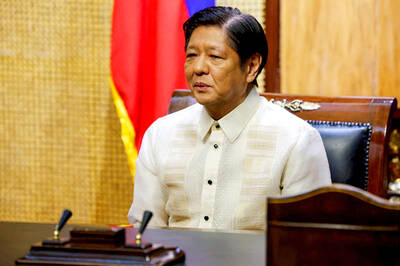
The Philippines would likely be involved in any conflict over Taiwan due to its proximity to the democracy claimed by China, President Ferdinand Marcos Jr said, reiterating a stance that risks angering Beijing. “In the Philippines, we do not have a choice because Taiwan is so close to the Philippines and we have almost 200,000 Filipino nationals living and working in Taiwan,” Marcos said in an interview with Japanese media in Manila on Monday. The Philippine leader’s comments come ahead of a state visit to Japan next week, where he is to meet with Japanese Prime Minister Sanae Takaichi to discuss security


 RSS
RSS