


Legislators from across party lines yesterday pledged support for major reforms to shorten the legal workweek, as the legislature’s Social Welfare and Environmental Hygiene Committee cleared amendments to the Labor Standards Act (勞動基準法).
If passed by the legislature’s plenary session later this month, the landmark piece of legislation would change regulations that define work hours as 84 hours per two weeks to 40 hours per week — effectively ensuring two days off per week.
The new policy is set to be implemented by next year and expected to benefit about 3.4 million workers in the private sector.
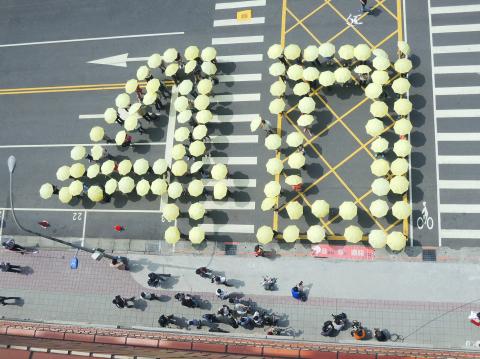
Photo: Huang Pang-ping, Taipei Times
However, the fate of a controversial clause that would increase the monthly limit for overtime work from 46 to 54 hours remained unclear, as the Executive Yuan’s version of the bill failed to reach the committee stage for review yesterday.
The move to raise the overtime cap provoked strong criticism from legislators from the Chinese Nationalist Party (KMT) and the Democratic Progressive Party (DPP) alike.
DPP Legislator Chao Tien-ling (趙天麟) said that increasing the overtime limit by eight hours would render the other reforms meaningless, because shortening work hours to 40 hours per week decreased work hours by precisely eight hours per month.
He accused the government of treating the people like monkeys, citing a classic fable in which an old man appeased monkeys under his care by promising them four chestnuts at dawn and three at dusk, instead of the other way around.
Given that all 12 versions put forward by legislators shortened the workweek without stipulating an increase in overtime work, it made no sense for legislators to support the Executive Yuan’s version, Chao said.
In a show of bipartisan cooperation, KMT legislators supported Chao, with Lin Hung-chih (林鴻池), Wu Yu-jen (吳育仁), Chiang Hui-chen (江惠貞) and others taking to the speaker’s podium to speak out on the clause.
They said that while the Executive Yuan’s version contained certain progressive aspects — such as a clause that requires employers to compensate employees for unused holidays that have passed their half-year limit — the proposal to increase overtime hours stymied the otherwise positive reforms.
Legislators also agreed on other reforms such as increasing fines for those who violate labor regulations, extra pay for employees working on national holidays, and making workers eligible to apply for flexible work hours by one hour for family reasons.
Although the two-days-off-per-week policy has been in place in the public sector since 2001, only about 50.1 percent of companies in the private sector have followed suit, while the remaining 49.9 percent of private enterprises do not guarantee two days off a week.
While legislators reviewed the act, nearly 200 protesters led by Taiwan Labour Front rallied outside the Legislative Yuan compound to protest the proposed increase in the overtime work limit.
Holding bright yellow umbrellas, participants arranged themselves to form the number “40” in the middle of Jinan Rd outside the legislature, chanting: “Open up the protective umbrella for workers.”
Taiwan Labour Front secretary-general Son Yu-liam (孫友聯) said that Taiwanese suffered from overwork to a dangerous degree, with the nation’s annual average number of work hours ranked third in the world at 2,124 hours a year, surpassed by only South Korea and Mexico.
He urged the government to withdraw its proposal to increase overtime hours, adding that Taiwanese employers rarely offer overtime pay.
“We urge the government to help us fulfill our pitiful demand of a 40-hour workweek, something many other nations already achieved more than 100 years ago,” Son said.

FUKUOKA SITUATION: Japanese media reported that the pathogen is expected to be identified by the summer, while the CDC downplayed the idea that it was hMPV A “mysterious cold-like illness” reported in Japan’s Fukuoka Prefecture does not seem to be a new disease, but Japanese authorities have been asked about the situation, the Centers for Disease Control (CDC) said yesterday. The Fukuoka Prefectural Medical Association on Wednesday told a news conference that a “mystery cold” that has become a hot topic on social media is “highly likely to be caused by some kind of viral infection,” Japan’s KBC News reported. “Many people are experiencing symptoms starting with a sore throat, followed by a runny nose, phlegm and a severe cough,” KBC News reported, citing association officials. Health authorities are

Nvidia Corp CEO Jensen Huang (黃仁勳) arrived in Taiwan yesterday ahead of upcoming AI and technology events, saying he plans to meet with clients and Taiwan Semiconductor Manufacturing Co Chairman C.C. Wei (魏哲家) during his visit. After landing at Taipei Songshan Airport, Huang posed for photos with fans and handed out Yakult drinks to reporters and supporters waiting at the scene, saying he has “a lot to do” during the trip. Asked about reports that Nvidia’s planned headquarters site in Taipei’s Beitou Shilin Technology Park could break ground on May 27, Huang said that if the company holds an event, he would

Carrefour Taiwan is to begin using a new name from the start of July, but it cannot divulge the name until then, the chairman of the supermarket chain's parent company said today. President Chain Store Co chairman Lo Chih-hsien (羅智先) was asked by reporters after a shareholders' meeting to confirm whether the company has settled on a new name for the supermarket brand. In March, the government-registered name of two Carrefour Taiwan branches was quietly changed to "Le Chia Kang" (樂家康) in Chinese, raising speculation that has been selected as the name. Lo said that because of local regulations and contractual obligations, the
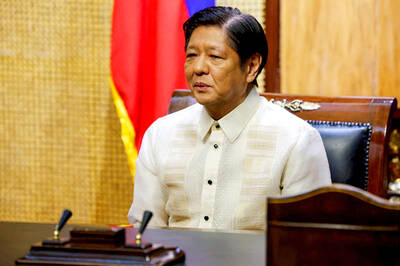
The Philippines would likely be involved in any conflict over Taiwan due to its proximity to the democracy claimed by China, President Ferdinand Marcos Jr said, reiterating a stance that risks angering Beijing. “In the Philippines, we do not have a choice because Taiwan is so close to the Philippines and we have almost 200,000 Filipino nationals living and working in Taiwan,” Marcos said in an interview with Japanese media in Manila on Monday. The Philippine leader’s comments come ahead of a state visit to Japan next week, where he is to meet with Japanese Prime Minister Sanae Takaichi to discuss security


 RSS
RSS