


President Ma Ying-jeou (馬英九) yesterday reiterated Taiwan’s determination to push ahead with its domestic submarine program to modernize its fleet and bolster the nation’s defense capabilities.
“We aim to acquire next-generation submarines to safeguard our coastal frontier,” Ma said at a ceremony at which two military vessels — Taiwan’s first home-grown stealth missile corvette and a new supply ship — were put into service.
“The submarine is the most significant weapon for a country building its naval defense capabilities. The military absolutely needs to acquire [new] submarines,” he said.
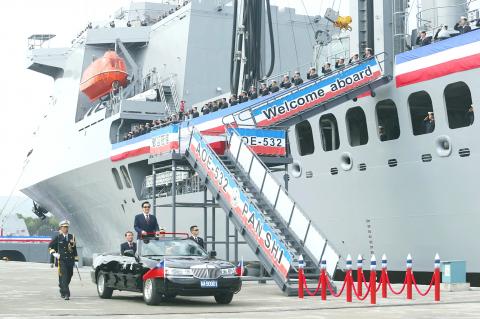
Photo: CNA
Emphasizing Taiwan’s effort to develop its own submarine program, Ma said: “We have the determination and we are definitely confident that we will achieve the goal of building submarines domestically.”
Yesterday’s ceremony was held at the Zuoying (左營) naval base in Kaohsiung, the largest naval base in the nation.
The two new vessels are part of the navy’s efforts to modernize its fleet.
The 500-tonne twin-hulled Hsun-hai class corvette, the Tuo Jiang, cost about NT$2.1 billion (US$66.04 million) to build and was officially delivered to the navy by domestic shipbuilder Lung Teh Shipbuilding Co at a ceremony held on Dec. 23 last year in Yilan County’s Suao Port.
The Tuo Jiang is equipped with several weapons, including domestically developed Hsiung Feng II and Hsiung Feng III anti-ship missiles, a 76mm gun and Mark 46 torpedoes, the navy said.
It has a range of 2,000 nautical miles (3,704km), is 60.4m long and 14m wide, and carries a crew of up to 41. Training on the vessel has already begun.
The new supply vessel, the Pan Shi, was delivered to the navy by domestic shipbuilder CSBC Corp in January at a ceremony in Kaohsiung, and training has since begun on the second supply vessel in the navy’s fleet.
The vessel will help extend the navy’s maritime combat capabilities through its support of Taiwanese warships, and boost the nation’s ability to provide international humanitarian assistance, Ma said.
The Pan Shi is to be used to transport fuel, ammunition and other supplies to support the navy fleet in wartime. In peacetime, it is to be used mainly to carry supplies, conduct maritime rescue missions, and provide humanitarian assistance.
The new supply vessel, which cost NT$4.09 billion to build, is 196m long and 25.2m wide, can accomodate a crew of up to 165 people, and has a range of 8,000 nautical miles, according to the navy.
It can reach a maximum speed of 22 knots and has a load displacement of about 20,000 tonnes.
In addition to the Tuo Jiang and the Pan Shi, other domestically built military boats and vessels used by the coast guard were docked at the naval base to showcase the nation’s shipbuilding capabilities.
Pointing to an empty space in the harbor, Ma said: “That area is being saved for the nation’s domestically made submarines in the future.”
Facing challenges to procure submarines and other military hardware from abroad because of Beijing’s objections, Taiwan has begun to build naval vessels on its own, which Ma said has helped upgrade the nation’s domestic shipbuilding capabilities and also created job opportunities.
The Tuo Jiang is to be based with the 131st Fleet in Keelung on Taiwan’s northern coast, while the Pan Shi is to join the 151st Fleet, which is based in Zuoying.
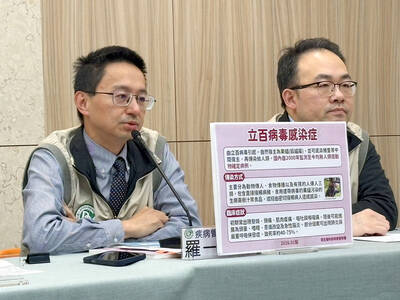
Nipah virus infection is to be officially listed as a category 5 notifiable infectious disease in Taiwan in March, while clinical treatment guidelines are being formulated, the Centers for Disease Control (CDC) said yesterday. With Nipah infections being reported in other countries and considering its relatively high fatality rate, the centers on Jan. 16 announced that it would be listed as a notifiable infectious disease to bolster the nation’s systematic early warning system and increase public awareness, the CDC said. Bangladesh reported four fatal cases last year in separate districts, with three linked to raw date palm sap consumption, CDC Epidemic Intelligence
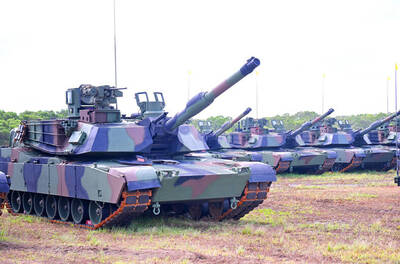
The manufacture of the remaining 28 M1A2T Abrams tanks Taiwan purchased from the US has recently been completed, and they are expected to be delivered within the next one to two months, a source said yesterday. The Ministry of National Defense is arranging cargo ships to transport the tanks to Taiwan as soon as possible, said the source, who is familiar with the matter. The estimated arrival time ranges from late this month to early next month, the source said. The 28 Abrams tanks make up the third and final batch of a total of 108 tanks, valued at about NT$40.5 billion

Two Taiwanese prosecutors were questioned by Chinese security personnel at their hotel during a trip to China’s Henan Province this month, the Mainland Affairs Council (MAC) said yesterday. The officers had personal information on the prosecutors, including “when they were assigned to their posts, their work locations and job titles,” MAC Deputy Minister and spokesman Liang Wen-chieh (梁文傑) said. On top of asking about their agencies and positions, the officers also questioned the prosecutors about the Cross-Strait Joint Crime-Fighting and Judicial Mutual Assistance Agreement, a pact that serves as the framework for Taiwan-China cooperation on combating crime and providing judicial assistance, Liang
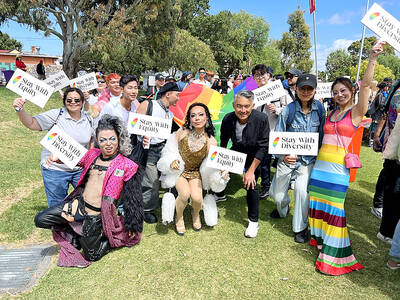
A group from the Taiwanese Designers in Australia association yesterday represented Taiwan at the Midsumma Pride March in Melbourne. The march, held in the St. Kilda suburb, is the city’s largest LGBTQIA+ parade and the flagship event of the annual Midsumma Festival. It attracted more than 45,000 spectators who supported the 400 groups and 10,000 marchers that participated this year, the association said. Taiwanese Designers said they organized a team to march for Taiwan this year, joining politicians, government agencies, professionals and community organizations in showing support for LGBTQIA+ people and diverse communities. As the first country in Asia to legalize same-sex


 RSS
RSS