


The government is closely monitoring a flurry of construction work by rival claimant nations in South China Sea islands and reefs, National Security Bureau (NSB) Director-General Lee Shying-jow (李翔宙) said, although he disagreed with calls to bolster Taiwan’s military built-up in the disputed region.
Lee was asked about reports about Vietnam deploying heavy artillery guns and other enhanced military installations on the Spratly Islands (Nansha Islands, 南沙群島) by Chinese Nationalist Party (KMT) Legislator Lin Yu-fang (林郁方) at a session of the legislature’s Foreign Affairs and National Defense Committee yesterday.
“In the South China Sea, for any country undertaking efforts to strengthen their defense and to project a stronger military presence, it is not a good thing for the stability of that region,” the bureau head said.
According to Lin, Vietnam has been active in the area, undertaking construction and installing heavy artillery weapons on Sandy Cay (Duncian Shajou, 敦謙沙洲) and Namyit Island (Hongsiou Island, 鴻庥島).
Lin said that Sandy Cay lies just 6 nautical miles (11.11km) from Itu Aba Island (Taiping Island, 太平島), which is Taiwan’s largest territory in the South China Sea.
Lin urged the government to renew construction on extending the airstrip on Itu Aba Island to accommodate C-130 military transport aircraft.
“The runway extension will enable us to conduct marine rescue operations and disaster relief missions,” Lin said.
“When carried out, these can reduce tension in the region and can help to enhance Taiwan’s good image in the international community,” Lin added.
However, Lee backed away from endorsing plans to continue the runway extension work.
“Besides competition, we should consider cooperation in the international arena,” Lee said.
“If we boost our military installation on Taiping Island, it might harm the nation’s situation in the region,” Lee said.
“It is also not conducive to regional stability in the South China Sea,” Lee added.
Regarding Vietnam’s new military facilities and construction work on the Spratly Islands, Lee said the bureau is aware of the situation and has it under close monitoring.
Taiwan’s intelligence agency and armed forces are also closely following stepped-up construction and land reclamation activities by China in the region, including on Fiery Cross Reef (Yongshu Reef, 永暑礁), Johnson South Reef (Chigua Reef, 赤瓜礁), Hughes Reef (Dongmen Reef, 東門礁), Cuarteron Reef (Huayang Reef, 華陽礁) and Gaven Reef (Nansyun Reef, 南薰礁).
Meanwhile, Lee confirmed that the Democratic Progressive Party’s (DPP) official Web site had been shut down on Tuesday due to a series of DDoS (distributed denial of service) attacks from outside Taiwan.
Although Lee would not give more details, DPP legislators said the 100,000 hostile attacks within a five-minute period came from bases in China.
DPP officials said they have reported the hacking attacks to the police and urged authorities to find ways to protect the nation’s digital networking security.
During the committee session yesterday, the NSB head said that the agency would establish a cybersecurity department in May and would staff the unit with professionals from the private sector.
The new department would comprise four divisions staffed by people who are trained to fight cybercrime, Lee said, adding that they would not be hackers.
Certain amendments to the nation’s information and communications regulations would be required to recruit cybersecurity and computer network experts from the private sector, Lee said.
The bureau would also seek to facilitate exchange programs with foreign cybersecurity communities to upgrade the skills of the unit’s staff, he said.
Additional reporting by CNA

NATIONAL SECURITY: Authorities are working to confirm the identities of the military personnel involved and investigating possible illegal conduct and regulatory violations Authorities are probing possible national security implications after Kinmen police and immigration officers on Sunday found a Chinese woman allegedly posing as a tourist while engaging in prostitution involving more than 10 military personnel. The woman, surnamed Chen (陳), has since been deported, authorities said, adding that investigators are still working to confirm the identities of those implicated, as the records only listed code names and aliases. The case stemmed from a report received by the Kinmen District Prosecutors’ Office on Friday last week from the Jinhu Precinct of the Kinmen County Police Bureau. On Sunday, police, along with the National Immigration

GLOBALGIVING: ‘ Caving to external pressure is not acceptable for an organization that has cultivated justice reform and human rights for 30 years,’ one NGO said A slew of non-government organizations (NGOs) have withdrawn from the GlobalGiving fundraising platform after it announced it would use “Chinese Taipei” instead of “Taiwan” from next month. The Taiwan Good Rice Association wrote on Facebook on Friday that it was informed on April 28 via a teleconference call of the change, which was made because the platform wanted to operate in China. Taiwan Good Rice is to terminate all cooperative relationships with GlobalGiving in response to the platform’s “unilateral and non-negotiable” decision to remove references to Taiwan, the NGO said. “Taiwan is in the official name of Taiwan Good Rice Association and the
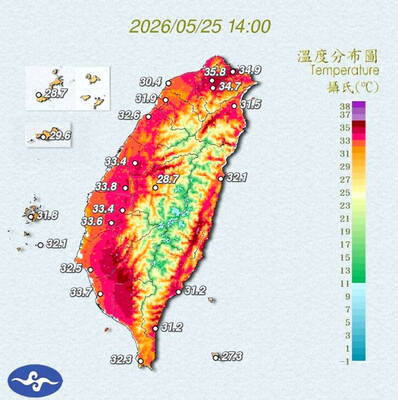
STAY COOL: The HPA recommended that people stay hydrated, use air-conditioning or fans while indoors, wear loose-fitting clothes and walk in the shade while outdoors Employers must implement measures such as installing cooling equipment, and providing drinking water and rest breaks for outdoor workers starting from Monday next week, the Taipei Department of Labor said on Sunday. Employers who fail to comply could face fines of NT$30,000 to NT$300,000 under the Occupational Safety and Health Act (職業安全衛生法), the department said. Businesses in Taipei employing fewer than 100 workers, as well as registered self-employed workers with labor insurance coverage, could receive on-site assessments and guidance from occupational safety consultants to help them apply for central government subsidies to implement or improve heat-protection measures, it said. Under the Ministry of

Chinese Nationalist Party (KMT) Chairwoman Cheng Li-wun (鄭麗文) yesterday briefed her party’s Central Standing Committee regarding her scheduled visit to the US between Monday next week and June 16, saying that her purpose would be to persuade the US that the Republic of China (ROC) Constitution was a “one China” constitution that would foster stable and peaceful cross-strait relations. The ROC Constitution is the most important defense for all Taiwanese citizens, as it upholds our democracy and has contributed to our robust economy, which aligns with international and US interests, she said. “We would not be troublemakers and drag the US under,”


 RSS
RSS