


On the anniversary of the start of last year’s Sunflower movement, New Taipei City Mayor and Chinese Nationalist Party (KMT) Chairman Eric Chu (朱立倫) pledged to develop policies to address youth employment and education, housing and tax reforms, adding that the party is listening to the views of young people.
“The KMT is reflecting [on its mistakes],” Chu said at the party’s Central Standing Committee meeting yesterday.
The KMT is cognizant of its lopsided policy emphasizing economic growth and cross-strait relations at the expense of a fair distribution of wealth and intergenerational equality, he said, adding that the party is putting youth employment and higher salaries at the top of its agenda.
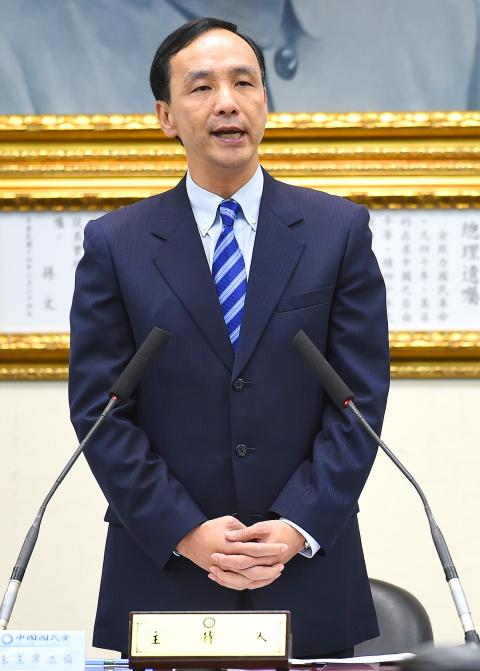
Photo: Chang Chia-ming, Taipei Times
The KMT would collaborate with labor groups to achieve a fairer distribution of wealth and create more job opportunities and a friendlier environment for young entrepreneurs, he added.
The KMT would attach greater importance to housing and residential justice — issues that young people care greatly about, Chu said.
To facilitate the fairer distribution of wealth, the KMT legislative caucus and Minister of Finance Chang Sheng-ford (張盛和) would push for tax-reform legislation in this legislative plenary session, he said.
“[The KMT] especially aims to make rich people pay more taxes to make Taiwan a fairer society,” Chu said.
Chu said that many young graduates are doing jobs that have little to do with their qualifications, which suggested that the nation’s education system — especially in regards to vocational education — is inadequate.
To boost the nation’s competitiveness, the KMT wants to improve vocational education by hastening a fuller integration of vocational training with industry, with the party cooperating with the Ministry of Education in formulating relevant policies, he said.
Amid a surge of young candidates entering next year’s legislative elections, Chu said that it is commendable that young people care about politics and engage in social service, but added that it takes more than passion to come up with clear and constructive visions and put those policies into practice.
He said that both the nation and the party depend on young people, who are Taiwan’s future.
Fast food chain McDonald's is to raise prices by up to NT$5 on some products at its restaurants across Taiwan, starting on Wednesday next week, the company announced today. The prices of all extra value meals and sharing boxes are to increase by NT$5, while breakfast combos and creamy corn soup would go up by NT$3, the company said in a statement. The price of the main items of those meals, if ordered individually, would remain the same. Meanwhile, the price of a medium-sized lemon iced tea and hot cappuccino would rise by NT$3, extra dipping sauces for chicken nuggets would go up
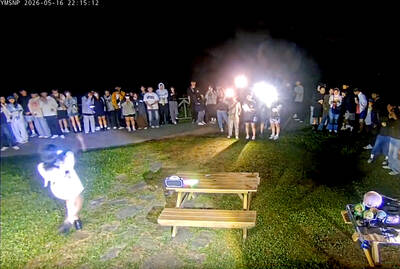
Yangmingshan National Park’s Qingtiangang (擎天崗) nature area has gone viral after a park livestream camera observed a couple in the throes of intimate congress, which was broadcast live on YouTube, drawing large late-night crowds and sparking a backlash over noise, bright lights and disruption to wildlife habitat. The area’s livestream footage appeared to show a couple engaging in sexual activity on a picnic table in the park on Friday last week, with the uncensored footage streamed publicly online. The footage quickly spread across social media, prompting a tide of visitors to travel to the site to “check in” and recreate the

GROUNDED: A KMT lawmaker proposed eliminating drone development programs and freezing funding for counterdrone systems, despite China’s adoption of the technology China has deployed attack drones at air bases near the Taiwan Strait in a strategy aimed at overwhelming Taiwan’s air defense systems through saturation attacks, the Mainland Affairs Council (MAC) said. The council’s latest quarterly report on China said that satellite imagery and open-source intelligence indicate that the Chinese People’s Liberation Army (PLA) had converted retired J-6 fighter jets into J-6W drones, which the PLA has stationed at six air bases near Taiwan, five in China’s Fujian Province and one in Guangdong Province. The report cited J. Michael Dahm, a senior fellow at the US-based Mitchell Institute, as saying that China has

Carrefour Taiwan is to begin using a new name from the start of July, but it cannot divulge the name until then, the chairman of the supermarket chain's parent company said today. President Chain Store Co chairman Lo Chih-hsien (羅智先) was asked by reporters after a shareholders' meeting to confirm whether the company has settled on a new name for the supermarket brand. In March, the government-registered name of two Carrefour Taiwan branches was quietly changed to "Le Chia Kang" (樂家康) in Chinese, raising speculation that has been selected as the name. Lo said that because of local regulations and contractual obligations, the


 RSS
RSS