


Ahead of anti-nuclear demonstrations scheduled for Saturday, former presidential adviser Rex How (郝明義) yesterday criticized the government for backing the extension of the service life of the Jinshan Nuclear Power Plant in New Taipei City’s Shihmen District (石門), and drew attention to the issue of used fuel rods.
In an article published in the Chinese-language Liberty Times (the Taipei Times’ sister newspaper), How slammed the government for touting the benefits of nuclear energy, while failing to address its own incompetence at nuclear waste management.
He said that there are two reactors at the Jinshan plant, and the fuel pool of the No. 1 reactor reached capacity at the end of last year.
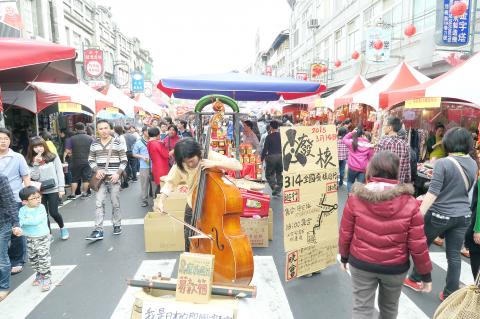
Photo: Tsai Wen-chu, Taipei Times
The fuel pool of the No. 2 reactor will reach its capacity in March next year, meaning that there will be no more space to store the two reactors’ spent fuel rods, he wrote.
On Taiwan Power Co’s (Taipower) request to extend the service life of the plant for 20 years after its scheduled decommissioning in 2018, How said both the proponents and detractors of the plan have overlooked the problem of the lack of storage space for nuclear waste.
“Many who oppose extending the service life of the plant have accepted the 2018 deadline, while supporters say that with proper maintenance, the plant can remain operational until 2038. Both sides fail to address the problem of the lack of spent fuel rod storage,” he said.
“Just like a person who has a three-to-five year life expectancy but whose anus has been blocked, how can he survive without the ability to void?” How wrote. “Similarly, no matter what condition a nuclear power plant is in, how can it continue to operate without any room for spent fuel rods?”
It is dangerous to use anything that has expired, not to mention powering a nuclear reactor with spent fuel rods, he said.
“No one in the world has ever tried it, yet that is exactly what Taipower plans to do,” he said.
The plan has been put on hold following an incident in December last year, when a No. 1 reactor fuel rod cask handle was found to be loose, for which Taipower has said it would seek NT$1.5 billion (U$47.6 million) in compensation from French firm Avera, How said.
While that incident is to be covered by compensation, any potential accidents caused by burning spent fuel rods, on Taipower’s own initiative, would not be, he said, adding that the consequences of such actions would be unthinkable and beyond anyone’s ability to control.
How called on demonstrators in the upcoming nuclear march to focus their attention on the used-up fuel pool, saying that it should be decommissioned at once and so should the second pool, once it reaches capacity.
“We must be prudent of the great danger we are in, and prepare for future generations. A potential nuclear meltdown must be averted,” he said.

UPGRADE: The Kang Ding-class frigate is replacing its Chaparall missiles with Tien Chien II and Hua Yang VLS, which would provide it with long-range, 360° air defense Taiwan plans to produce 1,200 to 1,376 Hai Chien II missiles (海劍二, Sea Sword II) — also known as TC-2N — to serve as the standard air defense system of the navy’s surface combatant fleet, a source said yesterday. Last week, the Hai Chien II, the naval version of the Tien Kung II missile (天劍二, Sky Sword II), completed a live-fire test in waters off the National Chungshan Institute of Science and Technology’s Jiupeng facility (九鵬) in Pingtung County’s Manjhou Township (滿州). The MIM72 Chaparral and other dated air defense missiles that currently arm Taiwanese ships have inadequate range to combat Chinese

REASONS FOR TRAVEL: An assistant professor said that proposed amendments to penalize drivers if they used drugs overseas would not deter people from traveling People who operate a motor vehicle under the influence of marijuana would have their driver’s license revoked, even if they used the substance while overseas, the Ministry of Transportation and Communications said yesterday, citing proposed amendments to the Road Traffic Management and Penalty Act (道路交通管理處罰條例). The amendments would also authorize the government to revoke the licenses of people determined to have used Category 1 or Category 2 narcotics, even if they were not operating a vehicle while under the influence of drugs, as well as ban them from taking the license test for three years, the ministry said. People aged 18 or

HEAVY WEATHER: Typhoon Jangmi is due to crash straight into the Ryukyus as airlines look to shift flights to larger aircraft or cancel flights to Okinawa entirely Taiwan’s international air carriers announced flight adjustments over the weekend as Typhoon Jangmi is forecast to hit the Ryukyu Islands today and tomorrow. The Central Weather Administration (CWA) upgraded Jangmi from a tropical storm to a typhoon at 8am yesterday, with the eye located 580km south of Naha city. It was moving north at 19kph. Today, China Airlines’ CI-120, CI-121, CI-122 and CI-123 flights between Taoyuan and Naha, Okinawa, have been canceled as well as CI-132 and CI-133 between Kaohsiung and Naha. EVA Air’s BR-112, BR-113, BR-186 and BR-185 flights between Taoyuan and Naha are also canceled. Low-cost carrier Tigerair Taiwan canceled IT-230,
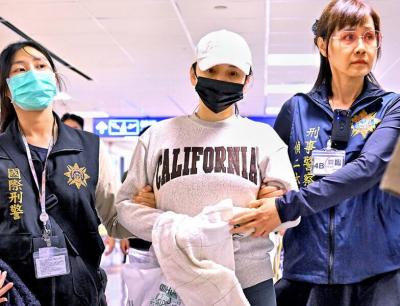
Johanne Liou (劉喬安), a Taiwanese woman who shot to unwanted fame during the Sunflower movement protests in 2014, returned to Taiwan last night after being deported from the US. She is to stand trial in Taiwan for charges involving embezzlement, fraud and drug crimes. The Criminal Investigation Bureau (CIB) said it took her into custody at Taiwan Taoyuan International Airport and would first question her before transferring her to the New Taipei District Prosecutors’ Office. She was arrested upon disembarking a flight from San Francisco that landed shortly before 7pm. Liou absconded to the US in 2019 after jumping bail


 RSS
RSS