


An 80-year-old who was falsely imprisoned following the 1952 Luku Incident (鹿窟事件) has published a memoir of the dark chapter in the White Terror era on a bid to do justice to history and commemorate others caught up in the events.
The Luku Incident began with a four-month military campaign to uncover and arrest alleged “communists” said to be operating in the mountainous areas around Luku Village, which borders now-New Taipei City’s Sijhih (汐止) and Shiding (石碇) districts. The action saw 35 people sentenced to death and 98 imprisoned, making it one of the harshest episodes of suppression during the White Terror era.
Lee Shih-Cheng (李石城), the author of the memoir, also financed the building of a memorial column at Sijhih’s Daqijiao (大崎腳) in 2000 to commemorate an uprising organized by a group of townspeople, including his father, against the Japanese colonial government more than 100 years ago, he said.
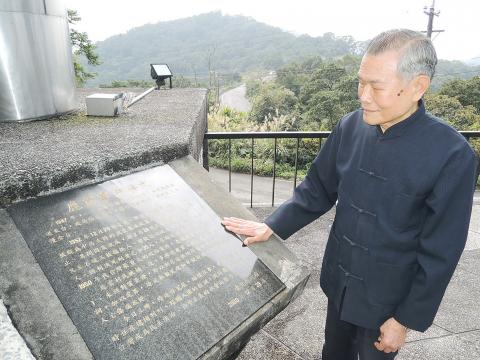
Photo: Weng Yu-huang, Taipei Times
The resistance, composed of a group of untrained and insufficiently armed citizens, was met by a superior Japanese force, resulting in heavy causalities, with 99 people killed at Daqijiao. The Japanese government branded those involved in the uprising “bandits,” a stigmatizing term Lee aimed to correct by establishing the column.
He was also called a “communist bandit” when he was 17 and served 10 years in prison following the Luku Incident, he said.
Lee was born to poor farmers in Sijhih and he received only two years elementary education before leaving to work on the family farm, he said.
He was underage when he was recruited by villagers, including a distant relative of his, into an armed group active in the mountains around Luku Village, he said.
He became a member of the group’s “youth vanguard,” but he did not do anything illegal and received no financial benefit, he said, adding that he only offered the group friendly support.
However, government forces laid siege to Luku and the surrounding areas in December 1952 to crack down on what they termed “a communist rebellion,” and more than 200 people were arrested, interrogated and tortured, he said.
Lee suffered spinal injuries and lost his teeth under torture, but he denied any involvement in the so-called rebellion, knowing that an admission of guilt meant certain death, he said.
“I escaped death but not a prison term,” he said.
He was given a 10-year sentence for his “involvement in a communist organization and attempt to overthrow the government,” he said
The court commuted the sentence to five years as Lee was only 17, but he was not released until he was 28 — after having served the full 10 years, he said.
His mother died shortly after he was imprisoned, but he did not find out until after his release, he said.
He was originally denied employment as his identification card indicated that he was restricted from military service — usually signifying a criminal record — but a fellow villager later gave him a mining job, he said.
Having survived hard times, he went on to father a family of five, and his children are all doing well, he said.
He wrote his memoir to document the injustices of the White Terror era and pay tribute to his fellow victims, he said, adding that he taught himself to read and write during his imprisonment.
He said that history must not be forgotten so people do not make the same mistakes, and that he had learned to let go of the bitterness and resentment.
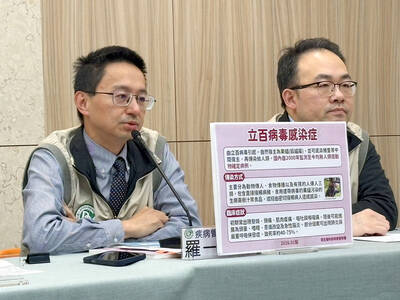
Nipah virus infection is to be officially listed as a category 5 notifiable infectious disease in Taiwan in March, while clinical treatment guidelines are being formulated, the Centers for Disease Control (CDC) said yesterday. With Nipah infections being reported in other countries and considering its relatively high fatality rate, the centers on Jan. 16 announced that it would be listed as a notifiable infectious disease to bolster the nation’s systematic early warning system and increase public awareness, the CDC said. Bangladesh reported four fatal cases last year in separate districts, with three linked to raw date palm sap consumption, CDC Epidemic Intelligence
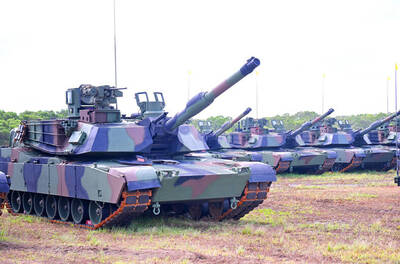
The manufacture of the remaining 28 M1A2T Abrams tanks Taiwan purchased from the US has recently been completed, and they are expected to be delivered within the next one to two months, a source said yesterday. The Ministry of National Defense is arranging cargo ships to transport the tanks to Taiwan as soon as possible, said the source, who is familiar with the matter. The estimated arrival time ranges from late this month to early next month, the source said. The 28 Abrams tanks make up the third and final batch of a total of 108 tanks, valued at about NT$40.5 billion

Two Taiwanese prosecutors were questioned by Chinese security personnel at their hotel during a trip to China’s Henan Province this month, the Mainland Affairs Council (MAC) said yesterday. The officers had personal information on the prosecutors, including “when they were assigned to their posts, their work locations and job titles,” MAC Deputy Minister and spokesman Liang Wen-chieh (梁文傑) said. On top of asking about their agencies and positions, the officers also questioned the prosecutors about the Cross-Strait Joint Crime-Fighting and Judicial Mutual Assistance Agreement, a pact that serves as the framework for Taiwan-China cooperation on combating crime and providing judicial assistance, Liang
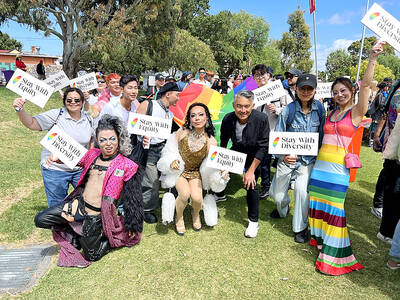
A group from the Taiwanese Designers in Australia association yesterday represented Taiwan at the Midsumma Pride March in Melbourne. The march, held in the St. Kilda suburb, is the city’s largest LGBTQIA+ parade and the flagship event of the annual Midsumma Festival. It attracted more than 45,000 spectators who supported the 400 groups and 10,000 marchers that participated this year, the association said. Taiwanese Designers said they organized a team to march for Taiwan this year, joining politicians, government agencies, professionals and community organizations in showing support for LGBTQIA+ people and diverse communities. As the first country in Asia to legalize same-sex


 RSS
RSS