


The Ministry of Economic Affairs came under fire after a draft free-trade agreement between South Korea and China was revealed on Wednesday, as the tariff reductions proposed in the pact were not as significant as the ministry previously claimed.
Critics said that the Chinese Nationalist Party (KMT) administration exaggerated the impact of the pending treaty to coerce the public into supporting trade agreements between Taiwan and China.
They said that the ministry used the Beijing-Seoul deal as a “scare tactic” in an attempt to swing the vote in the KMT’s favor during last year’s nine-in-one elections.
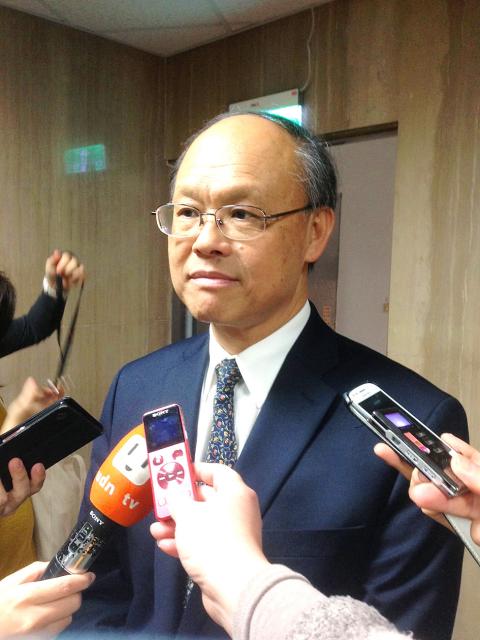
Photo: CNA
In November last year, the ministry said that the pending Beijing-Seoul pact would deal a NT$650 billion (US$20.7 billion) blow to Taiwan’s economy and urged the nation to ratify the proposed cross-strait service trade agreement to mitigate the impact.
A KMT campaign advertisement leading up to the elections last year featured a woman dressed in traditional Korean garb who thanked the Democratic Progressive Party (DPP) for blocking cross-strait trade bills.
In contrast with the ministry’s earlier claims, Minister of Economic Affairs John Deng (鄧振中) on Wednesday said that the draft was “quite different” from the ministry’s previous expectations.
According to the Beijing-Seoul draft, tariffs for many industries considered key export industries for Taiwan will not be reduced significantly — including LCD panels, automobile parts, petrochemicals and machine tools.
Human rights lawyer and Economic Democracy Union convener Lai Chung-chiang (賴中強) yesterday said that the unveiled contents of the draft “shattered all sorts of exaggerated and unrealistic threats” by the KMT.
Lai said that the pending Beijing-Seoul agreement gradually lowers tariffs between the two nations over a buffer period of 20 years.
“Members of the public should not panic over the agreement,” Lai said.
Lai added that the transparent deliberation process of the pact could serve as an example for Taiwan, as both China and South Korea would be given another four months to conduct economic assessments of the draft before the treaty is ratified.
He said the “transparency mechanism” presented by the Beijing-Seoul treaty could serve as a lesson for the KMT administration in its interactions with China.
Tens of thousands of protesters took to the streets last year during the Sunflower movement, after a KMT legislator was perceived to ram through the proposed cross-strait service trade agreement while bypassing legislative deliberation.
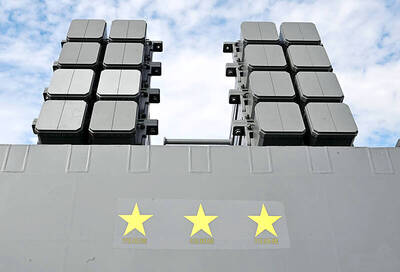
UPGRADE: The Kang Ding-class frigate is replacing its Chaparall missiles with Tien Chien II and Hua Yang VLS, which would provide it with long-range, 360° air defense Taiwan plans to produce 1,200 to 1,376 Hai Chien II missiles (海劍二, Sea Sword II) — also known as TC-2N — to serve as the standard air defense system of the navy’s surface combatant fleet, a source said yesterday. Last week, the Hai Chien II, the naval version of the Tien Kung II missile (天劍二, Sky Sword II), completed a live-fire test in waters off the National Chungshan Institute of Science and Technology’s Jiupeng facility (九鵬) in Pingtung County’s Manjhou Township (滿州). The MIM72 Chaparral and other dated air defense missiles that currently arm Taiwanese ships have inadequate range to combat Chinese

REASONS FOR TRAVEL: An assistant professor said that proposed amendments to penalize drivers if they used drugs overseas would not deter people from traveling People who operate a motor vehicle under the influence of marijuana would have their driver’s license revoked, even if they used the substance while overseas, the Ministry of Transportation and Communications said yesterday, citing proposed amendments to the Road Traffic Management and Penalty Act (道路交通管理處罰條例). The amendments would also authorize the government to revoke the licenses of people determined to have used Category 1 or Category 2 narcotics, even if they were not operating a vehicle while under the influence of drugs, as well as ban them from taking the license test for three years, the ministry said. People aged 18 or

HEAVY WEATHER: Typhoon Jangmi is due to crash straight into the Ryukyus as airlines look to shift flights to larger aircraft or cancel flights to Okinawa entirely Taiwan’s international air carriers announced flight adjustments over the weekend as Typhoon Jangmi is forecast to hit the Ryukyu Islands today and tomorrow. The Central Weather Administration (CWA) upgraded Jangmi from a tropical storm to a typhoon at 8am yesterday, with the eye located 580km south of Naha city. It was moving north at 19kph. Today, China Airlines’ CI-120, CI-121, CI-122 and CI-123 flights between Taoyuan and Naha, Okinawa, have been canceled as well as CI-132 and CI-133 between Kaohsiung and Naha. EVA Air’s BR-112, BR-113, BR-186 and BR-185 flights between Taoyuan and Naha are also canceled. Low-cost carrier Tigerair Taiwan canceled IT-230,
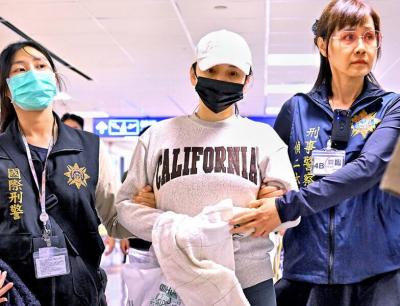
Johanne Liou (劉喬安), a Taiwanese woman who shot to unwanted fame during the Sunflower movement protests in 2014, returned to Taiwan last night after being deported from the US. She is to stand trial in Taiwan for charges involving embezzlement, fraud and drug crimes. The Criminal Investigation Bureau (CIB) said it took her into custody at Taiwan Taoyuan International Airport and would first question her before transferring her to the New Taipei District Prosecutors’ Office. She was arrested upon disembarking a flight from San Francisco that landed shortly before 7pm. Liou absconded to the US in 2019 after jumping bail


 RSS
RSS