


Foreign media have lauded pilot Liao Chien-tsung (廖建宗) for his courageous endeavors in the final moments of TransAsia Airways Flight GE235, steering away from buildings to avoid further casualties, while comments from former pilots appear to confirm rumors that Liao told the company that there was a problem with the engines.
Flight GE235 bound for Kinmen crashed into the Keelung River on Wednesday morning about 5km out of Taipei International Airport (Songshan airport).
There were 53 passengers and 5 crew members on board.
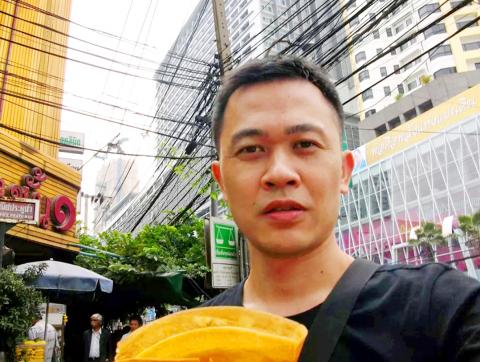
Screen grab from Liao Chien-tsung’s Facebook account
At least 31 of the passengers have been confirmed dead and rescuers continue to scour the river for the remaining 12 passengers.
A total of 15 passengers survived, most with injuries,, while two passengers in a taxi that was hit on the bridge by the plane sustained minor injuries.
Hong Kong-based aviation analyst Daniel Tsang said: “Based on the flight path, the pilot deviated and tried to avoid obstacles. The pilot apparently made a conscious effort to avoid further and unnecessary casualties by ditching in the river. It was a very courageous move.”
Former aviation safety inspector at the US Federal Aviation Administration (FAA) David Soucie said: “Well I’ve gone through each of them [the dash-cam videos] frame by frame and as you can see … it goes out of sync meaning that the left propeller lost power ... so this movement to the left was intentional by the pilot to avoid the buildings … and to make an attempt to reduce fatalities by trying to get it onto the water and miss the obstructing bridge.”
One source said that most pilots were “trained to just continue straight, it’s the best lift and the engine will allow you to continue to travel” if they suffer a flame-out of an engine during a critical phase of flight, adding that Liao had “made that decision, a conscious decision” to steer the plane into the river.
Former US Department of Transportation Inspector General Mary Schiavo said: “He was pretty close to actually saving many more … here they would have probably made it, and many more would have survived, if that wing hadn’t dropped and they hadn’t scraped the wing.”
“Statistically speaking, just an outrageously bad safety record,” Schiavo said referring to TransAsia’s safety record, which has suffered five crashes since 1995, including TransAsia Airways Flight GE222 which crashed in Penghu in July last year, killing 48 people of the 58 on board.
Many former pilots of the ATR72-600 series said that it was possible to fly and land the plane using a single engine, which suggests a faulty engine was to blame.
Meanwhile, former Civil Aeronautics Administraton director-general Billy Chang (張國政) said that the pilot’s actions had sought to minimize damages to the ground, especially as the plane was above a densely populated region.
Taipei Mayor Ko Wen-je (柯文哲) also said that the pilot had done his best, adding that the plane crashed 50m before a utility tower holding high voltage lines, which could have caused a major blackout in Taipei.

NATIONAL SECURITY: Authorities are working to confirm the identities of the military personnel involved and investigating possible illegal conduct and regulatory violations Authorities are probing possible national security implications after Kinmen police and immigration officers on Sunday found a Chinese woman allegedly posing as a tourist while engaging in prostitution involving more than 10 military personnel. The woman, surnamed Chen (陳), has since been deported, authorities said, adding that investigators are still working to confirm the identities of those implicated, as the records only listed code names and aliases. The case stemmed from a report received by the Kinmen District Prosecutors’ Office on Friday last week from the Jinhu Precinct of the Kinmen County Police Bureau. On Sunday, police, along with the National Immigration

GLOBALGIVING: ‘ Caving to external pressure is not acceptable for an organization that has cultivated justice reform and human rights for 30 years,’ one NGO said A slew of non-government organizations (NGOs) have withdrawn from the GlobalGiving fundraising platform after it announced it would use “Chinese Taipei” instead of “Taiwan” from next month. The Taiwan Good Rice Association wrote on Facebook on Friday that it was informed on April 28 via a teleconference call of the change, which was made because the platform wanted to operate in China. Taiwan Good Rice is to terminate all cooperative relationships with GlobalGiving in response to the platform’s “unilateral and non-negotiable” decision to remove references to Taiwan, the NGO said. “Taiwan is in the official name of Taiwan Good Rice Association and the

HEAVY WEATHER: Typhoon Jangmi is due to crash straight into the Ryukyus as airlines look to shift flights to larger aircraft or cancel flights to Okinawa entirely Taiwan’s international air carriers announced flight adjustments over the weekend as Typhoon Jangmi is forecast to hit the Ryukyu Islands today and tomorrow. The Central Weather Administration (CWA) upgraded Jangmi from a tropical storm to a typhoon at 8am yesterday, with the eye located 580km south of Naha city. It was moving north at 19kph. Today, China Airlines’ CI-120, CI-121, CI-122 and CI-123 flights between Taoyuan and Naha, Okinawa, have been canceled as well as CI-132 and CI-133 between Kaohsiung and Naha. EVA Air’s BR-112, BR-113, BR-186 and BR-185 flights between Taoyuan and Naha are also canceled. Low-cost carrier Tigerair Taiwan canceled IT-230,

Chinese Nationalist Party (KMT) Chairwoman Cheng Li-wun (鄭麗文) yesterday briefed her party’s Central Standing Committee regarding her scheduled visit to the US between Monday next week and June 16, saying that her purpose would be to persuade the US that the Republic of China (ROC) Constitution was a “one China” constitution that would foster stable and peaceful cross-strait relations. The ROC Constitution is the most important defense for all Taiwanese citizens, as it upholds our democracy and has contributed to our robust economy, which aligns with international and US interests, she said. “We would not be troublemakers and drag the US under,”


 RSS
RSS