


Taiwan has again been ranked one of the freest countries in the world by human rights organization Freedom House in its latest annual report, earning a perfect score for political rights.
The nation was given 1.5 points on a sliding scale in which 1 was free and 7 indicated the worst possible oppression in the Freedom in the World report released on Wednesday.
The report evaluated the state of freedom in 195 countries and 15 territories.
Taiwan earned a perfect 1 score for political rights and a 2 for civil liberties.
“Notably, the people of Taiwan, through student protests and local election results during the year, strongly voiced their preference for a future in which popular sovereignty prevails,” the report said.
The Washington-based organization is to publish a detailed report on Taiwan and its democracy in the next few months.
Of the 195 countries surveyed, 89, or 46 percent, were judged to be free, while 55 countries, 28 percent, were said to be partly free and 51, 26 percent, were rated not free.
Thirty-eight percent of the 45 countries and territories surveyed in the Asia-Pacific region were rated as free.
China was near the bottom of the ratings with a 6.5 freedom score — 6 for civil liberties and 7 for political rights.
The report said that during the past year, hardline policies on political freedoms and civil liberties continued in China and harassment of previously tolerated civil organizations, labor leaders, academics and churches intensified.
In Hong Kong, the student-led “Umbrella movement” “epitomized” Beijing’s refusal to countenance the basic tenets of democracy and the ultimate weakness of its legitimacy among the public, Freedom House said.
“It also stood as a powerful reminder that while China’s model of state-driven growth combined with strict political control is attractive to elites in authoritarian settings, ordinary people and especially the young find China’s rejection of freedom profoundly unappealing,” the report said.
More aggressive tactics by authoritarian regimes and an upsurge in terrorist attacks contributed to a “disturbing decline” in global freedom during the last year, it said.
It was the ninth consecutive year in which the organization found an overall decline in freedom.
“Acceptance of democracy as the world’s dominant form of government — and of an international system built on democratic ideals — is under greater threat than at any other point in the last 25 years,” said Arch Puddington, vice president for research at the think tank.
Puddington said that until recently, most authoritarian regimes claimed to respect international agreements and paid lip service to the norms of competitive elections and human rights.
However, now they argue for the superiority of what amounts to one-party rule and seek to throw off the constraints of fundamental diplomatic principles, he said.
Nearly twice as many countries suffered declines in this year’s report as registered gains — 61 to 33 — and the number of countries with improvements hit a nine-year low.
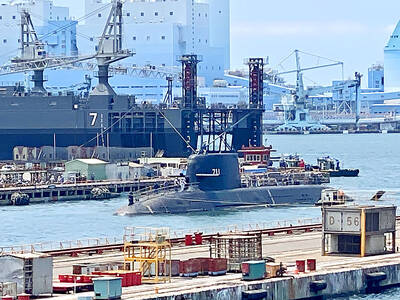
AGING: While Japan has 22 submarines, Taiwan only operates four, two of which were commissioned by the US in 1945 and 1946, and transferred to Taiwan in 1973 Taiwan would need at least 12 submarines to reach modern fleet capabilities, CSBC Corp, Taiwan chairman Chen Cheng-hung (陳政宏) said in an interview broadcast on Friday, citing a US assessment. CSBC is testing the nation’s first indigenous defense submarine, the Hai Kun (海鯤, Narwhal), which is scheduled to be delivered to the navy next month or in July. The Hai Kun has completed torpedo-firing tests and is scheduled to undergo overnight sea trials, Chen said on an SET TV military affairs program. Taiwan would require at least 12 submarines to establish a modern submarine force after assessing the nation’s operational environment and defense

A white king snake that frightened passengers and caused a stir on a Taipei MRT train on Friday evening has been claimed by its owner, who would be fined, Taipei Rapid Transit Corp (TRTC) said yesterday. A person on Threads posted that he thought he was lucky to find an empty row of seats on Friday after boarding a train on the Bannan (Blue) Line, only to spot a white snake with black stripes after sitting down. Startled, he jumped up, he wrote, describing the encounter as “terrifying.” “Taipei’s rat control plan: Release snakes on the metro,” one person wrote in reply, referring
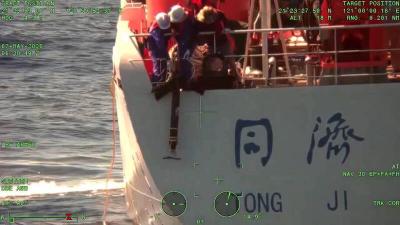
The coast guard today said that it had disrupted "illegal" operations by a Chinese research ship in waters close to the nation and driven it away, part of what Taipei sees a provocative pattern of China's stepped up maritime activities. The coast guard said that it on Thursday last week detected the Chinese ship Tongji (同濟號), which was commissioned only last year, 29 nautical miles (54km) southeast of the southern tip of Taiwan, although just outside restricted waters. The ship was observed lowering ropes into the water, suspected to be the deployment of scientific instruments for "illegal" survey operations, and the coast

Taiwan’s two cases of hantavirus so far this year are on par with previous years’ case numbers, and the government is coordinating rat extermination work, so there should not be any outbreaks, Centers for Disease Control (CDC) Director-General Philip Lo (羅一鈞) said today in an interview with the Liberty Times (the Taipei Times’ sister newspaper). An increase in rat sightings in Taipei and New Taipei City has raised concerns about the spread of hantavirus, as rats can carry the disease. In January, a man in his 70s who lived in Taipei’s Daan District (大安) tested positive posthumously for hantavirus, Taiwan’s


 RSS
RSS