


A former Mainland Affairs Council (MAC) deputy minister said that the Democratic Progressive Party (DPP) should not see the low popularity of President Ma Ying-jeou (馬英九) and his China policy as a godsend to the party’s hopes of winning the national elections next year.
Tung Chen-yuan (童振源), a National Chengchi University professor who served on the council during former president Chen Shui-bian’s (陳水扁) administration, made the remarks as the DPP prepares to relaunch its China Affairs Committee tomorrow.
“Some in the DPP think that since Ma’s popularity is so low, as is support for his China policy, the DPP does not need to make adjustments to its own China policy to win the 2016 presidential election,” Tung said.
A majority of senior DPP members who support Taiwan independence do not recognize the so-called “1992 consensus” — a tacit agreement that the Chinese Nationalist Party (KMT) says was reached with the Chinese Communist Party (CCP), stating that there is only “one China,” with each side free to interpret the meaning of the term.
The “one China, different interpretations” consensus serves as a foundation for Taiwan and China to engage with each other, the KMT says.
In a congratulatory message to new KMT Chairman Eric Chu (朱立倫) on Saturday, Chinese President Xi Jinping (習近平) did not forget to remind the former of the importance of the “1992 consensus” and the two parties’ joint opposition to Taiwan independence.
Tung said there is little mutual trust between the DPP and the CCP, but there are also few incentives for the DPP to change its China policy for fear that any change will only get a lukewarm response from Beijing or a demand for more changes.
Tung said that even if the DPP makes substantive changes to its China policy, the CCP would still prefer to deal with the KMT as a firm foundation of mutual confidence has been built up over the past decade.
In addition to the presidential election, Taiwan is to hold legislative elections that will likely see DPP candidates in central and southern Taiwan call for maintaining the party’s current China policy platform — calls that will likely handicap the party’s presidential candidate, Tung said.
One solution to this problem would be for the DPP to set up an “internal communications mechanism” that could form a “majority consensus” within the party and restrain its presidential candidate from expressing “personal views” on the party’s China policy, Tung said.
If the DPP does not try to show that it has in place a reasonable and efficient mechanism for forming a stable and trustworthy China policy, the party will have difficulty “waging a group war” against the KMT in the coming elections, the professor of national development said.
He suggested that the DPP’s China Policy Committee members “meet regularly” to map out the best policy options for the nation in cross-strait and international affairs.
He also suggested that the DPP “integrate” its previous resolutions and policy white papers on China policy, including updating its statements on Taiwan’s national status.
In 2011, when DPP Chairperson Tsai Ing-wen (蔡英文) ran for the presidency, she said that “Taiwan is the Republic of China and the Republic of China is Taiwan.”
If Tsai’s statement runs counter to the DPP’s other position papers, the party’s candidates will be grilled on the campaign trail next year, which will be a disadvantage for the party’s election bids, Tung said.
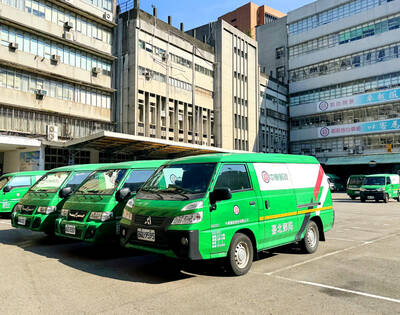
SHIPS, TRAINS AND AUTOMOBILES: The ministry has announced changes to varied transportation industries taking effect soon, with a number of effects for passengers Beginning next month, the post office is canceling signature upon delivery and written inquiry services for international registered small packets in accordance with the new policy of the Universal Postal Union, the Ministry of Transportation and Communications said yesterday. The new policy does not apply to packets that are to be delivered to China, the ministry said. Senders of international registered small packets would receive a NT$10 rebate on postage if the packets are sent from Jan. 1 to March 31, it added. The ministry said that three other policies are also scheduled to take effect next month. International cruise ship operators
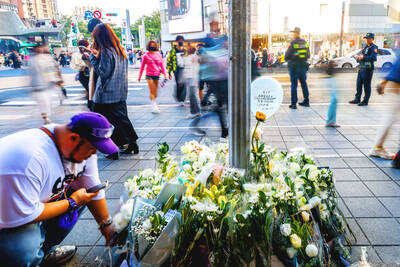
HORROR STORIES: One victim recounted not realizing they had been stabbed and seeing people bleeding, while another recalled breaking down in tears after fleeing A man on Friday died after he tried to fight the knife-wielding suspect who went on a stabbing spree near two of Taipei’s busiest metro stations, Taipei Mayor Chiang Wan-an (蔣萬安) said. The 57-year-old man, identified by his family name, Yu (余), encountered the suspect at Exit M7 of Taipei Main Station and immediately tried to stop him, but was fatally wounded and later died, Chiang said, calling the incident “heartbreaking.” Yu’s family would receive at least NT$5 million (US$158,584) in compensation through the Taipei Rapid Transit Corp’s (TRTC) insurance coverage, he said after convening an emergency security response meeting yesterday morning. National
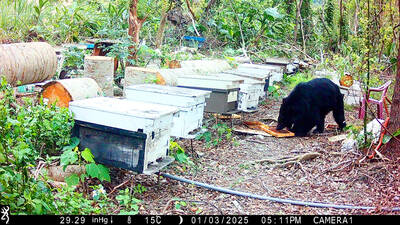
The Forestry and Nature Conservation Agency yesterday launched a gift box to market honey “certified by a Formosan black bear” in appreciation of a beekeeper’s amicable interaction with a honey-thieving bear. Beekeeper Chih Ming-chen (池明鎮) in January inspected his bee farm in Hualien County’s Jhuosi Township (卓溪) and found that more than 20 beehives had been destroyed and many hives were eaten, with bear droppings and paw prints near the destroyed hives, the agency said. Chih returned to the farm to move the remaining beehives away that evening when he encountered a Formosan black bear only 20m away, the agency said. The bear

PLANNED: The suspect visited the crime scene before the killings, seeking information on how to access the roof, and had extensively researched a 2014 stabbing incident The suspect in a stabbing attack that killed three people and injured 11 in Taipei on Friday had planned the assault and set fires at other locations earlier in the day, law enforcement officials said yesterday. National Police Agency (NPA) Director-General Chang Jung-hsin (張榮興) said the suspect, a 27-year-old man named Chang Wen (張文), began the attacks at 3:40pm, first setting off smoke bombs on a road, damaging cars and motorbikes. Earlier, Chang Wen set fire to a rental room where he was staying on Gongyuan Road in Zhongzheng District (中正), Chang Jung-hsin said. The suspect later threw smoke grenades near two exits


 RSS
RSS