


Children living in poverty are largely happy with their family life despite everyday hardships, but more aid is needed to keep their families from falling apart, the Taiwan Fund for Children and Families (TFCF) said.
The charity said that of the 10,429 households that it provides with regular financial aid, there are about 21,000 children that have at least one sick or absent parent.
However, a survey conducted by the fund and the Chinatrust Charity Foundation last month found that minors living in impoverished households do not worry about taking care of the sick family member, but fear that “one day, their only home will be gone,” fund executive director Betty Ho (何素秋) said.
“In the mind of those children, they feel happy as long as they get to stay in a family with a positive relationship. However, such happiness is fragile. It could crumble any time if there is a family problem, even a small one,” Ho said.
The survey, conducted between Dec. 14 and Dec. 25, found that 76.6 percent of responding children said they are happy just to be able to live with their family, even though it also found that 35.1 percent of the respondents go without breakfast at least once a week.
That is more than 10 times as many as the 3.5 percent of children in households that are not classified as poor, the fund said.
Another 49 percent of interviewed families supported by the fund live without air conditioning and heating, compared with only 11.1 percent of households overall.
Moreover, 63.2 percent of the families said they did not have learning tools or other materials for children, 36.1 percent lack an Internet connection and 32.9 percent do not have a computer.
To help provide more aid for such children, the fund and the foundation last week launched the Lighting Up the Fire of Life program in the hopes of raising NT$100 million (US$3.15 million).
At a news conference on Wednesday last week to announce the program, several youngsters introduced themselves and their families, although they did not give their real names.
Ten-year-old Tung Tung’s (童童) father was a carpenter before developing mmyotrophic lateral sclerosis, which is also known as Lou Gehrig’s disease. His inability to work left the family in poverty, but Tung Tung remains in high spirits, despite the stress of helping to care for his father.
“I try not to think too much and live in the present, and I hope for our family to enjoy every day. I hope dad can recover one day and we can be together forever,” Tung Tung said.
Hsiao Chun (小淳) said she has to get up in early every day to help her parents buy ingredients for their small breakfast shop before going to school. The 11-year-old has six siblings, and her father suffers from severe asthma and heart and kidney diseases.
With an income of about NT$18,000 a month, the family lives in a 20 ping (66.12m2) rented home and is under a great deal of stress, Hsiao Chun’s mother said.
“Our kids are all so helpful. As long as we can live closely together, we are not afraid of any pressure,” she said.
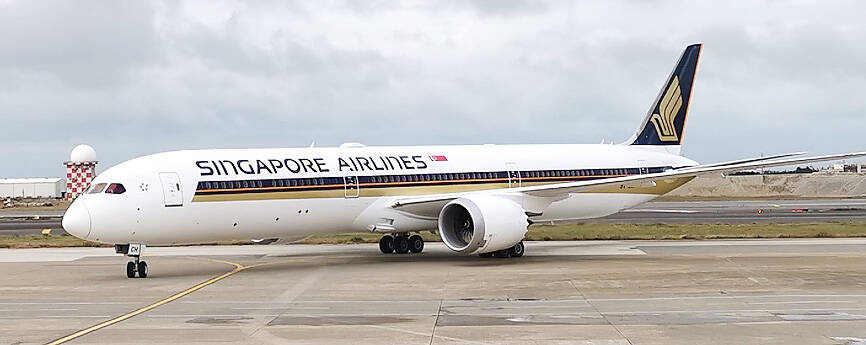
INCREASED CAPACITY: The flights on Mondays, Wednesdays, Fridays and Sundays would leave Singapore in the morning and Taipei in the afternoon Singapore Airlines is adding four supplementary flights to Taipei per week until May to meet increased tourist and business travel demand, the carrier said on Friday. The addition would raise the number of weekly flights it operates to Taipei to 18, Singapore Airlines Taiwan general manager Timothy Ouyang (歐陽漢源) said. The airline has recorded a steady rise in tourist and business travel to and from Taipei, and aims to provide more flexible travel arrangements for passengers, said Ouyang, who assumed the post in July last year. From now until Saturday next week, four additional flights would depart from Singapore on Monday, Wednesday, Friday
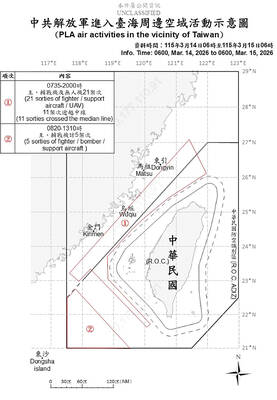
The Ministry of National Defense yesterday reported the return of large-scale Chinese air force activities after their unexplained absence for more than two weeks, which had prompted speculation regarding Beijing’s motives. China usually sends fighter jets, drones and other military aircraft around the nation on a daily basis. Interruptions to such routine are generally caused by bad weather. The Ministry of National Defense said it had detected 26 Chinese military aircraft in the Taiwan Strait over the previous 24 hours. It last reported that many aircraft on Feb. 25, when it spotted 30 aircraft, saying Beijing was carrying out another “joint combat

Taiwan successfully defended its women’s 540 kilogram title and won its first-ever men’s 640 kg title at the 2026 World Indoor Tug of War Championships in Taipei yesterday. In the women’s event, Taiwan’s eight-person squad reached the final following a round-robin preliminary round and semifinals featuring teams from Ukraine, Japan, Thailand, Vietnam, the Basque Country and South Korea. In the finals, they swept the Basque team 2-0, giving the team composed mainly of National Taiwan Normal University students and graduates its second championship in a row, and its fourth in five years. Team captain
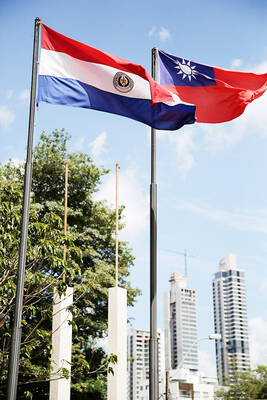
When Paraguayan opposition lawmaker Leidy Galeano returned from an all-expenses-paid tour of six Chinese cities late last year, she was convinced Paraguay risked missing out on major economic gains by sticking with longtime ally Taipei over Beijing — a message that participants on the trip heard repeatedly from Chinese officials. “Everything I saw there, I wanted for my country,” said Galeano, a member of the newly-formed Yo Creo party whose senior figures have spoken favorably about China. This trip and others like it — which people familiar with the visits said were at the invitation of the Chinese consulate in Sao Paulo


 RSS
RSS