


Former US Senate majority leader and presidential candidate Bob Dole has urged the US Congress to increase pressure on the White House to help Taiwan build its own submarines.
US President Barack Obama should reinvigorate his “pivot to Asia” and at the same time “accommodate the security needs of Taiwan, our nation’s friend and ally,” Dole said in an article published by the Washington Times.
Other sources told the Taipei Times that Dole was lobbying the new Republican-dominated Congress to push for increased arms sales to Taiwan.
“Taiwan’s greatest need is new submarines,” Dole said in his newspaper article.
“Only the United States is willing to support Taiwan — which counts me among those assisting with its agenda in Washington — with major defensive weapons,” he wrote.
“Unfortunately,” he said, in spite of Washington’s military strength, it can still be intimidated by Beijing.
“In 2001, [then-US] president George W. Bush committed to help Taiwan acquire or produce eight more subs, but since then our government, apparently succumbing to intimidation, has taken no further action,” Dole wrote.
He also said that the failure to sell new F-16 jets to Taiwan has resulted in “another glaring deficiency in the nation’s arsenal.”
Dole wrote that the new Congress may be “more cognizant of the potential peril to Taiwan and the US” caused by the massive military buildup in China.
“Taiwan has many supporters in Congress on both sides of the aisle and the number likely to play a more active role in promoting our bilateral security relationship increases with the influx of Republican members in both houses and the Republican takeover of control of the Senate,” Dole said.
He concluded: “I urge the august body that I once led to take early action to increase pressure on the administration to allow Taiwan to acquire the technical support and weapons systems necessary to produce its own submarines.”
“I hope that the Obama administration will move swiftly to heed congressional advice and simultaneously diminish the Chinese threat to Taiwan and regional security, lessen the US naval burden, and increase the responsibility of democratic nations seeking to maintain stability in their own China seas,” he said.
The Israeli Web site Defense-Update said on Friday that a study was likely to begin this year by Taiwan evaluating different alternative designs for submarines ranging from 1,200 to 3,000 tonnes.
“The Taiwanese navy ruled out the use of a large fleet of 120-ton [108.86 tonne] midget submarines instead of using conventional submarines,” Defense-Update said. “The use of midget submarines was one of the alternative plans promoted by the US administration seeking to bolster the region’s military might against the Chinese expansion along the Pacific Rim.”
Defense-Update said that opponents did not exclude the midget submarine concept, but not as an alternative for a fleet of full-size submarines.
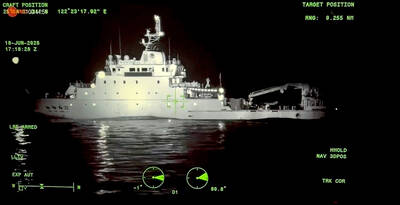
EXCUSES: Beijing is using government and research vessels as a pretext to harass the nation and enter its EEZ, and engage in ‘hegemonic expansion,’ the coast guard said The Coast Guard Administration yesterday said it drove away Chinese oceanographic research vessel Xiang Yang Hong 22 (向陽紅33) from restricted waters after warning it that it was in Taiwan’s exclusive economic zone (EEZ). The Chinese vessel entered restricted waters off the coast of Yilan County’s Suao (蘇澳) at 11:35pm on Thursday, the coast guard said, adding that it dispatched the Lanyu patrol vessel and the boat PP-10077 to shadow the Chinese ship and issue radio warnings ordering it to leave. China has no sovereignty over waters off Taiwan’s east coast, Lanyu’s crew told Xiang Yang Hong 22 over the radio, and demanded
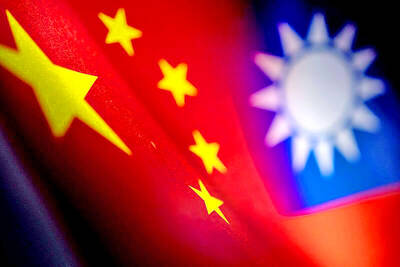
BAIT AND SWITCH: Allowing KMT-run counties to sell to China while the threat of abrupt cancelations hangs overhead is another form of coercion, officials said Beijing is using agricultural purchase offers announced during the Straits Forum to deepen Taiwan’s dependence on the Chinese market, a Taiwanese official said yesterday as they criticized the Taitung County commissioner’s participation in the initiative. During the Straits Forum held in Xiamen on Saturday, Chinese officials announced a sales and purchase agreement for agricultural products from some counties led by the Chinese Nationalist Party (KMT). Taitung County Commissioner Yao Ching-ling (饒慶鈴), who was barred from attending the event in person by the Mainland Affairs Council, participated via video. Under the agreement, China would purchase atemoyas, pomeloes, tea and grouper harvested in Taitung,
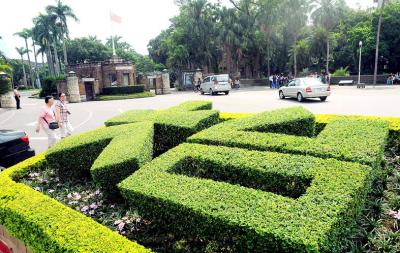
Four Taiwanese universities have been ranked among the world's top 200 institutions in the Quacquarelli Symonds (QS) World University Rankings for next year, the highest Taiwan has ever placed in the category, with National Taiwan University (NTU) achieving its best performance at 54th globally and 17th in Asia. The four Taiwanese institutions in the global top 200 are NTU (54th), National Tsing Hua University (142nd), National Yang Ming Chiao Tung University (177th) and National Cheng Kung University (191st), the rankings showed. All four universities achieved their highest-ever global rankings this year, QS data showed. National Cheng Kung University entered the top 200 for
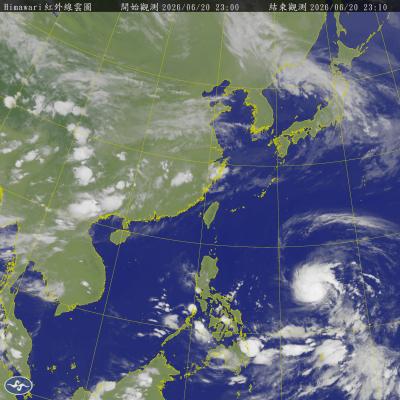
Tropical Storm Mekkhala is forecast to strengthen into a typhoon tomorrow and could come close enough to Taiwan later in the week to prompt a sea warning, the Central Weather Administration (CWA) said yesterday. As of 2 pm, the storm was located 1,870 kilometers southeast of Taiwan's southern tip and moving west- northwest at 23 km per hour. CWA forecaster Cheng Chieh-jen (鄭傑仁) said Mekkhala is expected to continue moving west-northwest through Tuesday under the influence of the Pacific high- pressure system before gradually turning north toward waters east of Taiwan or south of the Ryukyu Islands. The timing and angle of the


 RSS
RSS