


Amid controversies over the selection of the director of Taipei City Government’s Department of Labor, independent Taipei mayor-elect Ko Wen-je (柯文哲) yesterday officially introduced the first 13 officials-to-be in his city government, vowing to strive to fulfill his promise for an open and transparent administration despite the recent setbacks.
“I would like to introduce 13 people who will serve in my city government,” Ko told a press conference. “As I’ve said, my election is not about me winning the position, rather it is about reclaiming power and returning it to the public, and therefore, most of the top officials in my administration — besides the deputy mayors — have been selected by the respective committees.”
“I would like to reiterate that, during my term as mayor, all public servants, including top officials, no longer need to serve any particular political party or ideology, they don’t even need to serve the mayor, and should only serve the people of Taipei,” he added.
The city officials introduced yesterday include the future deputy mayors Teng Chia-chi (鄧家基) and Lin Chin-jung (林欽榮), secretary-general Su Li-chiung (蘇麗瓊), Department of Education director Tang Chih-min (湯志民), Department of Sports director Yang Jong-her (楊忠和), Department of Rapid Transit Systems director Chou Li-liang (周禮良), Department of Urban Development director Lin Jou-min (林洲民), Department of Public Works director Peng Jhen-sheng (彭振聲), Department of Civil Affairs director Lan Shih-tsung (藍世聰), Department of Health director Huang Shier-chieg (黃世傑), Department of Information and Tourism director Chien Yu-yen (簡余晏), Department of Compulsory Military Service director Fu Yong-mao (傅永茂) and Indigenous Peoples Commission chief Chen Hsiu-hui (陳秀惠).
While most of the named officials have a political background to a certain extent, future Urban Development director Lin Jou-min was a renowned New York-based architect and has no previous political experience.
“Lin Jou-min was picked because he was recommended by the selection committee, and I think his background is interesting,” Ko said when asked to explain his choice. “I’ve been to a lot of cities around the world and always think that Taipei is too, I’d say, ugly, and I think it needs some serious urban renewal.”
“Lin Jou-min has been an architect in New York and is familiar with urban development there, I think he could help a great deal in making Taipei a city that’s competitive with other world-class cities,” Ko added.
Ko said the selection process for the remaining posts is still ongoing.
Asked about his choice for third deputy mayor, Ko said he has talked to a candidate, but is still awaiting a response.
“The political environment in Taiwan isn’t very good and makes people hesitate,” he said, adding that two of the five finalists for the labor department director withdrew their candidacy on Thursday because they had had enough of the negative political environment.
Ko said that because the two candidates withdrew, he would ask Teng to persuade two other well-qualified candidates who did not make it on the original short-list to reenter the race for the positions.
Despite originally having said that she would not be filling a vacancy after being eliminated from the final lshort-list of candidates, long-time labor activist Lai Hsiang-ling (賴香伶) said that she was on the list after a discussion with the Taipei City Confederation of Trade Unions.
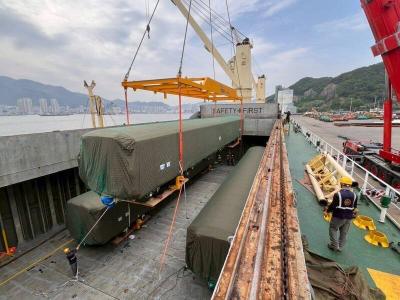
The first of 10 new high-capacity trains purchased from South Korea’s Hyundai Rotem arrived at the Port of Taipei yesterday to meet the demands of an expanding metro network, Taipei Rapid Transit Corp (TRTC) said yesterday. The train completed a three-day, 1,200km voyage from the Port of Masan in South Korea, the company said. Costing NT$590 million (US$18.79 million) each, the new six-carriage trains feature a redesigned interior based on "human-centric" transportation concepts, TRTC said. The design utilizes continuous longitudinal seating to widen the aisles and optimize passenger flow, while also upgrading passenger information displays and driving control systems for a more comfortable
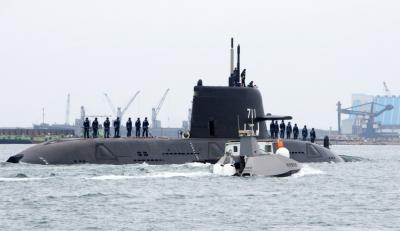
Taiwan's first indigenous defense submarine, the SS-711 Hai Kun (海鯤, or Narwhal), departed for its 13th sea trial at 7am today, marking its seventh submerged test, with delivery to the navy scheduled for July. The outing also marked its first sea deployment since President William Lai (賴清德) boarded the submarine for an inspection on March 19, drawing a crowd of military enthusiasts who gathered to show support. The submarine this morning departed port accompanied by CSBC Corp’s Endeavor Manta (奮進魔鬼魚號) uncrewed surface vessel and a navy M109 assault boat. Amid public interest in key milestones such as torpedo-launching operations and overnight submerged trials,
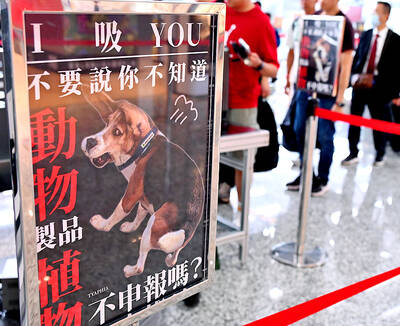
Quarantine awareness posters at Taiwan Taoyuan International Airport have gone viral for their use of wordplay. Issued by the airport branch of the Animal and Plant Health Inspection Agency, the posters feature sniffer dogs making a range of facial expressions, paired with advisory messages built around homophones. “We update the messages for holidays and campaign needs, periodically refreshing materials to attract people’s attention,” quarantine officials said. “The aim is to use the dogs’ appeal to draw focus to quarantine regulations.” A Japanese traveler visiting Taiwan has posted a photo on X of a poster showing a quarantine dog with a
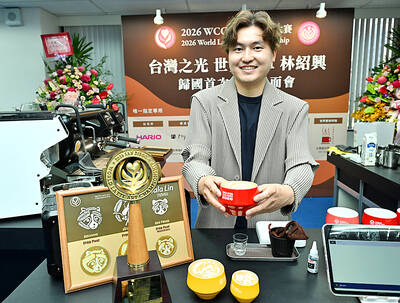
Taiwan’s coffee community has launched a “one-person-one-e-mail” campaign, calling for people to send a protest-e-mail to the World Coffee Championships (WCC) urging it to redesignate Taiwanese competitors as from “Taiwan,” rather than “Chinese Taipei.” The call followed sudden action last week after the WCC changed all references to Taiwanese competitors from “Taiwan” to “Chinese Taipei,” including recent World Latte Art champion Bala (林紹興), who won the World Latte Art Championship in San Diego earlier this month. When Bala received the trophy, he was referred to as representing Taiwan, as well as in the announcement on the WCC’s Web site, until it


 RSS
RSS