

Minister of Transportation and Communications Yeh Kuang-shih (葉匡時) yesterday said that he would seek to communicate with Taipei mayor-elect Ko Wen-je (柯文哲) on issues related to the construction of a direct rail line connecting Taipei and Yilan, adding that the government must consult environmental experts.
After a meeting on Sunday, Ko said he reached a consensus with Yilan County Commissioner Lin Tsung-hsien (林聰賢) to jointly push for a Taipei-Yilan rail line, adding that they would seek to build the shortest route — or “route A,” through the Feitsui Reservoir’s (翡翠水庫) catchment area — rather than “route B,” a curved path avoiding the environmentally sensitive area.
“We should look for a way to succeed, not excuses for failure. The decision [to take route B] is dodging the environmental issue; we should first try to see if the environmental issues can be solved. If they can, then we should of course choose route A. If they cannot, then we would go to route B,” Ko said on Sunday.
Environmental activists vehemently opposed the proposal, as Ko and Lin’s preferred route would pass through a primary source of drinking water for residents in the Greater Taipei area.
When asked by legislators about the issue during the Transportation Committee meeting in Taipei yesterday, Yeh said the central government chose the route that would bypass the reservoir’s catchment area due to strong opposition from the Taipei City Government, adding that the ministry is conducting an environmental impact assessment on the route that will not pass through the reservoir.
“The ministry will take into consideration any new idea proposed by the Taipei City Government and Yilan County Government. However, we must respect the opinions of the experts, particularly those who are experts in environmental protection,” he said.
The government’s route goes from Taipei’s Nangang District (南港) to Toucheng Township (頭城) via Dashi Township (大溪) in Yilan County and is about 53km long.
The route would shorten the travel time from Taipei to Yilan by 18 minutes, with the construction estimated to cost NT$49.1 billion.
The route selected by Lin and Ko is 36.3km and goes through the Feitsui Reservoir area.
The route would reduce travel time from 65 minutes to 39 minutes. Construction is estimated to cost NT$45.8 billion.
Chinese Nationalist Party (KMT) Legislator Lee Hung-chun (李鴻鈞) said he opposed the project, regardless of the route.
He added that the government’s route is not likely to be approved by the Environmental Assessment Committee either, as it passes through some ecologically fragile zones and mining areas along the way.
While the ministry estimated the cost to be about NT$49.1 billion, Lee said the government might not pull the project off even if it pumps in NT$100 billion.
Separately yesterday, outgoing Taipei Mayor Hau Lung-bin (郝龍斌) also expressed in a note posted on Facebook “strong opposition” to “any” plan that would put a railroad through the Feitsui Reservoir area, due to concerns the project could jeopardize the city’s water supply.
“It is extremely difficult to restore water quality,” Hau wrote. “Therefore, [on this issue] when it’s impossible not to choose between development and the environment, the environment should take top priority.”
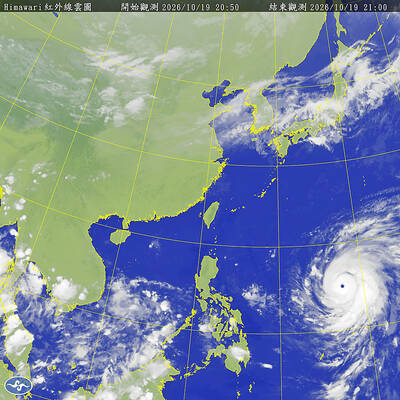
Typhoon Champi is forecast to turn northward earlier than previously expected, sparing Taiwan a direct hit but still bringing heavy rain to the north of the country on Friday and Saturday, the Central Weather Administration (CWA) said yesterday. Typhoon Champi had strengthened and increased in size over the past 12 hours, and as of yesterday afternoon, was packing sustained winds of 198kph near its center, CWA forecaster Cheng Chieh-jen (鄭傑仁) said. However, due to the weakening of a Pacific high-pressure system the storm is now expected to turn northward earlier than initially forecast, likely around Japan’s Ishigaki Island, Cheng said. As Champi brushes

A Chinese People's Liberation Army (PLA) Navy aircraft carrier group was being monitored after entering the western Pacific, the Ministry of National Defense said today, after Beijing yesterday criticized Taiwan for using a water cannon against a Chinese fishing boat near the Pratas Islands (Dongsha Islands, 東沙群島). A Chinese naval task group led by the aircraft carrier Liaoning (遼寧) yesterday sailed to the western Pacific for training, Chinese state-run Xinhua news agency quoted the PLA Navy as saying. “The drill is part of the annual routine training plan aimed at testing and improving the troops’ combat readiness and enhancing their ability to
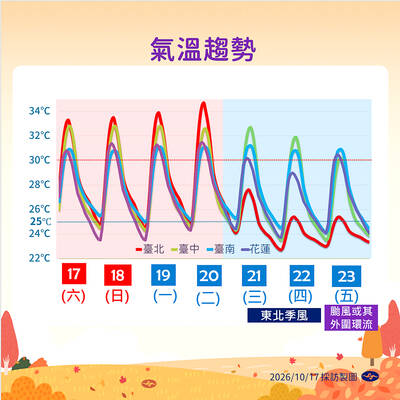
TYPHOON WATCH Champi closes to east Typhoon Champi could continue to strengthen and approach waters off eastern Taiwan by Thursday, with some forecast models suggesting it could move west and cross the nation, the Central Weather Administration (CWA) said yesterday. As of 2pm yesterday, Champi was 2,980km east-southeast of Oluanpi (鵝鑾鼻), Taiwan’s southernmost tip, and moving west at 22kph. It had maximum sustained winds of 162kph and a storm radius of 180km, CWA data showed. CWA forecaster Chang Cheng-chuan (張承傳) said Champi could intensify as it moves west before turning west-northwest toward Taiwan. The storm is expected to reach waters off eastern
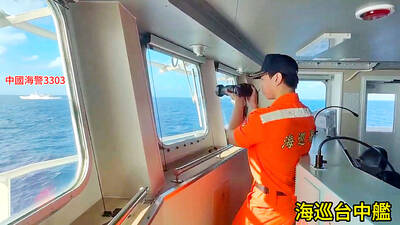
Taiwan said yesterday it had driven away 16 Chinese coast guard, research and fishing vessels involved in simultaneous “maritime harassment” operations. An “unusually large” number of Chinese vessels took part in the coordinated operations around Taiwan proper and Taiwan-controlled Pratas Islands (Dongsha Islands, 東沙群島), the Taiwanese coast guard said in a statement. The Chinese vessels, including four fishing boats, carried out “simultaneous operations at multiple locations and engaged in hybrid warfare,” the statement said. The locations were off Taiwan’s eastern, southern and southwestern coastlines, and around Pratas. Some of the Chinese vessels entered Taiwan’s restricted


 RSS
RSS